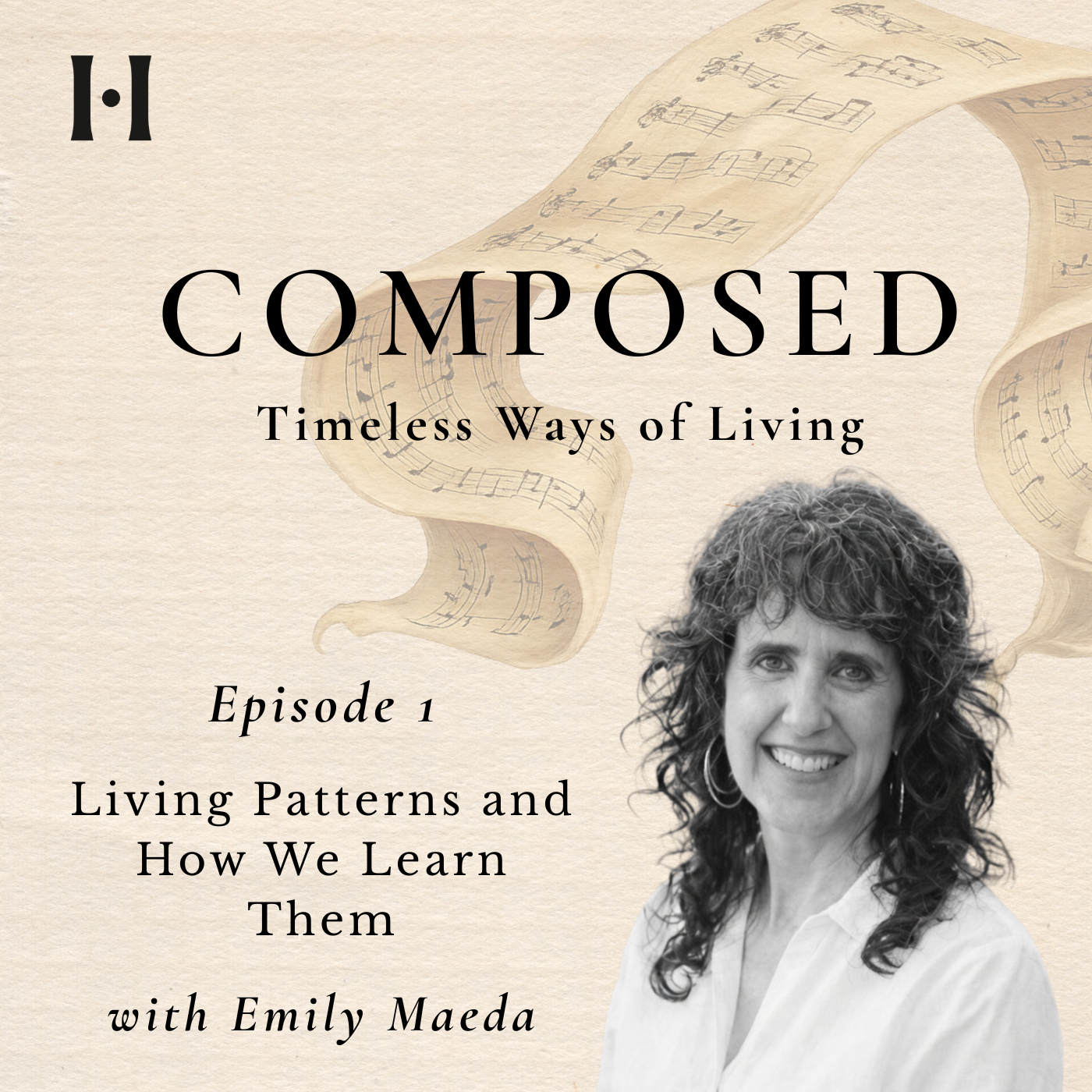

Christine Perrin (00:00.984)
Hi, Emily Maietta. Welcome to Composed.
Emily Maeda (00:06.074)
I am so excited to be here with you. I've been looking forward to it all week.
Christine Perrin (00:09.87)
So have I. What a delightful way to pass an hour. I'll just say a few formal things about you, and then I want you to talk to us. Emily is the vice president of Tree of Life Landscapes. She's a designer. She and her husband, Mark, started the company a number of years ago. And this is really only one of the many things that she does.
Emily Maeda (00:13.904)
It is.
Christine Perrin (00:38.088)
One of the reasons I wanted to talk to her is because she was the first person to kind of show me what it looked like to take these ideas of living patterns and infuse them into daily life and domestic life, as well as the life of a company and many other patterns, living patterns. Tell us a little bit about yourself, your work, and a few things that
took you to the things that you do now.
Emily Maeda (01:11.41)
Well, I'm so excited to talk to you about these things. And I have to say, I'm excited because you happen to be the best question asker I have ever met. You ask questions that make me think. And so as I was looking at some of the questions you sent me this week, it has been a real gift to think back through all these things and to think about them. So what do I do? Well, I'm not, my formal training was not in garden design, actually. My formal training was in.
Christine Perrin (01:22.734)
Bye.
Emily Maeda (01:39.312)
music. I was a pianist. I went to school for piano performance. And that was a big pattern forming part of my life as far back as I can remember. And music is all patterns, you know, so I guess and I've thought so much in my design about how music translates into scene design. So I music has been a huge pattern maker for me. And then from that with my own children, I've also spent a lot of time and
classical education, which is how I met you, because I wanted to understand how to bring those patterns that I had experienced within music training into education as a whole. And, you know, I hadn't been raised that way, although I had some gifts along that way, but not fully classical education. And so that was another way to understand these rhythms that form our lives.
Christine Perrin (02:38.008)
I'm thinking even in just what you've said, you've talked about all these domains, the domain of daily life, the domain of education, of music, of gardens. And that seems to me just particularly rich when you get an idea such that you can pass it through different domains. You can apply it. You can know it in different ways.
Emily Maeda (03:03.944)
Mm-hmm. Mm-hmm.
Christine Perrin (03:07.06)
I would love to hear just a little bit more about how you came to Christopher Alexander, what maybe even was intuitive about him when you met him. And we're talking about Christopher Alexander without even naming. He was an architect. He wrote a number of remarkable books. And he thought very much about, he called it pattern language.
Emily Maeda (03:20.253)
Mm-hmm.
Emily Maeda (03:24.018)
Mm-hmm. Mm-hmm.
Emily Maeda (03:32.712)
Mm-hmm. Mm-hmm. Mm-hmm.
Christine Perrin (03:34.786)
And he himself applied it across domains. But maybe it began in a very esoteric way of highway for him because he was an architect. But how did it begin for you?
Emily Maeda (03:42.706)
Mm-hmm. Mm-hmm. Mm-hmm.
Well, I read Christopher Alexander for the first time. was just remembering this. It was about 18 years ago. So a dear friend of mine, Erin, we had already redone our house and I had read the Not So Big House, which was a student. She was a student of Christopher Alexander. So I had been introduced to his ideas when we had redone our house and when I was in my early 20s. But
My friend Aaron said, well, you have to read a pattern language. You just have to read it. And when I was thinking about when I read it, I've had this experience. We've talked about this before with certain books where you read them and you start crying, not because you're sad, but because you realize somebody else has felt this too. And that's how I felt when I read the pattern language, you know that, these things that I have felt just in cohately, you know, in my
Christine Perrin (04:37.326)
no.
Emily Maeda (04:46.94)
the back of my mind, something's been wrong and I haven't known how to describe it. He suddenly could put words to these feelings that I had had. You know, when I walked into a room and said, this room doesn't feel right, he named why the room didn't feel right. You know, he named why I liked certain cities and why I didn't like other cities. He named why a journey to a house felt good in one place and not another place. So I had felt these things and I had known that doesn't work.
but I didn't have the words. I didn't have the way to describe it. And he gave that to me.
Christine Perrin (05:19.808)
It does seem still remarkable to me that you had felt those things. mean, presumably all human beings have felt those things, but then to have that level of recognition when you heard him say it, could you go back maybe to childhood a little bit and just talk about what formed you in such a way that you would begin to have an intuitive knowledge of this?
Emily Maeda (05:26.993)
Yeah!
Emily Maeda (05:31.93)
Yeah.
Emily Maeda (05:38.93)
Mm-hmm.
Emily Maeda (05:45.896)
It's such a mysterious question to answer, isn't it? But I've been thinking about it, I've been pondering it, what formed me? I my parents' story, of course, formed me. My parents were both devout Catholics. My mother had a really living experience of faith in the late 60s and early 70s through the Catholic Charismatic Revival.
Christine Perrin (05:49.837)
Yes.
Emily Maeda (06:13.12)
And she really did form our lives around the church calendar. She really did. You know, we, celebrated the feast with, with great joy and we also lived on a farm. And so we had these living patterns to pattern off of, know, I was just thinking about how I grew up milking goats. I milked goats morning and night, my entire childhood. mean, I, you know, it was a great privilege to be able to start milking the goats. So I probably started milking goats at like age nine.
Christine Perrin (06:30.424)
Mmm.
Emily Maeda (06:43.076)
And I was thinking about how that was a pattern that we had to be home morning and night every night. And now I would think about that and think, gosh, that's kind of a constraint. But you know, that's how I grew up. I didn't even think about it. But thinking like Christopher Alexander makes this point that we don't ever separate ourselves out. He's like, this is one of the problems with modern life is that we've segmented our lives, you know? So this is our work. And
I think my mother gave that to us, this feeling of a organic life, you know? So maybe that was what I resonated with when Alexander was able to say, no, the way a window is placed is just as important as how a shrub grows. Like that's all of a piece. There's no difference. And that we have to be in tune with these things or else we build badly and we create badly. So I don't know. I wonder if...
Christine Perrin (07:30.808)
Hmm.
Emily Maeda (07:40.562)
that had such a large part, you know, that she attuned us to rhythms.
Christine Perrin (07:46.894)
It's so interesting because in some ways it's a very anti-expert approach to life, know? This sense of… and you've followed that. mean, you've had expert training in one domain, but you've felt confident to transfer that knowledge too and to say, I'm going to start… I'm going to learn… I mean, I know plants, but I'm going to learn more about plants and I'm going to start designing.
Emily Maeda (07:55.592)
It is.
Emily Maeda (08:09.853)
Mm-hmm.
Emily Maeda (08:15.324)
Mm-hmm.
Christine Perrin (08:16.554)
I'm going to, you know, I'm an educated person. I'm going to educate my children and start a school that, you know, is a university model school that can educate other children. It seems like that's another piece I'm hearing from you as you talk right now that I wouldn't have known to ask you about. I didn't realize that he also gave that kind of, he, and I guess in partnership with your mom, gave that
Emily Maeda (08:22.685)
Ha
Emily Maeda (08:29.234)
Mm-hmm.
Emily Maeda (08:35.24)
Hmm.
Emily Maeda (08:38.6)
Mmm.
Emily Maeda (08:44.904)
Mm-hmm.
Christine Perrin (08:46.318)
kind of confidence to trust your intuitions.
Emily Maeda (08:49.148)
Hmm. Yeah. Yeah, that's really interesting that I mean, I think thinking back about these books that have done that for me, those when you have felt these things and then somebody is able to name it, which is such a gift, right? His his naming of this has been such a huge gift in my life because you do go back. Well, did I really see that? I mean, I can also say that within my family, we're not all so
organically driven and there were a lot of people within my family who would say, well, that's not right. You can't say that. That's not better than this. And I'd be like, no, but I do think it's better than that. You know, I do think it's better to have a feast on real dishes with silverware and flowers. I do think that there's something there, but you know, that wasn't fully valued even within my own family.
Christine Perrin (09:39.81)
Or universal intuition by virtue of how you were raised in you that… Yeah, I wish you'd say a little bit about, you know, your… the largeness of your family of origin and also of the family that you've had because I think that's another part of what you're talking about, this sense of let's not segment our lives.
Emily Maeda (09:43.428)
Yes, right, because it didn't. I don't know. mean, that's what's mysterious, right? It's it's mysterious.
Emily Maeda (09:57.993)
Yeah.
Emily Maeda (10:08.994)
Mm-hmm. Mm-hmm.
Christine Perrin (10:10.006)
a whole life that involves all of us. So maybe just a little more about that because I think that's one of the hardest things that people do in life right now is try to think about how to have families and have other aspects of life. it really is pretty unsustainable unless there's some sense of their interpenetration. Like I think even of
Emily Maeda (10:13.831)
Mm-hmm.
Emily Maeda (10:20.722)
Mm-hmm. Mm-hmm.
Emily Maeda (10:28.338)
Mm-hmm.
Emily Maeda (10:32.124)
Mm-hmm.
Mm-hmm.
Christine Perrin (10:37.11)
The idea that the nuclear family is something that's too hard to do without community is in the same bin of thought.
Emily Maeda (10:42.268)
Mm-hmm.
Yes, it is. Yeah, you know, I go back to my mother again, the great gift that she was. So I'm one of seven and my father was a university professor of electrical engineering. And, know, I do thank my mother because she gave us such an example. She fully believed that raising us was the most important thing that she did. And, you know, it was at a time when the feminist movement was really gaining hold.
She was among university people who kind of constantly questioned what she was doing. And she had a firm conviction that this is what she was giving to her children. And I was very grateful for that. I was also thinking a little bit about my own approaches to technology with my children and how my, this is a little bit different, but of a similar note. My mother sort of formed us well in that, for instance,
You know, she didn't let us watch TV. Like she thought the TV was bad and she thought Sesame Street was particularly suspect because things, things moved too fast on Sesame Street. So we were, we were allowed to watch Mr. Rod, Roger's neighborhood. we only had one phone because she said, look, relationships don't occur through the phone. So when the teenagers all grew up, we had to speak on the phone in the middle of the house and nobody had long conversations.
Christine Perrin (11:49.206)
I love that logic.
Emily Maeda (12:08.153)
She didn't let us have Walkman because she said, look, that cuts you off from being with other people. So I was thinking about how when you've been given that as a child, makes you, it gives you a filter for how to engage with technology. Not that I'm super great. I've got to deal with my phone all the time too. But like with my own children, it's helped me to say, a phone, like, no, you don't need a phone because we're going to be together. I mean, you don't have relationships through the phone.
Christine Perrin (12:25.07)
Thank you.
Emily Maeda (12:35.846)
This is a little far afield of what you were saying, but I was just thinking about how she gave us that pattern too. You know, here's a way to deal with technology, something I'm really grateful for. So yeah, I was one of seven. My mother was very firm in her beliefs, even firm with my father, who was not as faithful as she was. We always went to church, but he had a much more, I guess, nominal faith, I would say, for part of my childhood.
Christine Perrin (12:41.251)
Hmm.
Emily Maeda (13:03.304)
He was actually diagnosed with a very serious disease when I was seven and then he died when I was 13. So even my own experience of my family kind of has a before my dad's death and an after my dad's death experience. But nonetheless, that really did shape me and my mom was a great believer in the power of family and we all did things together and if.
You know, was good enough for one, it was good enough for all of us, and she wanted us to sing, and she wanted us to read books, and I do credit her with so much in giving me a rich, treasured childhood.
Christine Perrin (13:42.114)
What a tribute. Again, I hear you saying that she formed your intuitions in a way that has served you so well, that now you're old enough to see that it's served you. You've used them well. Another thing that I would love to hear you say is one moment when you heard her stand up for the value of what she was doing in the face of being questioned. Or maybe it wasn't articulated, but you saw that visibly.
Emily Maeda (13:52.102)
Yes.
Emily Maeda (14:04.38)
Mm. Mm hmm. Mm hmm. I heard her relate this story and it does stick in my mind. She was at a university function and another wife came up and asked what she did and she said she raised her children and the woman said, well, does he pay you for that work? And my mother said he couldn't pay me enough to do everything that I do. Which is true.
Christine Perrin (14:31.086)
Wow, what a question. Right, which makes me think of those terrible charts that people have made, like statistical analysis of what it would cost to do this. You money is the most important thing in our culture.
Emily Maeda (14:33.549)
right? Which is true.
Emily Maeda (14:39.921)
Yes.
Yes. Yes. Yes. She and I loved that. You my mother said what I do is beyond any like you could not pay me enough. I am so valuable. You could not pay me. Yeah.
Christine Perrin (14:54.112)
Right. Yes, yes. This is a thing done for its own sake. Well, you've had seven children as well, and you have done that alongside doing garden design and having a business as a family. And I'm also interested in how that created structures for you to be together and work together.
Emily Maeda (15:04.466)
I have.
Emily Maeda (15:23.196)
Mm-hmm.
Christine Perrin (15:24.294)
and how you thought of that or how you, I don't know, even just ambled your way into it. Sometimes it's intimidating to hear other people's stories if they're too self-conscious from the beginning, you know? Because you think, I'm not that self-conscious in my life. But anyway, tell us how that developed for all of you.
Emily Maeda (15:29.298)
Mm-hmm.
Emily Maeda (15:39.298)
Mm-hmm. Mm-hmm. Mm-hmm. Mm-hmm.
Yeah, that is, it is really funny when you look back, you think, I was so confident in this thing. Right. And it was, and we had other people saying to us, what are you doing? And you know, they were kind of right. Like looking back on it, but it is, there is something to be said about just believing in, in a dream or having a dream. So, I married very young unexpectedly to myself, quite honestly.
I thought I was going to get a PhD and I didn't end up doing that. But I did feel that it was what God had brought to me and so I married. And that was a very difficult decision because I knew if I was marrying that I was accepting certain constraints. I knew that I couldn't just decide. that is what I put, you know, I realized marriage brings its own constraints that if you're going to accept those constraints, you have to look at full in the face.
It wasn't that I thought, I can't get a PhD, but in some ways I did think, you know, if I'm choosing this, I'm choosing a different path. I'm choosing to combine my life with another. And, you know, I don't get to just make every decision that I want to make. So I think it was a good thing to marry young with that idea, you know, I will be giving up certain things if I choose this path. So we married.
We lived in Arizona. My husband was working for Motorola as an accountant. He came home every day, totally drained, know, sort of flat face. And I said, you know, your problem is you don't ever do any like physical work. Like you don't ever feel how good it feels to work. And so you're just drained every day. I was like this, you know, I don't think you want to do this job forever. And he's like, but what else am I going to do? And I said, well, let's start a landscaping business.
Emily Maeda (17:44.264)
And he was like, I've never done anything. mean, honestly, I had done more manual labor than my husband had to. He hadn't even mowed his lawn. So we started thinking about it. I was like, look, I know so many plants. My cousin's a landscape architect. She'll help me. She can teach me design and we can work together and, um, you can do all the work. You're an accountant. It'll be perfect. So, I mean, these are crazy ideas, right? That's crazy. Like, that's just crazy. Why did we even do that? So we're like, yeah.
We're going to do this. So I started taking classes at the university and I was doing music, but I also took landscape architecture classes. And then we decided I got pregnant with our first son and we decided we were going to move back to Colorado and some friends of ours were starting up a business and they said, come and join us. So we did. And it was terrible. But by the end of the summer we decided, well, we can just do this ourselves. So we did.
And that's just crazy. We should, but now I would never recommend a child doing that. I don't think. Um, also Mark's father was very concerned about the fact that we weren't going to have health insurance. we're like, health insurance, mouth insurance, who needs health insurance? We don't need it. We're fine. Um, you know, all of these things that if we had known what was coming for us, we would never have done it. Right. Because, uh,
Soon after we moved back, two years after we moved back, my husband was diagnosed with a very serious liver disease and we had just gotten insurance. but you know what I mean? Like if you had, if I had known you would never do what we did. mean, Mark learned how to build all these things at our house. I, you know, worked with my cousin who helped me on our like first couple years of designs.
Christine Perrin (19:28.728)
Yes, I did.
Emily Maeda (19:43.1)
So that was great because I mean, honestly, that's how this profession should be learned through apprenticeship, which is what we did. But we started it without really knowing anything. I mean, not anything, but you know, not enough.
Christine Perrin (19:59.394)
Yeah, yeah. I hear you use the word constraint in a positive way. And I'm also wondering what you would say the relationship between constraint and pattern is.
Emily Maeda (20:07.762)
Yes.
Emily Maeda (20:15.012)
that is such a good question. I think about this in the designs we do because sometimes when I'm working with a new designer or something, they can, we can go to a house that's already built and the house that's already built has all sorts of constraints. There's trees already existing. There's sidewalks already existing. You know, things have already been done and I've had this experience a few times where the designer will say, if only we just had a piece of land that had nothing on it.
then we could really design. I'm like, no, the constraints are always where the brilliance is found. It's working inside these constraints, figuring out a solution that creatively incorporates these constraints. That's where a true design happens. It's not just having a blank canvas for anything. So I think constraint is part of the formation of pattern.
Christine Perrin (21:09.102)
Yeah, mean, I'm thinking of music, right? You have to have constraints. Thinking of poetry, yes, the limits are what make the shape. But what I love again, and I experienced this in your talking right now, but in your thinking in general, this ability to kind of see a thing at an abstract or higher level of thought, and then to think life's like that.
Emily Maeda (21:11.078)
Yes. Yes. Poetry. You have to have constraints. The limits. Yes. Yeah.
Christine Perrin (21:38.038)
and I'm going to use that knowledge with life. Like for instance, marriage is a constraint and constraints aren't bad. And I know that from music and I know that from Christopher Alexander and I know that from space. That seems to me to be, I don't know, that might be your superpower. And I wonder if working in so many domains or even if
Emily Maeda (21:42.866)
Mm-hmm.
Mm-hmm. Mm-hmm. Mm-hmm.
Emily Maeda (21:58.696)
That's right.
Christine Perrin (22:07.628)
you know, having children early and then, you know, having to figure out how to do motherhood that you valued so deeply with these other skills and crafts that you wanted to develop. How would you describe that relationship between ideas and the lived life that are so, that's so vital to you?
Emily Maeda (22:19.592)
Mm-hmm.
Emily Maeda (22:23.73)
Mm-hmm.
Emily Maeda (22:39.587)
Well, I was thinking about that just, you know, when we started, we had one little baby. So it's funny too, because there was sometimes conflict between Mark and I, even on how we were going to work out our business, because I would say, oh, we're just going to bring Thomas with us to the job site. And he'd be like, that's not professional. We can't do that. And I was like, well, it's professional for us because this is who we are.
So we would often go back and forth on what was appropriate or what was acceptable. I, well, I had been homeschooled through junior high and high school, much to my chagrin at the beginning. And then I was happy about it by the end. So I had had that experience of practicing the piano, doing school.
practicing the piano again, doing school, going out and babysitting, going out and working, coming back and, you know, so this idea that you don't just get this set off time, it was, okay, I did some here, I did some here, I came back. And so then young motherhood was much that way. And there was also an ebb and flow as to how much time I had to devote. So I used to say that God worked mysteriously.
a couple, like one summer that I had a baby in the middle of the summer, had a huge job that somebody else had designed and I didn't have to do any design. And I said, thank you Lord for, for giving me that space. So it seemed like if I could accept a life of flow and a life at the margins, then I could do these things. If I needed it to be sort of clearly delineated, I grew up maybe around a lot of chaos that maybe helped me.
so that I didn't, I never had an expectation of being by myself. So, know, Thomas and Sophia come in and I'm working on a design and I say, okay, well you have to go over there and play. And then I go back and work a little bit more on the design and then they come back and they need food. And so then I go get them food and the kids, but you know what I mean? Like I didn't have an expectation of it being delineated. And so I think that probably served me well, you know, to come in and out.
Christine Perrin (24:55.426)
I love hearing about this. I love that homeschooling, that this is one way to look at a life in homeschooling, that you learn ebb and flow and you learn how to exit and enter something, transitions. That's quite...
Emily Maeda (25:09.01)
Mm-hmm.
Christine Perrin (25:20.142)
I don't think I've ever heard anyone say that that's something that homeschooling can give you and a good reason to do it. But I would love to hear more about this word flow in your life. How do you conceive of what is most important? You know, if you're working with limits and thinking about patterns and you have all these
Emily Maeda (25:33.394)
Hehe.
Christine Perrin (25:48.78)
balls in the air, how do you decide like what goes in first and then what kind of flows around that? And has that changed over decades? I mean, obviously it changes, but still are some of those things staying the same for you and what helped you to make those choices?
Emily Maeda (25:54.044)
Mm-hmm.
Mm-hmm.
Emily Maeda (26:00.764)
Mm-hmm.
Emily Maeda (26:09.67)
Yeah, mean, you know, flow. I was thinking, it is funny how we forget things. was thinking back to my young motherhood and how disorganized I was. I mean, I'm just not an organized person. I have come to more organization as I have aged, but that is not my tendency. So I remember.
Being really fine. mean, I always gave my baby naps, my baby's naps and, you know, had sort of a little bit of a routine. I mean, it wasn't that I was routine less. We always ate dinner together every night. But in terms of like, when did I get up? When did I start? When did I do the laundry? I mean, I still don't do any of those things like on a calendar. I just kind of do that. But at some point I realized, OK, my freewheelingness, I've got to give it some constraint here. So, I mean, a lot of that kind of happened when my kids got to school age.
And then really when they were started playing instruments because we had to practice. So it's funny how that constraint really sort of, so I was like, okay, I, I, I've just, I'm out of bounds. So I've got to get myself a little organized here. Okay. So we're going to have a daily schedule. We're going to have a daily routine. We're going to get up. We're going to practice at six 30 in the morning. We're going to have breakfast. We're going to do our morning time. We're going to do math. So I am thinking about how did I decide.
Okay, well, once we got to school age with my kids, was like, those two things have to happen every day. If nothing else happens, those two things. So, I mean, when I was actively homeschooling a bunch of little people and practicing instruments with them, like that came first. And then all of the design and everything else, you know, happened at night or happened during, I mean, I always religiously guarded my afternoon time. So often it happened in the afternoon.
Christine Perrin (28:02.062)
This is very funny. I practiced my instruments growing up by my own decision at 6 a.m. before school. That's very funny to me. I've never heard that before. it strikes me too that here is another deeply intuitional choice. First of all, if you ask most people what they should focus on in education, their first answer would not be music. And then to think that that is
Emily Maeda (28:13.564)
You
Emily Maeda (28:28.589)
I know, I know.
Christine Perrin (28:31.478)
not only what you're gonna focus on, but you're gonna organize your day around it. And then knowing what I know about what it takes to give music to children. I mean, that is a long commitment. That is super. mean, you really, like, should you do it at all? Because it's going to take you, take energy every day. So I'm interested in hearing just more practically, but also,
Emily Maeda (28:43.656)
Holy cow.
Christine Perrin (29:01.462)
I don't know, in terms of your conception of beauty, your conception of order, of what is valuable to give to children, and then some of the things that you learned by making that constraint part of your life. mean, obviously, you were classically trained and basically an expert in that. So you had an advantage in that to that extent. But my sense is even if you hadn't gone to college for that,
Emily Maeda (29:17.404)
Mm-hmm.
Emily Maeda (29:27.154)
Mm-hmm.
Christine Perrin (29:30.732)
you probably would have done the same thing with your kids.
Emily Maeda (29:33.564)
Yeah, probably so. I mean, just because music had been so formative. I mean, outside of my training as a pianist, we sang as a family, you we we sang in church. I mean, all of that experience was so important to me that I mean, I knew what music had given me and I wanted that for my children, you know, and I always said to them, to whatever extent you want to use it, but you will always have this. If you have this, you will always have it. I just knew that it was a treasure.
that you never get. I had met to this day, I had never met a person who says, I'm sorry that I studied music. The only response ever given is I am so sorry I quit studying piano. I wish my parents would have made me. So I mean, I had a really key moment. I think I was in fifth grade where I wanted to quit piano and I was driving home with my father. He had picked me up from my music lesson.
and I was having this battle inside my soul and I said, no, I can't do it. My parents have invested too much in this. And I didn't quit. And by the time I was in seventh grade, I had a really profound experience with music that I decided that's what I wanted to do. But I wanted to give my kids that. So now as I'm thinking about it in this conversation with you, it's funny. The two things that I said had to happen were both patterns, weren't they? Music and math.
Christine Perrin (30:37.966)
Wow...
Christine Perrin (30:58.712)
Yes.
Emily Maeda (30:59.592)
I mean, we did everything else too, but it was like we had to organize ourselves around this.
Christine Perrin (31:05.762)
Well, and it's interesting because they're both highly patterned activities. They build on each other and they also have remarkable life, applied life.
Emily Maeda (31:12.519)
Yeah.
Emily Maeda (31:19.044)
Yeah, yes, yeah. Yes, music, right, right. Yeah, I mean, I, you know, it's one of the hard things now. I have a six year old. have a twenty seven year old and I have a six year old and it is costly. He just started violin lessons. And so here's another thing that when you have your first children, you you commit to these things. And I knew what I was committing to. Like when I when we started with Twinkle Twinkle Little Star.
Christine Perrin (31:21.772)
Music more apparently than math.
Christine Perrin (31:47.79)
You
Emily Maeda (31:47.888)
I almost lost my mind and I was like, it's so far. have so far to go because I know how much it takes. But now I even know more. So I'm starting again with another six year old like, this commitment. you know, it there's no corners to cut, but it's I am so happy that I did it, you know, and it was costly because we chose the most difficult route with.
Christine Perrin (31:50.616)
with the sixth year old.
Christine Perrin (32:03.342)
There's no corners to cut here.
Christine Perrin (32:10.05)
Hmm. Hmm.
Emily Maeda (32:16.364)
music, which was Suzuki lessons where the parent practices with the kid. dear, but it was worth it. I will never be sad I did it.
Christine Perrin (32:28.91)
One of the things that strikes me about your life and your commitments is how much trust you have in beauty, in the way that beauty functions in our lives. It forms us, it heals us, it gives us so much. I'd love to hear
Emily Maeda (32:41.062)
Mmm.
Emily Maeda (32:49.98)
Mm-hmm.
Christine Perrin (32:58.41)
Again, this is a deep intuition. Could you talk about a moment or a patterned experience or something that you can remember early on that told you beauty was for you, it was worthwhile? And then maybe just talk about how that shapes your life now.
Emily Maeda (33:18.258)
Mm-hmm. Mm-hmm.
Emily Maeda (33:24.154)
Mm-hmm. was trying to, you had that in the questions and I've been thinking about it. I think I have two different things. I remember being a very small child and my favorite record that we had were the Dvorak Slavonic dances. And I remember dancing in my living room to those and feeling so in the music. You know, I was inside of it and that feeling of like, want to be inside the music, which I don't.
Christine Perrin (33:47.246)
Hmm.
Emily Maeda (33:52.688)
I would never have known to call it an experience of beauty, but it was an experience of beauty. And so I had that and I would also think that part of this conviction that music was so key and that music was healing, I think probably also was deeply patterned in my father's death because he was very sick and then he...
Christine Perrin (33:57.262)
Mm. Mm.
Emily Maeda (34:19.336)
was on hospice for about a week. And so once he was on hospice, here's another space where my mother said it was all one piece. You he did not go away to die. He came to our living room and we sat with him and we sang for pretty much a week straight. You know, we just like, we, not the whole time, but all day long we would sing, we would just sit and sing hymns and different songs that had been meaningful to my dad. And then he died in our living room.
and he was buried in our backyard. And you know, as my mom was like, we're not separating this out. And you know, now I realize what a gift it was to have experienced death in that way, because most people don't get to do that. You know, but also not just death, but the hope, right? The hope and the making time pass with music.
like time passed with the music. So I mean, I think that that was really formative. Like I was, you know, I, we were sort of held by the music that we sang through all of that time. So, and he was too, yeah.
Christine Perrin (35:18.574)
Hmm.
Christine Perrin (35:32.386)
and he was too, perhaps. Could you see that? Could you tell that?
Emily Maeda (35:37.222)
I mean, you he became pretty non-responsive, but he would hold our hands. And yeah, I think that that was a huge experience for me. And that was just singing, you it wasn't performing, but that sense that music could hold time for us in a way that other things can't, you know? It was very beautiful.
Christine Perrin (36:01.518)
It is. They're such different experiences and yet they rhyme with each other so deeply. To encounter as a child the possibility of being inside something like that, but then to be inside it again in one of the moments of greatest exigency. It makes me think of another
Emily Maeda (36:06.566)
Yeah.
Emily Maeda (36:15.196)
Yes, yes.
Christine Perrin (36:30.374)
question that I think I sent you, is something about when you're lost. can't remember. What do you, what restores you? And that seems to be part of what you're saying.
Emily Maeda (36:35.708)
Mm-mm. Yes.
Yeah.
Emily Maeda (36:44.872)
Yeah, definitely and through my life music has been that for sure, you know just the ability to go and sit and play when nothing else is working out, you know, there's a It's a meditative practice. It's a reordering. It's a if you feel it within your body, you know I think also of my friend uncle Vance who taught me so much about this he is the father of my dear friend Eve and
Christine Perrin (37:04.396)
Mm-hmm.
Emily Maeda (37:14.374)
We shared so much music making over about 25 years. And in the last few years of his life, we actually were able to live with him through a strange set of circumstances. And, he was in late stages, Alzheimer's, and he'd really remembered very little, but by golly, he could remember the Mozart piano sonata in C major and play it with me. You know, the Mozart piano sonata in the F major. And I thought, this is.
This is a gift that sees you through your life.
Christine Perrin (37:51.843)
You've also talked about Uncle Vance as someone who helped you to understand the feast and feasting. And you've read Joseph Pieper and his idea that in order to make art, in order to do religious or philosophical contemplation, you have to be able to have a feast. How have you come to understand that? That seems like such a strange thing to say.
Emily Maeda (38:00.22)
Mm-hmm.
Emily Maeda (38:08.008)
Hmm.
Emily Maeda (38:14.844)
Mm-hmm.
Emily Maeda (38:21.314)
Mm-hmm. isn't that Peeper, another one of those books that when I read it, I just cried because he was naming something so true, right? And elusive and yes, and counterintuitive and especially elusive as Americans where, you know, we can just eat our food however we want to eat it. I mean, I, you know, the literal feast to me has been so important. I mean, I think
Christine Perrin (38:33.004)
and elusive and completely untalked about.
Emily Maeda (38:51.366)
sitting at my mother's table and sort of experiencing the sacramentality of feasting together. You know, the goodness of butter from the cow that you milked, right? But the feast is worthwhile. Yes, we made cheese and she made yogurt. you know, this was in the time of Miracle Whip and margarine. And my mother said, no. I know your mother had these thoughts too. No, no to this trash food.
Christine Perrin (39:05.454)
And the cheese, right? Didn't you guys make a lot of cheese? Didn't you whip some of the goat? Yeah.
Christine Perrin (39:16.468)
Yeah.
Emily Maeda (39:20.476)
The real thing, it's worth it. And my mom, you know, grew her food and we milled, she got wheat and we milled wheat and she made bread. I mean, I think I had that experience, like the real thing, it is worth the work. Cause that's something about the feast too, is the feast doesn't just occur cause we want to have a great meal. The feast takes a lot of work. It takes a lot of work to have a feast.
Christine Perrin (39:45.475)
Mm-hmm.
Emily Maeda (39:48.68)
But that work is worth it, right? That work is actually what makes the feast. The fast makes the feast. I had an opportunity to talk about this with my kids before a wedding that we both participated in. And we were doing lots of work because we were growing flowers, we were cleaning the house, we were making planting plants, and my kids were complaining like, do I have to do all this work?
Christine Perrin (40:03.333)
Thank you.
Emily Maeda (40:17.5)
dumb, why are we doing all the Can we just get, why can't we just get married? And I was like, listen, the feast is worth the work. The feast is worth the work. And I had to say it over and over and over again. And then we had a beautiful wedding and that, you know, the older girls who had been complaining, said, listen, we're all going to do it for you too. And they said to me, you know, mom, the feast is worth the work. And I said, thank you.
Christine Perrin (40:42.12)
Mm. Mm. I mean, it just strikes me, you know.
It takes a lot of backbone.
It takes so much backbone. I mean, I hear you saying that your mom had a lot of backbone and that she gave you that gift. And I mean, I think part of what I'm hoping is that people will hear you talk and it will give them some backbone. How do we get that? How do we get that back in our lives? We're not so solicitous towards the feelings and the
Emily Maeda (41:05.371)
Yeah.
Emily Maeda (41:12.68)
I hope so too.
Emily Maeda (41:21.288)
Mmhmm. Mmhmm. Mmhmm. Mmhmm.
Christine Perrin (41:24.27)
passing whims of and even the judgment of those around us, but we have this sense of, no, this is worthwhile, we're doing this and we can derive backward from the telos, from the fullness and the end what it looks like here. I mean, that's what Pieper was saying, right? Pieper was saying in order to make beauty, life has to be worthwhile.
Emily Maeda (41:31.858)
Mm-hmm.
Mmhmm. Mmhmm. Mmhmm. Mmhmm.
Emily Maeda (41:49.074)
Mm-hmm.
Mm hmm. Yes, exactly. It has to be worth praising. Yes. Yes. Yes.
Christine Perrin (41:53.068)
And the way you know if life is worthwhile is because you can have a feast and say, being is good, being together is good. This isn't for anything, it's for itself. But I mean, and it strikes me as you've talked in this hour about how all those impulses of your mother, not impulses, all those vertebrae of your mother, they're even more necessary now.
Emily Maeda (42:03.452)
Yes, yes.
Emily Maeda (42:18.098)
Mm-hmm. Mm-hmm.
Emily Maeda (42:22.972)
They are. They are.
Christine Perrin (42:24.404)
And so what, like, what do you want to say to people as they're trying to like get the iron in their spine and just do these good things? What do you want to say?
Emily Maeda (42:36.004)
I I want to say that. I feel that so often with young parents, you have to believe in the good thing that you're going towards, and you have to be willing to receive your children's unhappiness in the middle of it to get to that good thing. I think that there's so much questioning around that because there's helpful and good thinking about trauma, you know what I mean? Or,
like the effects of childhood and now people I think feel so afraid to do anything that may, don't you think that it arises out of that a little bit? This self questioning, but if, yes.
Christine Perrin (43:13.678)
The fear of force and power because people are telling us that it's actually power that runs the world and is the most important and true thing.
Emily Maeda (43:21.916)
Yes.
Yeah, so if it's, but you have to have a vision for the good towards which you're building and you have to receive the unhappiness of your children. I mean, this is the, guess I partially have confidence in that. I mean, my mom.
gave to us the sense of delayed gratification. That's also part of it. You know, the thing that I was telling my kids with the wedding, they couldn't, it's understandable. They can't see the feast. They haven't experienced the feast. They have to rely upon my experience. And of course they're going to be unhappy because it is hard work. Like that's how it is. But they rely upon my experience of the feast, the joy that I know that's going to come. You know, it's the same thing with music practice.
Christine Perrin (44:02.263)
Yeah. Yeah.
Emily Maeda (44:12.488)
They're unhappy. They don't want to do it. It's stupid. Why do we have to do this? Max was just telling me this the other day. This is stupid. I don't want to do this. I said, I know, join the club. I mean, that's how we all feel. But it's worth it. that you have to believe that as a parent that you're straining toward the good. can't question and you have to be willing to turn if you've done something wrong and that you've intuited incorrectly. Right. You have to be willing to say you're sorry.
Christine Perrin (44:30.766)
Hmm.
Emily Maeda (44:41.554)
But that good holding forth or, you know, pushing them forward to something that they are going to love. I think about that all the time. Hiking mountains, going to art museums, listening to. There's all sorts of things that children don't want to do, but they do. If you do it with them, they do want to do it and they thank you afterwards that you did it with them. Right. They're so grateful.
Christine Perrin (44:53.262)
Thank you.
Christine Perrin (45:00.408)
Yes. And if you don't... Yeah. And if they can't have that arrival, then they can't transfer the knowledge to the next experience if you let them short-circuit it.
Emily Maeda (45:13.874)
They can't.
They can't. so exactly. So if you let a child decide, I don't want to do an instrument like, you know, there is no, let me tell you parents out there, there is no person that has ever once said to me, I wish I could have stopped playing. The only response is ever. I wish my parents had made me because everybody wants to quit doing hard things, right? I don't want to do hard things. Do you?
Christine Perrin (45:42.574)
That's a very complicated question for me. I was raised by a Marine.
Emily Maeda (45:49.774)
Do you want to keep doing them? Like we do keep doing them, but like it's not really natural to want to do hard things.
Christine Perrin (45:54.604)
Great, sure. No, sure. Like it's a very, yeah, it's a natural response to tension. I think before we leave, we have to keep talking about something you brought up, which is the body and embodiment. And I'm thinking about how much of what you've said involves being in the body.
Emily Maeda (46:04.477)
Yeah.
Emily Maeda (46:14.512)
Okay. Mm-hmm.
Emily Maeda (46:22.898)
Mm-hmm. Mm-hmm. Mm-hmm. Mm-hmm.
Christine Perrin (46:24.378)
and music, gardening, feasting, singing. Could you say more about why is that a pivot in all these things you're talking about? Or not a pivot, but like the foundation.
Emily Maeda (46:34.365)
Mm-hmm.
Emily Maeda (46:47.292)
Mm-hmm.
Yeah, I mean, it just is, right? It just is the foundation. But why, I don't know. mean, why am I drawn to that? Is it because of that early experience of being in the music and knowing that I wanted to feel that in myself? I don't know. A book that we both have loved is Learning the Virtues that Lead You to God.
Christine Perrin (46:52.866)
Hahaha.
Emily Maeda (47:17.264)
One of the great things that he talks about, Romano Gordini talks about in that book is learning, like one of the first acts of virtue is to accept who you are. And you're like, really? But no, you have to accept all of the things that make you you, both not just the good, but also the bad, you know, the other side, the shadow side of these good things. So I would say,
Christine Perrin (47:28.536)
Yes.
Emily Maeda (47:46.588)
That need to feel in me, I guess, has always grounded me in my body. Do you know? It's also been, of course, a source of problem when that need to feel is not... takes primacy over other things, But that sense that I wanted to experience things in myself, I didn't want it just to be an abstraction.
Christine Perrin (47:54.894)
Hmm.
Emily Maeda (48:16.092)
I don't know. I just feel that some people are more geared that way than others. Although I believe firmly and deeply that it is the way that children must experience life, right? Whether they're more abstracted or not, they must experience life through experience. Yeah, through experience. Like you don't learn. I mean, I think this is what drew me to you. Like you
Christine Perrin (48:34.914)
Depends, no matter what their personality is, right?
Emily Maeda (48:45.56)
I heard you speak on George Herbert and it wasn't just an academic exercise, it was that George Herbert had kept you alive.
I mean, I don't think I'm speaking too strongly, am I? That he had kept you alive and that it wasn't far away from you, that it was something that you had taken into yourself. Like that is why I responded to your discussion of poetry, you know, was because of that. So that embodied sense, which another thing that our world so segments like, you think over here and you feel over here, but aren't they supposed to be together?
Isn't what we think about supposed to make us deeply feel? There's another aha book that I read that I felt like, Ian McGilchrist, know, the matter with things. He says this and that too. Like, why do we hold these two things apart? Like they're opposed. Oddness to be brought into you.
Christine Perrin (49:45.73)
Was there a moment for you maybe early on where you could see that this knowledge that you had in the body and this reading that you were doing bore upon each other? Because even though I agree with you that this ought not to be separated and that I feel like it's an extraordinary, it's found an extraordinary experience or exponential experience in your life.
of looking at thinking deeply about something and experiencing something deeply and then having them marry each other so that you even have access to the idea when you're doing the thing and the thing when you're doing the idea. I feel like that would be another gift that you might give listeners. It's just, I'll first tell us an early memory or a memory of that, but then how could that be strengthened in us?
Emily Maeda (50:29.01)
Mm-hmm. Mm-hmm.
Emily Maeda (50:45.064)
I'm thinking right now of in seventh and well probably like in eighth grade eighth and ninth grade I really started reading scripture for myself and I remember reading the book of Romans and reading like chapter seven and then into chapter eight and thinking my gosh Paul knows exactly how I feel
did he know exactly how I feel? I mean, this sounds so ridiculous now, doesn't it? But that feeling of like, of a teenager, like, how did he know me? How is he able to name me? I remember that so clearly, like that sense of speaking across time. I think this is it because I was wrestling with the doctrine, but it was this sense of he understands me. And then I remember reading
Christine Perrin (51:19.36)
No, it does not sound ridiculous.
Emily Maeda (51:44.848)
Augustine's confessions in late high school and having that same feeling. my gosh, like he wasn't just, you know, your conception as a teenager is, they're so far and removed from me. I hear these names and they mean that these people who are so smart and lived so far away. But when I read the confessions and I realized same thing, like how did how did he know how I felt? Right. I don't know.
That I think maybe that, does that answer your question?
Christine Perrin (52:17.166)
It does. I had the same experience with the Psalms when I was about 12. But what's interesting to me is that typically this is how people describe novels and their experience with novels. But I kind of hear you describing it with more discursive literature. And that might be unusual. Do you have a novel that you remember that happening for you?
Emily Maeda (52:20.836)
Okay. Okay.
Emily Maeda (52:29.188)
Yes. Yes.
Emily Maeda (52:37.158)
Yes.
Emily Maeda (52:45.202)
Well, I did read Pride and Prejudice every year from 13 on. So I wouldn't say that I felt like, Lizzie Bennet was aspirational. Do you know what mean? Yeah, she was aspirational. I was like, if only I could be like that. If only I could have the things to say in the moment. So I did have that with that. I mean, I did have that with
Christine Perrin (52:57.91)
Okay, we need that too.
Emily Maeda (53:15.482)
A Tale of Two Cities.
Christine Perrin (53:17.134)
Mm.
Emily Maeda (53:18.818)
the first time that I read that and I got to Sydney Carton's death, I mean, I
I wanted to, I mean, I cried like for a night straight, I think, over the death of Sydney Carton. Because it was so touching, that sacrificial love, right? That sacrificial love was so grabbing to me. Like, how could this be?
Christine Perrin (53:33.55)
you
Christine Perrin (53:48.024)
Did you ever have an experience in a novel that you hadn't had before?
Emily Maeda (53:53.884)
hadn't
Christine Perrin (53:55.03)
you know, almost gave you an experience that was not in your repertoire before you read it.
Emily Maeda (54:02.342)
say that with I would say that as a young person with Pride and Prejudice, I mean, because it spoke of love, you know, I hadn't I hadn't had that relationship. I would say that I would say more into my 20s and 30s. A book we love, Kristin Laverne's daughter gave that to me. And. It may be like a way that I didn't necessarily want. mean, you know, that Kristin Laverne's daughter is her whole life.
Christine Perrin (54:11.182)
Mm-hmm.
Emily Maeda (54:31.482)
And I didn't want to accept her vision of old age.
Christine Perrin (54:35.528)
Mm. Mm. What were you resisting in it? mean, yeah, we did.
Emily Maeda (54:41.052)
The self, the oblation, the self-giving, know, that she gives everything up. I didn't want to accept, I mean, I didn't want to see that. Do you know? I would say that about lots of novels that open your eyes. One novel, I mean, like that's the amazing thing. First Circle by Alexander Solzhenitsyn. I will never forget the reading of that, that it just opened this.
completely alternate world that I would never have considered or thought about in a
deeply moving way.
I mean, we could probably, we could sit here and talk about these books.
Christine Perrin (55:25.976)
we could, where do you put reading in your pattern of life?
Emily Maeda (55:32.264)
mean reading as a young mother and a young wife, I was really lonely. I was so lonely because I was much younger than my friends who were having children. know, my friends were mostly in college and doing things, you know, doing fun things. Like I'll never forget my sister went to visit two of my dearest friends and I was staying home with a baby and that was very
Christine Perrin (56:02.446)
Yeah.
Emily Maeda (56:02.48)
sad to me, right? There's the constraint that didn't feel so good. so I read, yeah. And I started a book club because I was like, I want to read these books that are always talked about and nobody reads them. So we're going to read them. So we started a classics book club and had to be written before 1900. In fact, the book club broke up over the reading of Flannery O'Connor. Anyway, these things are funny.
Christine Perrin (56:07.168)
Yeah. See you, Red.
Christine Perrin (56:29.838)
Oh, how interesting. Yes, yes.
Emily Maeda (56:32.134)
These things are funny. But in that book club, we read, you know, the confessions, we read Gulliver's Travels, we read Eusebius's account of the early church, we read Paradise Lost, we read everything.
Christine Perrin (56:49.08)
So then you had time and you were missing out. You had FOMO, so you read a lot. But then what about as time got more scarce? it seems to me that it's another one of those things that is hard to believe is valuable. People are building their resume or they're taking their kids to experiences or something like that.
Emily Maeda (56:54.79)
Haha
Emily Maeda (57:09.34)
Mm-hmm.
Mm-hmm.
Emily Maeda (57:17.426)
Mm-hmm.
Christine Perrin (57:19.086)
How did you have the conviction to hollow out a space? And what was that space? What did that look like on a weekly basis?
Emily Maeda (57:27.996)
When I was young, younger, a young mother, I mean, I told you that I religiously guarded my afternoons and I really did. And I highly recommend this to anyone. You will go crazy if you don't have space from your children. So I had time every afternoon and I did spend a lot of that. It was either reading or practicing. I did one or the other. I mean, usually both. When I read certain novels, my house was neglected.
I remember when I read Lord of the Rings for the first time, didn't, you know, my house was a mess. I just read. I read every night. So I just said it's worthwhile. Like I would rather read than have a clean house.
Christine Perrin (58:11.916)
What were in the afternoons, what were the children doing while you were reading and practicing?
Emily Maeda (58:16.838)
They were doing something quietly themselves. So they could read, they could play with Legos, they could draw, they could do anything they wanted that was quiet and didn't involve me.
Christine Perrin (58:29.984)
It sounds like hardship and asceticism is another part of the piece of what you're describing. Those things that are imposed externally, but also the things that we choose to impose, the non-feasting times, right? I I will say those bon appetit emails to your box.
Emily Maeda (58:47.43)
Mm-hmm.
Yeah.
Christine Perrin (58:56.61)
the day after Thanksgiving telling you the really amazing thing you should be making on Friday. We're not really in a culture that thinks that going without can have formative power. what have you learned about that? does Christopher Alexander say anything about that?
Emily Maeda (59:05.361)
Mm-hmm. Mm-hmm. Mm-hmm.
Emily Maeda (59:18.888)
Christopher Alexander say anything about that? I mean, I think he does. He doesn't say anything directly that I can think of, but just in the sense that more and more and more is not more. Right. So, I mean, I would say his design principles have an idea of a set of system built into them because you have to make choices and maybe those choices, because of cost or something, you know,
You want to do the better thing, not the cheapest thing. And so that may take more time. So I think that there's an applied asceticism with Christopher Alexander. I mean, I think living with animals does teach you, that's a funny thing to say, but teaches you that asceticism because you have to provide for them before, you know, that was something we grew up with. Like you, you take care of the animals before you take care of yourself. I mean, that's a strange one.
Christine Perrin (01:00:14.712)
Hmm. In a daily way. In a very daily way.
Emily Maeda (01:00:18.012)
What's, yeah, you know, if it's cold out, we go and make sure the animals have warm water before we have our breakfast or our dinner, you know? Music practice is a form of asceticism. I mean, that sounds strange, but it is because you know the long, if you're going to serve a piece of music well, it takes hours and hours of work, right? You owe it to the beauty of the music and to what the composer created to do that.
I think in our life, illness has been a form of a set of system. That's an imposed constraint from the outside, you know, a constraint that I did not want and that I, you know, was unhappy. yeah, was unhappy to receive, but that had to be received. and I, you know, and the thankful for that it's strange. think my reading life and the last.
10 to 15 years since we've had two major health issues in our family actually has been sort of supercharged because I realized that if I were going to survive the hospital, I had to read books that were actually really hard because I needed to put all of my thought there. I could not read fun books because fun books, my mind could wander. I had to read things that required me to think really hard about them.
to keep me in that and not sort of the medical things that I couldn't do anything about. That seems maybe strange to say.
Christine Perrin (01:01:55.628)
No, that's a great example of asceticism because like you say, you had no control over what was happening and it was a deprivation.
Emily Maeda (01:02:02.951)
Yeah.
Yeah. So, I mean, that's that converse blessing that came, right? That it gave me such deep experiences with these books that I wouldn't have had otherwise. But I would not have chosen that. Yeah.
Christine Perrin (01:02:22.124)
No, it still wouldn't. What would you say about asceticism in the garden? Or even hardship in the garden?
Emily Maeda (01:02:28.4)
Mmm. Mm-hmm.
Emily Maeda (01:02:35.046)
I I think... I have to think about that one for a second.
mean, I think the garden...
If you're going to embrace sort of the design that we do, which is a naturalistic approach to garden design, you know, it's not the highly regimented symmetrical controlled gardens of Versailles, for instance, which sort of speak to maybe evergreen, fully controlled, you know, which feels nice too. But if you're going to accept this other form of design that we are really interested in, then you are accepting death.
as a part of the garden, right? And you're accepting things that were once deemed messy or unclean as part of the beauty that the garden gives. That you're not only just searching for a garden that looks good from June to August, but you are accustoming yourself and what to see deeper, to see into the full pattern. And if you see into the full pattern, you're also accepting dead.
you're also accepting the lifeless form, you know, as being a source of beauty as well. So I think that, yes, skeletons.
Christine Perrin (01:03:50.67)
like seed heads and it's not over. Yeah.
Emily Maeda (01:03:57.1)
so I think that that is the, you know, it's emblematic of our culture that only wants green all the time at whatever cost it comes, right? That's, that's sort of emblematic of an unreality. So I think, I think that that's where I see a set of system in the garden. I mean, aside from, you can think of a set of system in a whole bunch of different ways.
Christine Perrin (01:04:20.664)
That's really helpful. I mean, it's making me want to ask you also about seasons. And I think that's another way of framing what you're talking about in relationship to life and even flow. Can you say more about the garden teaches us about seasons and the lives?
Emily Maeda (01:04:26.098)
Mm-hmm.
Emily Maeda (01:04:32.338)
Mm-hmm. Mm-hmm. Mm-hmm.
Emily Maeda (01:04:39.087)
Yeah.
Seasons are so important. My mom did talk about that a lot. Like, oh, well, this is the season that you're in. And maybe sometimes that would annoy me, but it is really true, you know, that there are different seasons and the garden roots us in that. You know, it roots us in it so strongly. That experience, these are the things that we can just go through our life.
not noticing, not watching. It's so easy as modern people to be so disconnected from the lived patterns that we're around all the time, you know, because we can shield ourselves from the weather. We can keep on our lights at night. We can do all sorts of things to have unnatural green grass, right? So, but if you do accept the constraints that the seasons give, then you have to start real.
Christine Perrin (01:05:27.116)
eat anything.
Emily Maeda (01:05:39.228)
Not that you have to, you get the blessing of appreciating each moment as it comes. And if you can appreciate each moment within a year for the beauty that that moment offers, you can start, I think, to appreciate the beauty within your own life for the moments that it offers. So I had a conviction. I don't know if you had this sense, but I had a sense right from the beginning that my life with my little children
while it was hard physically and demanding in certain ways was way easier than what life was going to be like with my older children, where the complexities are far beyond, I need food and I need to go to sleep. And so appreciating that season, like it was only going to be a moment. mean, and I now I feel sad for the passing of that season. Not that I'm hoping, I mean, I'm, I'm
getting beyond that, you know, I will never nurse another child and that's, there's a sadness in that.
But you have to, you know, it also means that I'm freed up to do other things. But if you don't appreciate the season that you're in, then you're always discontent, right? You can never receive the goodness for what that moment that you're in.
Christine Perrin (01:07:01.422)
It just strikes me that we probably all have one aspect of our life that taught us a little bit about this, that you're giving shape to with your narrative and your almost liturgical experiences, repeated experiences with so many of these kinds of aspects. If somebody was listening to you and they said, I just want to start
learning this way of life as opposed to like the 24-hour convenience store hell. That's what I used to call it 20 years ago. Now I would call it like maybe the Amazon hell or something like that or the game, video game world or, know, just anything that erases what you're describing. What if somebody wanted to start? Is there a realm or a domain that
Emily Maeda (01:07:37.128)
Hmm.
Emily Maeda (01:07:46.724)
Mm-hmm. Mm-hmm. Mm-hmm.
Christine Perrin (01:08:00.694)
or maybe a list of domains that you would say, start here.
Emily Maeda (01:08:04.796)
I just heard on the symbolic world, Sarah Feeam, Roland or Richard Roland give a talk on the universal history. this is you can go listen to that podcast. But he said, so how do we re-enchant our world? He said, let's just do something really simple. Start with food. So I will pass it along because I do think start with food. Make something from scratch.
Christine Perrin (01:08:26.638)
Hmm.
Emily Maeda (01:08:33.064)
the delight of making something from scratch. Figure out a feast to celebrate. He passed along that his family celebrates a Dickens feast on January 1st every year because they wanted to see what it was like to fix the food from Christmas Carol. And I was like, what a good word. Re-enchant your world. Start by food. Another thing. Yes.
Christine Perrin (01:08:54.062)
That's fantastic.
Christine Perrin (01:09:00.334)
because it's basic, right? It's something we're gonna do anyway.
Emily Maeda (01:09:03.708)
Yeah, pick a feast and start celebrating it. mean, it is a long work of building traditions, but just do one, just do one and figure out how to incorporate like that to be your family tradition. You know, the goodness of having these things that we come back to. was also thinking about when I started reading the lives of the states to my children, that was hugely formative and the.
orientation around time being connected to great men and women of the faith. So, so good. You can read a Saint a day to your children and you will not be sad that you did it. And rooting yourself in the liturgical year as much as you can, setting aside.
Christine Perrin (01:09:49.89)
What is the liturgical year? Can you explain what that means?
Emily Maeda (01:09:52.988)
Yeah, just the feasts of the church, right? So we're coming up, I'm not sure when this podcast will air, but we are coming up on the beginning of Advent, which is the beginning of our church year. So time of Advent leads up to Christmas. Then we have the time of Epiphany when Christ reveals himself in his baptism and in the temple. And then we have Lent that leads up to Easter. These are the feasts and fasts of the church.
To whatever extent you can enter into that flow, like that is a real flow. The calendar of days, the academic calendar, the 24 hour clock, that is not flow. That is a segmenting. So root yourself in the flow of the church is, you know, to whatever degree you can.
Christine Perrin (01:10:31.532)
Yes, yes.
Christine Perrin (01:10:39.918)
One of the things that you're reminding me of in your good description is the whole notion of preparation and fulfillment. I hear you saying that about food, about the season, about birth. Yes, that we, in some ways, when we, with a consumeristic society, with a society, an advertising society, or one that like shortchanged the steps,
Emily Maeda (01:10:48.661)
Mm hmm. Very good. Mm hmm. Mm hmm. About music performance preparation fulfillment. Yeah.
Christine Perrin (01:11:09.614)
Let me tell you one of my weird experiences. I knew someone who was like this when I was about 21. And I remember telling her, oh, I can make pizza so easily. You just get, you buy the dough and this was like better than ordering it, right? And you just defrost it in the microwave. And she said to me, oh, that's too bad. And I remember thinking, I have no idea what you're talking about. Even though I had a mother who grew up making bread and such, I had to discover for myself.
Emily Maeda (01:11:09.64)
Mm-hmm. Mm-hmm.
Emily Maeda (01:11:22.597)
Yeah! Yeah!
Emily Maeda (01:11:33.256)
Yeah. Yeah.
Christine Perrin (01:11:39.052)
The fact that cutting down on some of those steps that it takes of preparation for fulfillment, because there's no fulfillment without preparation. And we kind of want to just always be in that fulfillment mode. And we think that's what we want. But there's another delight.
Emily Maeda (01:11:42.6)
Yeah.
Yes, yes, without the preparation, yes.
Emily Maeda (01:11:54.426)
We do. Yeah.
There's another delight. Yeah, yes. that's so good. What did she say to you again?
Christine Perrin (01:12:05.034)
She expressed chagrin over the fact that I could defrost dough in the microwave very quickly.
Emily Maeda (01:12:08.38)
Yeah.
Emily Maeda (01:12:12.154)
right. Yes. Instead of having to make it. Yes. Yeah. Yeah. So great. Yeah. And I understand that too, because, know, sometimes people have come from traditions that are really legalistic. And so the joy, you know, like you, you have to do it because that's what being a good person is like. No, no, no. That's not why you do it. You do it because it's the joy that comes after. Right. So there's no prescription about this or.
Christine Perrin (01:12:37.666)
Hmm.
Emily Maeda (01:12:43.462)
It gets tied in certain subcultures to holiness, right? Like that's not what this is about. This is about experience. Yeah, or morality. This is about experiencing God's goodness in this world. Like it's a gift to us, right? It's not about being a better person. It's not about being holier. It's not about being more moral. No, it's the way God feeds us. That's why it's worthwhile. It's who we are.
Christine Perrin (01:12:49.516)
or morality.
Christine Perrin (01:13:04.066)
Yes, it's who we are. That is so helpful. Thank you. feel rich. We've talked about these things before, but talking about them again always renews in me a deep desire to follow intuitions and understand to work my way back from telos or the ends of things.
Emily Maeda (01:13:25.956)
Yeah
Christine Perrin (01:13:32.524)
Is there anything you want to quote to us or read to us a poem or a passage before we say goodbye?
Emily Maeda (01:13:40.316)
I have just been reading George Herbert this week, which has been such a great treasure to me. So I should read that, but I could read us a quote that I love from Christopher Alexander, and maybe we should do that.
Christine Perrin (01:13:44.814)
Yes.
Christine Perrin (01:13:55.544)
That would be lovely. Okay.
Emily Maeda (01:13:58.354)
He writes, the capacity to make each brick, each path, each baluster, each windowsill. And I think we could add our own things that we're building in there. A reflection of God lies in the heart of every man and every woman. It is stark in its simplicity. A world so shaped will lead us back to a sense of right and wrong and a feeling of well-being. This vision of the world, a real solid physical world, will restore a vision of God.
Future generations will be grateful to us if we do this work properly.
Christine Perrin (01:14:33.262)
Thank you. That's exactly what you described to us all gathered up in his promise. Your life reveals that promise.
Emily Maeda (01:14:44.625)
as does yours to me.
Christine Perrin (01:14:46.818)
Well, thank you. I feel so rich.
Emily Maeda (01:14:50.408)
It's been great talking with you.
Christine Perrin (01:14:51.982)
It's been great.


_1x80oX.png)