Brian Williams: Greetings, folks. This is Brian Williams, host of Forged, a podcast about forging lives of discipline, delight, craft, calling that draws the classical tradition into contemporary times. I'm recording this morning from my office in beautiful Templeton Hall on the campus of Eastern University in Saint David's, Pennsylvania. You know, on Forged, I can imagine hosting a Tennessee farmer on the show or an Oxford Road scholar or a political campaigner. I can imagine hosting a Princeton PhD or a published poet or a scholar on Saint Augustine.
I can imagine hosting someone who maybe founded an international program for the character formation of college students. Hosting maybe a runner, someone I've edited a book with, or even one of my dear friends. What's hard to imagine is hosting someone who is and has done all of these things and has done them at such a young age with such a long career still ahead of him, but that is the case with today's guest, doctor Michael Lamb from Wake Forest University and the Educating Character Initiative. So welcome to the Forged podcast, Michael.
Michael Lamb: Great. Thank you, buddy. I'm grateful to be here and just really looking forward to our conversation today.
Brian Williams: Grateful to have you here. Michael and I overlapped for several years at the University of Oxford and really got to know each other on long runs around Oxford's Portmeadow and the Cotswolds when Michael was training for the Paris Marathon, and I was just trying to keep up with Michael. But you can really get to know someone on ten, fifteen, and 20 mile runs, and we did, and I'm so grateful for our friendship for for the last decade.
Michael Lamb: Likewise, Brian. I miss those runs.
Brian Williams: I do too. It's it's kinda too bad we're not doing this on a run. I mean, for us, because that would be a lot of fun, but I don't know. Our audience would have to listen to us huff and puff and sweat under our microphone, so maybe this is better. Well, listen, Michael is not a native Oxonian.
He's not a native of Oxford, as you might have picked up from his accent there. But Michael grew up on a farm in Tennessee, and I'd love to start there, Michael, in our conversation about kind of character formation. So you grew up on a farm in Tennessee, and I'm just I'm just wondering, now that you've been off the farm for a long time and you reflect back on your time on the farm, those kind of rhythms of land and work and chores that I know were part of your early life, how did those end up shaping your character? How did those contribute to your formation as the adult you are now?
Michael Lamb: Well, was quite formational for me, Brian. I grew up on a small farm. My parents worked other jobs. We had farming that we did on the weekends and at nights after school and after work, and, you know, just being on a place on the land makes you really connected to the land in ways that I didn't appreciate at the time, but now looking back, really see the ways it really shaped who I am. You know, we grew up raising tobacco, manual labor, and a lot of hard work, and it requires really a lot of discipline and at times skill to do it well.
And it's often done all by hand. You don't you can't use machines with tobacco. It's all done by hand. So, it's really embodied work.
Brian Williams: And Okay. Why is that?
Michael Lamb: The the crop itself, you know, requires handling each plant with with care. Okay. You know, the leaves on tobacco, for example, if you have a machine, they might get sort of cut or crunched, and so you you have to be very delicate with the leaves because the leaves are where you actually you you the crop is in the leaves. And so, it requires a kind of care with the plant that is quite different from other kinds of crops. Where, in fact, you touch the leaf so many times throughout the process from setting it to taking out the what are called suckers, the blooms of the plant when you top it.
And also, when you harvest it, you strip each leaf off by hand, put in different grades to to veil it and box it, and so it's a very intensive crop. And so it really forces you to be in touch with the land in ways that other crops might. And also, much of tobacco is done not only by hand but side by side, you know, with others in your in your family, my case, my family. And so, we often would swap labor with our uncles and cousins who had their own crops. And so, we'd swap labor, help them with their crop, they help with our crop, and we get in the harvest that way.
And so, that was a kind of a real experience for me of making sacrifices for a common project Yeah. In ways that often aren't taught when you're growing up. Me and my friends be growing up and on Saturday morning sleeping late, watching cartoons, playing video games. I was up at 05:30 or six out on the fields, and I resented that at times.
Brian Williams: Yeah. I bet you did. I bet you did.
Michael Lamb: But it was really part of my own formation, and it taught me hard work. It taught me responsibility. I had my own crop when I was 13. Okay. I used that crop to buy my first truck.
Brian Williams: Okay. What's that what's that mean? You had your own crop. So did dad set aside a a portion of one of the fields and say, Michael, that's that's yours?
Michael Lamb: Yeah. Good. Yeah.
Brian Williams: Care for and tend. My my mom grew up on a farm in South Central Kansas, and you know, she would raise a heifer and then take it to the county fair and sell it, but I and you know, get the money from it. I mean, was it the same kind of thing on a tobacco crop?
Michael Lamb: Initially started with a half an acre on our family's land, and my job was to then sort of, you know We didn't get paid growing up when we were younger, and so the goal was if I could actually raise my own crop, would, out of my earnings from that crop, pay for the plants and the fertilize Okay. And then whatever profit came from that, I could put toward my savings account, which became my account that I used to buy my truck. When I was little older, my uncle Tommy and I partnered on a one acre of tobacco on his land. He provided the land and the equipment and the barn, and I provided all the plants, fertilizer and labor. And then we split it, sort of, he got a third, I got two thirds.
And so we kind of sharecropped that way and that taught me about how to sort of save money, how to think about responsibility, how to sort of be creative in in getting people to to join together in this project. And so it's very important for my own formation. In fact, when I was going to college, I wrote my college essay on the field of dreams and talked about how my experience growing tobacco really changed me. Now, it's not it's not simple in some ways. In fact, you know, I also grappled when went to college with the ethics of growing tobacco and the ways in which that was part of my own experience.
And so, really had to grapple with the moral complexity of that crop, which I hadn't really realized growing up because it is part of what everybody did in your hometown. My parents did not smoke. My grandparents died of lung cancer because they did smoke. And so I've really grappled the moral complexity of that experience, but I think the actual act of farming it, and raising it, and growing it really shaped me in ways that I'm grateful for.
Brian Williams: Yeah. Yeah. What you described, if I can jump back just for a second, jump back to that sharing labor on neighboring farms. Know, one of my favorite authors, and I know it's an author that's been a lot to you, Wendell Berry over the years, and he has this concept that several of his characters refer to as the membership. And it's people who are never keep track of how many hours they put on each other's farms, but when you have a crop to to harvest, we harvest your crop.
And when I have a crop to harvest, we harvest my crop. I mean, does that describe It sounds like that's what you're Absolutely. That you lived that experience of membership.
Michael Lamb: I did, yeah. And I love Barry's work for that reason. He really captured, I think, the kind of small rural farming community who often shares labor. And if you have, you know, a harvest that needs to be gotten in from the rain, you have friends come and help you, you know. We we have, you know, a real kind of commitment to helping each other with their their work.
And so, you know, I was growing up, you know, if if we had my uncles had crop, we would help them on their crops. They help us on our crops. If, for example, a big rain was coming and we need to get it up, people come from neighbors and help us get it in before it rained. So there's a real sense of sharing and a common good there that's not based on transaction or on exchange, but on being good neighbors and being part of this membership, as you say.
Brian Williams: Yeah. I mean, it's contributing to that very local common good. Right. Do you think, is there any way to replicate that or capture that outside of small agrarian communities?
Michael Lamb: Absolutely. I know that agrarian communities are maybe sort of formed and structured around that kind of sharing, but I think that you see often in in urban areas too, people joining together around sort of common gardens, for example, or civic organizations doing work together as a as a community around certain areas of neighborhoods. You know, I've studied community organizers in in graduate school and see the ways in which many organizers, often in cities, are bringing people together around institutions, be that churches or synagogues or schools or temples, to often find ways to to advance certain common goods, you know, and I think you see it. So I think it does take a real sense of community though, and I think sometimes certain forms of space and place can actually disrupt community, but I do think it's possible, but it has to be very intentional, I believe.
Brian Williams: Yeah, and it's interesting. In agrarian communities like the one you grew up in, and the one my wife grew up in in Kansas, and my grandmother and mom grew up in, you're actually helping each other on their own kind of farm. You know what I mean? So it's slightly different than having a common project in a church or a school or a community organization because I'm actually helping you in your livelihood as kind of unpaid labor, and you're helping me and mine. And so, I mean, these are these are so deeply good, and we do learn to to contribute to the common good of my neighbor in an immediate way.
That's right. Were able to participate in these kind of communities.
Michael Lamb: Yeah. So I I was grateful for that formation. I think I think it really taught me a lot about what it means to be part of a community, to be a good neighbor, and to be a good teammate. I mean, I also played sports growing up. Yep.
And I think being
Brian Williams: Baseball.
Michael Lamb: Sports Right. Team baseball, basketball, but baseball's my main sport.
Brian Williams: Yep.
Michael Lamb: And when you're on a team, you actually have to do things for the good of the team. Yeah. And so and you can't always control every aspect yourself. Has really let go of some control because the team's really the one who's is doing it. But how do you sort of do that work in ways that contribute to the common good of the team while also truly trying to improve your own performance Yeah.
To make sure you're contributing all you can to that kind of project?
Brian Williams: Yeah. Mean, this just makes me think both of us have been informed by Aristotle's Nicomachean Ethics, and I teach it every fall. And one of the things that always strikes me in there that he says it's so important to learn to feel pleasure and pain at the right things even from childhood, right? Mean, says if you wanna lay the foundation for future character, future virtue formation, it's really important that as a kid you learn to feel pleasure and pain at the right things, and I've always loved that, and I'm sure we have quite a few parents listening to the podcast. So in those kind of terms, when you reflect upon your own childhood, what did you learn to feel pleasure and pain towards the kind of right way?
Michael Lamb: That's a great question, Brian. You know, I've read that passage many times, I've never thought about its own sort of impact in my own life. You know, I think, you know, when you play a sport or are involved in farming, the work is quite intense, the physical work even, and the labor of that, your muscles get tired, you're worn out, you're exhausted, and I was taught early on to that those kinds of ways of exerting yourself for the right ends can actually help build strength like muscles. In fact, I think about the formation of character or virtues like forming muscles. We need to stretch our muscles in ways that actually tear them apart, and then by building them back together, we actually become stronger.
And I think, in many ways, moral formation is about sort of building our moral muscles. Yeah. Our humility, our empathy, our courage, by by pushing us to the limit in some ways where it's not easy, where it's not comfortable, where it might stretch us a little bit, but in succeeding in that, we can then lift heavier moral weights as we go throughout life, you know, and I think that's what I learned growing up on a farm, and often use that metaphor with students because I think it really makes makes moral formation more concrete and more accessible because often, how do you build a character? Well, you have to build the muscles of your moral memory, your intellectual virtues to really do that well. So, I think that's one way I think about how my formation really shaped my sense of what character might mean for us today.
Brian Williams: Yeah. I'm just gonna come back to that question, when you think of feeling pleasure and pain. Mhmm. What what did you learn to feel pleasure towards, and what did you learn to feel pain towards, you know, growing up on a farm in in Tennessee?
Michael Lamb: Well, think growing up on a farm or playing sports, you know, anytime others as part of that common project don't do their share or skip out, there's pain in that, you know, which formed how I thought about my own role in those times, my own responsibility to be a good teammate or a good
Brian Williams: Or when you don't fulfill your responsibility to your teammates, and you feel that pain, and
Michael Lamb: you think,
Brian Williams: I'm not gonna do that again.
Michael Lamb: Exactly, that kind of that guilt or that kind of awareness of your failure. As far as pleasure goes, I really learned to find pleasure in joint projects. You know, when you when you got the crop in right before it rained, and you did it because everybody's working really hard and pitched in together, or, you know, you're able to finish up, you know, someone's crop and find the pleasure in a kind of a job well done, or when you do have a victory because of deep practice for for months, the kind of pleasure that comes from sustained and enduring work, I learned pretty early, and that was a very important part of my formation. Now, are also dangers of that when we think about work and and how it can become sort of unbalanced in the ways in which that might make us work too much or or not recognize the pleasures of other goods. I mean, one advantage of of both sports and farming is you often work alongside family or friends.
There's And pleasures of friendship and family that come along that. I mean, for me, for example, I learned the pleasures of spending hours working with my family and they would share stories about my great uncles and grandfather and things happening in the in the world. And so that sort of sharing of stories, the narrative Yeah. Kind of the joys that came along with that were really unique. And I look back on that and think about the ways in which we just entertained ourselves with stories.
Brian Williams: Yep.
Michael Lamb: And that's a very unique part of, I think, formation that I'm very grateful for now.
Brian Williams: Yeah, that's great. I would say that was an important part of my mother's formation and my formation on my grandmother's farm. At the end of the day, everybody would come and sit around the farm table, have dinner, and then there was really nothing else into the dew in the evening but sit around and tell stories. And it was telling stories of people and oftentimes animals or dogs that, you know, long gone but were part of the family story. They'd kinda been lifted into the family history.
And in a in a way, yeah, it kinda it rooted you, doesn't it? It roots you in a a story much larger than yourself. And in your case, and the case where my my mother and grandmother grew up, in a place and not just in a people.
Michael Lamb: Absolutely. And and one of Wendell Berry talks about in his work on membership is the ways in which, you know, those who are who are long gone are also still members of us.
Brian Williams: That's right.
Michael Lamb: The the dead are still parts of our lives in ways that form us and are part of our membership. And so when we call them back, when we remember them
Brian Williams: That's right. We remember them. It's such a lovely phrase.
Michael Lamb: Yeah. We join join with them again in that way, and I think that it helped me sort of be aware of my own sort of part and a history that was far bigger than than me and my own lifetime. And how I hope to be remembered someday too in ways that actually sort of contribute to the good of that that history, you know? And so I think it's a really an ancient concept of membership going even beyond life and death. Well, how
Brian Williams: do you reflect on today's kind of contemporary experience? Are the contemporary experiences of so many teenagers, you know, growing up today immersed in either a digital world or immersed, you know, living in homes where we all have our own devices. We have, you know, we have electricity and heat throughout the entire house, unlike, you know, the farmhouse that my mom grew up in. So we can all be off in our own spaces. We can all be entertained, you know, amused on our own devices.
And I and I just wonder, is there a loss of that shared story, you know, like within a family? Because we we often don't have time or we don't take the time to sit around and tell these kind of stories. But we come together for a meal, and then we go back off to our own things. I mean, I don't know. You work with a lot of college students.
I wonder if this is ever this kind of loss of story has ever come up in in conversations.
Michael Lamb: Yeah. We haven't talked about it in those in those terms, Brian, but I do think there's a way in which, you know, what Sherry Turkle says, we're alone together. Yeah. You know, we're Yeah. In our own spaces in the same place, and I think there is a loss there.
And I think a way in which we don't often pay attention to each other in the right ways, we're much more immersed in our own devices, own stories without thinking about the ways we are forming a collective story. I think that's true. I also want to be careful about not denying the joy of or value of technology itself. I think there are also ways technology does bring us into other kinds of stories that, especially for those who might be in a story that they don't want to write themselves and families that might be quite difficult or hard. I think technology and connection help us go beyond and find other stories.
So I also want to think about the ways technology can help us access stories. Yep. So it's not an either or kind of process.
Brian Williams: That's
Michael Lamb: right. But how do we be intentional about it, how do we be thoughtful about our use of technology, and try to be aware of the goods we want to sort of care for and and and, you know, realize in our lives. And if technology serves those, then we can pursue it. If it doesn't, how do we think about our flourishing in that context?
Brian Williams: Yeah, that's right. And that's probably the right way to describe it is to think about what goods do we wanna pursue in well lived, ordinary life? Or what kind of goods do we wanna pursue, and how does technology help us pursue those goods? Because sometimes we can get caught up in just doing technology as if the pursuit of technology were a good in and of itself. And oftentimes, we allow technology to hinder us from pursuing certain goods So so I think you're right.
It's not an either or with technology, it's what are those goods we wanna pursue in a well lived ordinary life, and is technology, or how does technology help me pursue those goods? Right? Is that the right way
Michael Lamb: to think about it? Yeah. Think right now we're talking via technology We are. This podcast, and I think that could promote conversation and and the joy of friendship in various ways. We can share that with other people.
Yeah. And so I think it can be a useful tool, but like any tool can be used for good or bad purposes. So how are we using the tool? And also, how are we using it in the right way? So I've written with a colleague and former student of mine a paper on virtue of digital temperance, how we think about the virtue of temperance with technology, how do we sort of both recognize the way it can help us flourish, but also the ways in which excessive use of technology or improper use of technology can actually hinder our flourishing, is we need the virtue of temperance to That's right.
Sort of guide us in using it moderately and well in a good life.
Brian Williams: Yeah, that's right. And that's something we're trying to help all of my college students, and I know all of your college students. How do we exercise temperance with devices that demand that we be intemperate with our use of them? Or certainly, you know, are conducive to being, and maybe in some cases are designed They're designed to help us become intemperate.
Michael Lamb: Yeah. They're designed to to be addictive in various ways. Yeah. How do we sort of recognize that, you know, that that structure of of motivation they're trying to sort of tap into and and then be sort of much more aware and intentional about resisting it when it might not serve our flourishing? So I think that kind of awareness is crucial.
Brian Williams: And I think that kind of awareness on an individual scale, in a family, but certainly in a community, to come back to that. I mean, I just know that here in the Temple and Honors College, we have communal practices and communal values, and a lot of schools do as well, and I know your program does as well. So sometimes it's a lot easier. You know, I know for my own kids, you know, who didn't have cell phones till they were into their late teens, it wasn't that big of a deal when they were in communities where other classmates also didn't have cell phones, or whatever the case might be, right? Or where you're in a community that's encouraging you to be attentive to these kind of common basic goods that we want to pursue.
Michael Lamb: Right. Yeah, think that's crucial. I mean, I think we often are influenced by the norms and expectations of our peers. Yeah. And I think helping sort of create an ecology, a moral ecology that supports character.
I think it's often easy to talk about character in very individualistic ways, but characters form like any any kind of skill or or or trait through the community we're part of and the the environment that we are are in. So we have to be attuned to our moral ecology and what kind of structures, incentives, norms are we cultivating in our students and ourselves? What are we making visible about our priorities or values? And what are we actually giving students permission to hold each other and ourselves accountable when we actually might sort of transgress those norms or or maybe sort of do things that might actually undermine the community spirit. And so I do think that there are ways in which friendships and accountability are really important to this process.
I'm teaching a class right now at Wake Forest called Commencing Character, where students read a set of commencement speeches and a study character from Aristotle onward.
Brian Williams: And Did Aristotle give a commencement speech? I might have missed that one. Maybe that's a lost text that you found somewhere. Yeah. I did
Michael Lamb: not find it yet, but I'm I'm hopefully, I'll discover it somewhere in an ancient Greek archive at some That's right.
Brian Williams: It's buried in the bowels of some library in Oxford, probably.
Michael Lamb: Yeah. Exactly. He did write about rhetoric, though, and so he had thought a lot about
Brian Williams: That's true. That's in
Michael Lamb: the process. Yep. But, you know, what we've just done this past month was had students choose a virtue they wanted to strengthen or develop more deeply, and then spend time after analyzing that virtue, developing a plan for it, spend two weeks actually practicing that virtue in this class context, and then writing a reflection about their own practice of that. And seeing students grapple with these virtues in a very real way in their communities when there's pressures and competing expectations of them has been really, I think, helpful for them, and illuminating for what you can do when you actually make that an intentional part of what education can be.
Brian Williams: Yeah. I mean, it's interesting, and here's evidence of Michael and I's friendship and cross pollination because I've just done the same thing with my class. I gave them a, after we learned about the virtues and vices of excess and deficiency, I gave them a chart that has the virtue down the middle and the vices on either side, and I have them use it as a self diagnostic test, and they treat every line as a continuum. They put x where they are with respect to every single one of the virtues and vices. And then I have each one of them choose a virtue to attend to, and then we choose one as a class.
And so and then so as a class, I have teach two classes back to back, and both of them chose the virtue of resilience separately, which was interesting, I thought It is. Yeah. Honors college students. But then we each choose an individual virtue and I choose one. Mine is usually patience because I'm not naturally patient.
And then we talk about Then we reflect week by week like, okay, where for me was my patience tested and what am I doing? And so we make commitments. And for me, one of my commitments was when I'm coming up to a stoplight, I'm not going to choose to get into the shortest lane. Just gonna stay in the one I'm in. When I go to the grocery store, I'm just gonna choose whatever the closest lane is, no matter how many people are in it, and trying to exercise, if you will, and stretch my muscles of patience.
And I have a few others, and we reflect on these, you know, or speed limits. You know, I I sometimes might push that because I'm not patient, you know. And so we reflect on how do we actually learn these kind of skills over over these virtues over time. So anyway, very very similar exercise. How do we do that in community then?
Michael Lamb: Yeah. And one of my students actually did patience this time, and her her practice was rather than ordering a sort of from Grubhub on the food court,
Brian Williams: she
Michael Lamb: had to stand in line Okay. At the Chick fil A or wherever, and actually sort of wait for her food.
Brian Williams: So Yeah. Again, tell my students, it's fine to order on Grubhub, and it's fine to switch lanes at passport control or at an intersection, but it might not be fine for me, because it might be reinforcing my vice of impatience. And so I have to, you know, like Aristotle says, we're all bent boards, just bent in different ways, and so we have to apply the pressure at different points to straighten us out.
Michael Lamb: Yeah. So I think it's a great exercise. I think students really value that sort of ability to practice what they're learning. Mean, it's one thing to read Aristotle and even to understand the concepts, but if we don't practice those concepts Yeah. If we don't give it kind of attention in our own lives, then those become abstract, you know, insights from an ancient thinker and not sort of wisdom for us to live with now.
Brian Williams: He knew this too because several times in the Nicomachean Ethics, which I think were lectures to his students, he says, the point is not to learn about virtue, but to become Right? Yeah. So I I repeat that mantra. Hey, could I get you to circle back to this phrase you used a second ago that some of our listeners might not be familiar with, moral ecology? Yeah.
Just for a sec, what what what do you mean by moral ecology, and what does that help us understand?
Michael Lamb: You know, we are all parts of ecologies every day. You know, our ecosystems that sort of shape us. Think about an actual As a farmer, think about your own ecology of your farm, you have soil, and forest, and grasses, and water sources, and that's gonna shape what can grow there.
Brian Williams: Okay.
Michael Lamb: Yep. So, if if you don't if you have soil that's lacking in nutrients, or if you have if you haven't been using proper cover crops that then erode the soil, then what you can grow there actually will be limited or hindered by that. And so, the same thing happens at a moral community. If we don't have the kind of supporting structures and the nutrients for that community to grow, if we don't have good exemplars or clear communal norms or structures to support people when they're when they're struggling, right, then we can't provide the context for character formation. So no matter how hard we try, you know, character can't grow in in soil that's not fertile in some ways.
Okay.
Brian Williams: So,
Michael Lamb: think about the ways in which our institutions create moral ecologies or cultures
Brian Williams: Yep.
Michael Lamb: That can nourish character formation in ways and that don't hinder it. If we're in a community, for example, which I think many of us in The US are, where achievement is your primary good
Brian Williams: Right.
Michael Lamb: And all you wanna do is achieve for status or recognition. That's gonna undermine the cases when, you know, doing the right thing might not get you attention or recognition. Right? And so if if we have an achievement culture that's nurturing a certain kind of set of virtues, which you might call the resume virtues, using David Brooks' term, and not the eulogy virtues, then our ability to cultivate virtues like humility, for example, or patience might not be as strong.
Brian Williams: Right.
Michael Lamb: And so, how we think about the incentives, the values, the priorities, the expectations of a culture will shape the ways in which we grow through that culture, toward that culture.
Brian Williams: And I just want to draw people's attention to the similarities or the word we're using here for culture is the same as to cultivate. Absolutely. Right? And sometimes we think about growing a culture in a petri dish in a lab, And so, I mean, cultures are doing are cultivating people. Sometimes we separate those, right?
We think about cultivation like growing something, and then we live in cultures, and we think about like, oh, just the music, and the urban planning, and our clothes, or whatever goes into a culture, without sometimes recognizing that's the same word. And what we mean by culture is that which cultivates us in a certain way.
Michael Lamb: Absolutely. And I think same thing for institutions. Like The institutions are these embodied abstract things, entities beyond ourselves, but they also are made up of people. You know, people And are when we sort of of objectify culture institutions and then make them seem separate from us, we miss the ways they're always forming us, and how we can also form them, right? I think it shows our own agency in helping to form or reform our cultures and institutions to be more conducive to flourishing.
Brian Williams: And they attune us to see certain things, and not see certain things, and to feel certain things, and not feel certain things. I've just finished a, I was having a conversation yesterday with my students. We've been reading a book by C. S. Lewis called Till We Have Faces, and they've got these two kind of central characters in there.
One's a pagan priest from pre Christian times, and one is a Greek philosopher. And my students, as you read the book, they identify with the Greek philosopher who's very skeptical about the pagan religion and the kind of naturalistic religion, and they think the the priest is this like crazy, super superstitious guy. And I said, well, one reason you might identify with the Greek philosopher is that you're kinda late modern post enlightenment thinkers who read a lot of Greek philosophy. I said, if I was reading this in certain communities where I've been in, you know, Kenya or Nigeria or Uganda or wherever, I think they might see the the the priest character as kind of the hero of this story and really ask questions about the Greek philosopher who's like debunking the the the local gods. And so, you know, it it was an interesting conversation where they realized, oh, yeah.
The culture in which I've grown up has cultivated my, even my ability to see certain things, and to interpret, and to feel, again, pleasure and pain at different kinds of things.
Michael Lamb: Absolutely. I think culture matters so much, and what I like about Aristotle's ethics and virtue ethics more generally is the ways in which it recognizes that virtues are relative to us and to our context, and how they show up, how we exercise them is going to depend on who we are and what our context is. And so I think this is very important for us to be attuned to context. Okay. In how we think about what character requires.
Brian Williams: And so let me ask you a question, Michael. I know that you've done tons of work with cultivating character and virtue in college and university students. You were instrumental in the founding of the Oxford Character Project at University of Oxford and the Educating Character Initiative now at Wake Forest, and that has had a global impact. I'm involved in a little program down the street at Villanova on Augustinian pilgrim virtues, which is wonderful, but that's replicated I think hundreds of times around the country. But I wonder, a lot of our listeners might be involved in k to 12 schools.
And we think about the, again, the early formation of young people in character and in virtue, thinking about moral ecologies that we're describing right now. Mhmm. And so I'm wondering if you've given much thought, or maybe it's just an easy transfer, how a school, a k to 12 school, might become a school of virtue, if you will, or might attend to the development of their own moral ecologies.
Michael Lamb: Yeah. Well, I think about this a lot, Brian. I've done a lot of research on how characters developed, and while my research focuses on university students primarily
Brian Williams: Yeah.
Michael Lamb: Much much of the same research supports the same methods in k. K to 12 communities. So, for example, I've done research on seven strategies you might use to form character. Okay. That research across psychology, philosophy, education, sociology suggests are effective for that.
And so I'll just name a few of those.
Brian Williams: Give us give us the seven.
Michael Lamb: Mean, I
Brian Williams: think it'd be interesting. I mean, if if educators are listening or people are involved in school, it might be might be useful to say, okay, how
Michael Lamb: do
Brian Williams: we already, or how could we attend to all seven of these, what'd you call them, strategies?
Michael Lamb: Strategies, Or
Brian Williams: cultivating character and developing a certain moral ecosystem in their schools. So give us the seven.
Michael Lamb: I'll give you the seven. So the first one is this virtue literacy. We need to understand what character and virtue are. What are the virtues, like patience or humility or empathy? What are the vices that might oppose them?
What are the ways in which they might shape our behaviors, thoughts, and feelings to be more virtuous? And so just understanding the virtues, reading reading about them, talking about them, developing a common language of character is really important for that. But as Aristotle said, and as you said earlier, just knowing about the virtues doesn't mean we actually habituate them.
Brian Williams: That's And so
Michael Lamb: we need to practice
Brian Williams: That's right.
Michael Lamb: Like you would a skill to practice virtues in ways that make them part of our character, to really repeat certain thoughts, feelings, and behaviors through practice in ways that make them sort of second nature to who we are. And so giving students a chance to practice the virtues are very important, like you do in your class. Yeah. Third, we also can can practice in ways that might not be helpful. So we need to reflect on our practice, a reflection on our experiences.
What went well, what didn't go well helps us to refine that practice and draw on our own lived experience to inform how we show up in certain moments with character or not. And so reflection's a very important component of that.
Brian Williams: That's great. You know that one of my favorite authors is medieval educator named Hugh of Saint Victor. Yep. And in his book on the initiation of novices, which is really how to incorporate 14 to 16 year old boys into his abbey community, One of the things he has them do in the morning is reflect on where during the day their virtues are going to be tested and anticipate those in advance. And then at the end of the day, reflect on where their virtues actually were tested and then reflect on how they did.
Michael Lamb: I love that.
Brian Williams: Yeah. Isn't that great? I mean, and I love that the book is on the initiation of novices. And he's dealing with the kinda emerging adults that you and I are, 14 to 16 to 18, and how do we very practically help them attend to the formation of their own virtues? And it's it's I think it's I mean, it sounds very similar to what you've just described.
Michael Lamb: Absolutely. You know, Benjamin Franklin does the same thing in his autobiography where he talks about choosing a virtue to practice each week, and then asking that day how he can actually do it in the night, kind of reflecting on his daily practice, and then to remarking times on the day when actually he did not live up to that virtue. And so I think there are ways that kind of self accounting is very important for this process, that reflection really provides for us. Of course, also what you're mentioning now an example of this, we also use exemplars. Okay.
Those from history or our own lives who embody good character or give us ways to think about cultivating it. So, role models have been shown through neuroscience to actually shape our character in very deep ways. So, how do think about who our role models are?
Brian Williams: Right.
Michael Lamb: What do they exemplify in our lives?
Brian Williams: That's massively important for a school. I mean, who do we put up on the walls? What pictures of which people do our students see? Who do they read about? Yeah.
Who are the moral exemplars that we're holding up to them both from history and also in our school. Right? If you ask students, who are the heroes in your school or who does your school care about or what do they care about? Is it just the accomplishment? Is it just the valedictorian?
Is it the state winning football player? Fine. But are there also moral exemplars that that are that are celebrated in your community? I think that would be would that is that fair to say? Is that a fair question?
Michael Lamb: A great great great way to think about it. We also think about the teachers themselves as exemplars. We're always modeling behavior to ourselves and to others, and so people are looking at us all the time. And so how we see ourselves as always modeling character?
Brian Williams: Right.
Michael Lamb: And then making sure we're modeling the right kind of character for our students to actually cultivate. And that goes to another sort of strategy here, is being aware of our own biases and tendencies. Okay. You know? We are alert to the fact that when we are impatient, we might actually become move too fast, right?
Or if we aren't aware of how our own biases are shaping how we might show up to a certain set of students or a certain situation, then we can actually act in ways that aren't as virtuous. So being aware of our own biases and tendencies and then finding ways to either avoid situations that might call them out or to make commitments in advance to not act on them, as Odysseus did, for example, in avoiding the sirens. You know, he he knew that he would be tempted by these siren songs, so he had his had himself tied to the mast so he could act on his temptations and had his sailors put wax in their ears Yep. To avoid actually hearing the temptations altogether. So being aware of our biases and sort of finding ways to creatively correct or resist them.
Brian Williams: And that might be true both for individuals and a school. I mean, might be interesting for say teachers in a school, in a faculty meeting, to think, what are the vices that our school might be nurturing? Is it pride? If we're an academically accomplished school, are we nurturing the vice of pride? Are we nurturing a kind of toxic comparison?
Are we nurturing a kind of toxic competitiveness among our students? Fighting for valedictorian, salutatorian, these kinds of things. So it might be less, might be an individual kind of reflection, also might be relevant for a school. Right?
Michael Lamb: Yeah. We we talk about awareness of self situations and systems. Okay. Right? And having having that beware of yourself, but also the situations you're in, which often call us out in different ways, but also the systems that actually form you, the cultures that form you in ways that Yeah.
Talk about. And so if you have that sort of awareness, you also can use another strategy, is moral reminders. Finding ways, quotations, passages, something that reminds you of your commitments. Honor codes are one example of this. Yep.
Reminds you of commitment to be honorable and have integrity in your academic work. And those things can help in times of temptation, especially call us to our best selves
Brian Williams: Right.
Michael Lamb: And to our previous commitments. And so those are very important for us in that context too.
Brian Williams: That seems similar to kind of the, either the moral ecology, but also the story that I'm a part of, right? To say I'm part of a community that pursues this. I'm part of a community that is characterized by humility, service, care, generosity. And so that's kind of an encouragement, I think. Right?
Absolutely. Yeah. These are what we value in our community. I mean, I know in some of your work at Oxford, you you were working with international leaders and you identified certain characteristics like service and humility. Things that might not be character That might not normally characterize leaders, but to say, hey, we are a community of leaders who are described by and marked by our service and our humility.
And I don't remember what the other couple were, but
Michael Lamb: Yeah, vocation and gratitude were Gratitude.
Brian Williams: That was the other one. Gratitude.
Michael Lamb: Yeah. Yeah. Yeah. Because those are virtues that often aren't cultivated in our contemporary university cultures.
Brian Williams: Right?
Michael Lamb: We often don't think about humility or gratitude being part of the formation of, might think about intellectual virtues like open mindedness or curiosity or
Brian Williams: Tradiciousness or something, yep.
Michael Lamb: Right, but what are virtues that might help us? Those are especially important, what we found for students in this age group of what we call emerging adulthood. You've written about this, Brian, in your own work about the way that emerging adulthood students are often in this search for identity, their own purpose, and also because of the way they're leaving home to go to university or college, they're attending more years of school, they're moving more frequently, they're not having kids as early as previous generations did, they're not getting married as early, and so their identity is more in flux. They don't have commitments to ground them in some ways, and so they often are pretty self focused. Yeah.
Right? And humility can help us recognize our limitations, and also gratitude can help us recognize those who helped us along the way get where we are. And so I think in this period of arranging adulthood, these virtues are especially important for students who might be tempted by the trends of that age period to actually be less aware of their own formation in ways that we want to really call them to.
Brian Williams: So do you have these off the top of your head? Can you run us through those seven again? Because I'd love for listeners Or just to hear those did we miss one?
Michael Lamb: I've I've named six. I thought
Brian Williams: we had one more. Thought we one more.
Michael Lamb: So the first ones are virtue literacy, habituation through practice, reflection on experience, engaging exemplars, reflecting on your own awareness of self situations and systems, kind of your own biases and tendencies. More reminders, number six. And then seventh will be friendships of accountability.
Brian Williams: There you go.
Michael Lamb: Who are our friends who not only support us in times of difficulty, but hold us accountable to our best selves, who say, you know, I saw you say this or do this, that's not who I know you to be. Is that who you want to be? Right? So those friends who really are honest with us and help us be our best selves. And those are friendships that I think in university students are often harder to cultivate, and I think our culture often sees accountability not as an expression of friendship, but as a threat to friendship.
Brian Williams: Which How we teach students
Michael Lamb: to actually recognize accountability not as a threat to friendship, but as an expression of true, deep friendship. And that's what we're trying to teach students here at Wake Forest and in our work across the country.
Brian Williams: Yeah. That's great. And I think you're right to say that that readily transfers to a K to 12 school, and that a K to 12 school that wants to become a school of virtue could attend to all seven of those strategies and reflect together on how they might be incorporating those.
Michael Lamb: That's really helpful. Yeah. I think that's really important.
Brian Williams: Let me ask you a question because you just mentioned friendships, kind of accountability friendships. Yeah. It's interesting as a as a as an educator who works with college students, university students, but I mean, my university students are with their friends all day every day. My son who's 18, my daughter who's 10, they're in school. So they're in they're in communities and institutions where they are with peers all day, every day.
You and I aren't. I mean, and most of our listeners are gonna be adults. We're out of school, we're out of university, we're out of college. Sure, we we work in places. Fewer of us probably work, you know, in in communities at work, where a lot of us work remote maybe.
When you think about the cultivation of these kind of virtuous friendships among adults,
Michael Lamb: how do you do that? Yeah.
Brian Williams: How have you tried to pursue friendships as an adult, you know, without the ready made friendships of like, you know, kinda, you know, high school and college?
Michael Lamb: Yeah. It's a great question. I think there's really a challenge for us now in this moment of increasing isolation Yeah. Which I think was exacerbated by COVID in various ways. That's right.
And it really changed the norms around even when people come to work or not, right, show up at work. And so, I think I think work can be one place. I have amazing friends at work who really are part of a common project here in our program Yeah. Who really care about similar values and commitments. And we're not only colleagues, we're also friends.
And that's really been a really valuable part of my own community here is having those kind of colleagues who can be friends. I've also have wonderful friends here in Winston Salem, where I live, who I see regularly and really make time for that. And I do think friendship should be understood pretty capaciously. So, for those people who might think about friendship, it could be a spouse or a partner or a sibling. Right?
So, we can have friendship with people across different roles in our lives. And so, just making time, not only just report on your day, but reflect on who you are and what you care about, your challenges, your opportunities, and really create that space for vulnerability and real sharing. I think we can do that in our workplaces too. We can create spaces. I was talking to one of my colleagues here.
We plan a retreat next week, and one of our things you're talking about, the ways in which we can actually cultivate a space for that kind of sharing of vulnerability and openness to help us know each other better, and then find ways we can then help support each other in our own growth toward our own goals, both as individuals but also as as a team. And so I do think creating spaces for it is really important and I think what I've also found in my own experience has been one of the best parts of retreats is not only the kind of content you might get from professional development workshops, but that community that emerges when people take time to reflect, to be together, to learn about each other, to tell stories, and to try to see each other more fully, as more fully human. I think we don't take time often to see each other and ourselves in ways that might help us recognize our humanity, and therefore nurture our humanity with each other.
Brian Williams: But man, it's hard. I mean, you're busy, I'm busy, we both know, you know, we're caught up, and I you know, I've I've got family and kids and, you know, more work than I can handle. And so sometimes it's very easy. Yep. Not only to have days go by, but weeks go by, months go by without just going out with, you know, with a friend on a run.
That's why I need you around more. She goes like, hey, let's go for let's go for a run. But even to to really, you know, attend to those friendships as goods in my life that are comparable to the good of my career or the good of, you know, my my family. That these are this is this is a good I got to pursue, but I I just think and maybe I haven't. Maybe it's a particular struggle for me because I'm I'm so busy, but I think that's not the case.
I think it's the it's the case for many of us that it's hard to really make a commitment to pursuing friendship in an intentional way.
Michael Lamb: Absolutely. I think it is hard, and so that's one good example, Brian, of how you might do it. You know, how do you if you wanna exercise anyway or run anyway, how do you do it with your friends? If you wanna eat a meal, how do make sure you do it with your friends? Yeah.
If you want to visit a museum or go to a sporting event? Yep. How do you see those times that you actually might be doing anyway as ways to really build friendships? And even things we're already doing, you know, it's not about adding one more thing to our schedules. It's about doing what we're doing already with intentionality and care and seeing that meeting and not a chance to finalize a task, but to get to know someone better.
How do we structure our meetings? So in our team meetings, for example, in our program here, we spend the first fifteen minutes with one person sharing a poem, an idea, a passage, a video, a story that helps connect their own character growth, and we'd have a chance to reflect as a team about that same experience. So we're trying to create in our team actually a chance for human connection and for storytelling that actually helps to build friendships. So we can do it in ways that might not take more time
Brian Williams: Right.
Michael Lamb: But can add more intentionality to what we're already doing.
Brian Williams: Yeah. No, that's great. When I was teaching in a K to 12 school, we would often differentiate between faculty meetings and meetings of the faculty. And faculty meetings, we all know what those were. Okay.
Who's driving the bus at 02:00 to the game, and who's locking the doors, and when is Thanksgiving break? That's a faculty meeting. Meetings of the faculty were very different. It's when we would be together and be present to each other as human persons, yes, as educators, but often we got to know one another in meetings of the faculty. And usually, our best ideas for the school and some of the coolest things we ever pulled off emerged from those meetings of the faculty, which rarely happened in faculty meetings.
Absolutely. Yeah. That was just one way we tried to practice what what you're describing. Well, even in one on
Michael Lamb: one meetings, I've often found myself, we have a lot to do to get through my to do list and work through an agenda very efficiently
Brian Williams: As and get it all I'm sure you do.
Michael Lamb: But also taking time, even two, three minutes at the beginning of a meeting, see how you check-in and see how you are, and and create a space for human connection there before the tasks sort of overwhelm us. I think it's very important, and I think I found in my own team a real sort of sense of connection and trust because those We take that time together to do that kind of connecting.
Brian Williams: Yeah, and here's where I've really benefited from the work of a 1950s German philosopher, of all people named Joseph Pieper, who's writing in the wake of Germany's rebuilding after World War II, where there was this just concentrated and systematic effort to reduce people's identity to that of worker, and it was to rebuild the German nation, we all need to see ourselves primarily as workers. And then we ended up collapsing ourselves into the identity of worker, and then you only go home to get a break to rest to go back to work the next day. And I think in our culture, it's easy to reduce ourselves to either producer or consumer. Worker or purchaser. And we see each other through that lens too in our workplaces.
You're a worker alongside me as a worker, and sometimes we've collapsed our humanity into that one single identity to real damage to ourselves and to our relationships, it seems like
Michael Lamb: to Yeah. Think our culture can help us be very reductive of ourselves. Yeah. So I think part of the joy of of education, of the arts Yeah. Is to recognize the the multi layered parts of humanity and the ways we can express ourselves and and cultivate ourselves in different ways, and not to be reduced to one identity when we are much more complex and beautiful and holistic persons.
Brian Williams: Michael, I would, you know, I would spend all day talking to to you about all these kinds of things, we care about this, but we have we have other things to get onto. But there are couple things I'd love to hear you comment on, and I wanna draw our our listeners' attention to your your fantastic book called The Commonwealth of Hope, Augustine's Political Thought, which I'm holding here in my hands. And I'd love to build on the conversation we've been having about cultivating our character and cultivating the character of us as holistic, integrated persons. And so much of this work, yes, is focused on Augustine, but it is focused on some of Augustine's work thinking about cultivating the political virtue of hope. So when we think about how do I what's the what's the character of the contemporary political citizen that we want to cultivate.
And I wanna just I wanna read for, our listeners just a couple sentences from your your preface about this book, and then ask you, okay, what what does Augustine give us when we think about cultivating the character of hope? And and so so listeners, here's, doctor Michael Lamb. In the face of political division, racial injustice, economic inequality, and ecological devastation, many citizens are understandably tempted to despair, wondering if politics can offer any hope in our troubled times. Others are tempted to downplay, neglect, or reject the real challenges we face. Augustine offers another way.
He criticizes pride, presumption, and the lust for domination, while also resisting cynicism, resignation, and despair. Recognizing both the limits and possibilities of politics, he encourages a realistic hope for a better form of community, not only in heaven, but on earth, and actively works to instantiate it through his service and citizenship. By holding together a robust critique of injustice with a legitimate hope for concord, he shows the importance of finding the mean between presumption and despair. Mhmm. Now that's that's inspiring, and I think many of us resonate with the the your description here of political division, racial injustice, economic inequality, ecological devastation, and feeling and just like the political division we see.
Absolutely. But you turn to Augustine and say, well, Augustine offers us a a maybe a better way that we need. Yeah. Just tell us a little bit more about that. Would you?
Michael Lamb: Yeah. Well, I would. In part because Augustine often is seen as a pessimist about politics in the world. And so, and when when you focus only on the things that are bad in the world, it's easy to really, give up hope about changing them or or or honoring them. And so what Augustine does, and what I do in this book, is show the ways in which Augustine sees hope, not as an emotion or attitude, but as a virtue.
And as a virtue, it has to be practiced. It's not something you just feel once and it goes away. You have to cultivate and sustain that practice of hope and make sure it's disciplined in ways that make it sustainable. But also, it has to avoid both both presumption and despair, the vices that actually might threaten hope. So presumption is is false or excessive hope when we hope too much or or for the wrong things, when we actually presume things will work out okay, when we actually don't recognize the risk or realities that might inhibit them.
Brian Williams: And what would that look like in a political context? What would the vice of presumption look like? I mean, is that saying, I don't need to be involved, I don't need to do anything, I don't need to worry about everything, because it's just gonna turn out fine.
Michael Lamb: Yeah. Exact Exactly. So, you know, it'll turn out fine. Or I presume this one person, this one candidate, this one Oh, yep. Party will will save all our problems.
Right? There's a way in which we presume that we don't then have to do any work ourselves.
Brian Williams: Right.
Michael Lamb: Vote for the right person, for example, support the right party. They'll do the work for us. And so there's kind of presumption about how things will unfold there. Okay. And often, presumption affects those who have certain kind of power or privilege Ah.
Who who are in some ways, sort of because of their experience, actually presume more easily that things work out okay. Often despair is often more tempted to those without power Okay. Or privilege who have been victims of real difficulty or injustice and see the way the systems often aren't supporting their own their own flourishing as citizens. And so their boys seem to be tempted by despair because they they've seen the ways in which systems often don't work for them. And
Brian Williams: so And they might think no matter what they do, no matter what anybody does, this is the way it's always going to be, and we might despair. I mean, is really, it is a perfect illustration of what you were commenting on earlier, one of the seven strategies, recognizing our context and the vices to which we might be drawn, those of us in positions of power might presume, well, everything seems okay, and everything's gonna be okay. Exactly. And that's the vice we're drawn to, whereas people who might not have power might be in oppressive situations, might be tempted to political despair, thinking nothing's ever gonna change, and nothing can ever be different.
Michael Lamb: Exactly. And so we need a virtue that helps us resist those temptations and provides a way between presumption and despair that actually recognizes the risk that might cause despair, but also doesn't presume too much
Brian Williams: Right.
Michael Lamb: And our ability or anyone else's ability to address them without really a lot of effort. And so, I think Guston gives us that virtue which helps us avoid despair and presumption, but also then calls us toward certain common hopes. He has a view of the commonwealth as being united by common objects of love, and I'd add common objects of hope, where we have to kind of join together to find common goods. And by seeking those common goods together, we become to trust each other, we have hope in each other to achieve common goods. And because of that, we can then find ways through difficulties we might be divided or polarized in our politics.
So I think there's a way that Guston gives a view of common objects of hope and love that calls us to a kind of citizenship for the commonwealth. It's a kind of stewardship of our public good. In fact, the word commonwealth or republic in Latin mean res publica, which means the public thing. Right? And and or public property.
So how do we steward the public thing, the public property we've been given that's not ours alone? How do we be good stewards of that, which can be both our politics, but also our ecological environment? Right? How do think about stewarding our our land, our place
Brian Williams: Right.
Michael Lamb: Alongside our our commonwealth? And so I think that kind of view of stewardship is a very important way he thinks about what citizenship might be.
Brian Williams: One more follow-up question here. How do you see this playing out in our kind of contemporary political sphere where we don't feel sometimes like we have much in common? You know, our political parties are very divided. We're in a binary system, you know, unfortunately. And so how how does political the virtue of political hope I mean, what does that what does that look like kind of in practical ways?
Or what might that look like in kind of very practical ways, you know, in contemporary America, which is where you and I happen to be living?
Michael Lamb: Yeah. Well, I think many of us, you know, in this country do care about certain common goods, be it healthcare or education, for example, or affordability of of our cost of living. And so when we focus on those things, it might it might transcend any party or any community, but actually might affect us all. We can then sort of find ways we might address those solutions. What we also can do if we have common objects of love also entail common objects we want to resist.
We might call objects of refusal. So, like, domination or injustice, for example, or unfairness. Right? Might find various ways in which we want to resist certain things in our community. So, example, when community organizers go into community, often ask what makes you angry as a way to identify what are things actually that you might want to resist or reform in some way.
And often people from different backgrounds will say, well, makes me angry. There could be ways we unite around those things to find certain common objects of good. So, for example, in many movements, scholars have shown, what often unites movements from abolitionism and slavery to civil rights is not necessarily a positive vision of what justice is, but what injustice is and what it should not be. And so they often are motivated to resist the injustice as a way to move toward more fully embodied views of justice. And so often identifying things we want to resist, not just those things we love, can be one way for us to actually come together.
So for example, if we want to resist certain forms of domination, or certain forms of ways in which people are treated unjustly, then that can be one way that might motivate us to come together to preserve a good care about.
Brian Williams: Right. So hope as a political virtue is identifying those common objects of love, or common objects of avoidance, maybe, and believing. I mean, that embedded in hope? Believing that we can achieve that good or that good can be pursued. The good is But it's gonna
Michael Lamb: require work. Exactly. One thing about Augustine's view of hope is very important for us. We often sort of obscure in our views of what hope is. Hope for us is often very individualistic.
What do I hope for? He also is about hoping in others. Right? Hoping in others to achieve certain common good. So for him, hoping in God, but also in our neighbors to achieve things we can't achieve on our own.
So we often focus on what we hope for, but not on what we hope in others to help us achieve. And so that kind of more communal, relational view of hope, I think, is something that that that could really help our citizenship in our country become much more alert to the common goods we share and provide means of actually achieving them when we might not be able to do it on our own.
Brian Williams: Yeah. That's great. Michael, one final thing I'd love to hear you comment on. We've been talking about your childhood on the Tennessee farm and learning to feel pleasure and pain at the right things there and how that shaped your character. Talked about some of the fantastic work you've been doing and are doing now to cultivate the moral character of college and university students around the world.
And you've drawn our attention to this important character virtue of of hope, political hope in Saint Augustine's work, and in your fantastic book, A Commonwealth of Hope. I'd love to hear you reflect upon though your practice and attentiveness to the craft of poetry. I mean, you're a busy guy. You're doing all these things I mentioned at the beginning, but yet I also know that you love to read poetry and write poetry. And so what why do you set aside time to read and to write poetry, and what has attending to the craft of poetry done for you as a person or in your own character?
Michael Lamb: Yeah. Well, thanks, Brian. I love I love poetry, and I didn't always love poetry. In fact,
Brian Williams: when was
Michael Lamb: growing up, I thought poetry seemed esoteric, and I wasn't smart enough to be able to read and write poetry.
Brian Williams: Yep.
Michael Lamb: Yep. But I found poets like Wendell Berry or Naomi Shihab Nye or Mary Oliver or Billy Collins who made poetry accessible to
Brian Williams: me. Okay.
Michael Lamb: And I think they really helped me see the ways in which poetry could be a bridge between worlds and and could help us to attend to things that we might otherwise miss. And so, while I love poetry is, it really sort of forces me to slow down, to to attend to particular words or forms, to ponder and question, to see that that there may be more than one meaning to words. I think I'm as someone who's an analytical philosopher, I tend to think about sort of precision and, clarity, and and I think poetry sort of unsettles and disrupts that tendency to sort of see more capaciously a world that is quite complex and capacious. So I think for me, it's it's been a great form of paying attention.
Brian Williams: Hold on. I've just got a comment. The way you just described paying attention to words is the same way you described paying attention to the leaves of the tobacco plant.
Michael Lamb: Absolutely, yeah.
Brian Williams: I mean, that's interesting that because when you were describing that early on, it was I had to attend to every single leaf and take care with that leaf, and you know, set it aside aside, you know, the good leaves from the bad leaves and really learn to attend to which means to lean towards something. I mean, that the same is it the same kind of posture you're you take towards words when you're reading poetry?
Michael Lamb: Well, I love that analysis, and I love even that leaves can be both actual leaves, but also leaves pages of Yeah. Words. Right? Yeah. I love the way that leaves can mean both those things, you know, and and as Whitman makes clear in Leaves of Grass.
Yeah. And so I think, you know, it is that haven't made that connection before, Brian, so I appreciate that connection. But I do think that attention to particularity
Brian Williams: Mhmm.
Michael Lamb: Is something that, you know, philosophers often are are tempted to generalize, and I think particularity kind of calls us to kind of more embodied way of being and a way of seeing. And so, I've been writing more recently some more haiku about my experience growing up on a farm. Oh, Okay. Ways to capture the moments that actually might form me, but also that might capture an actual moment with clarity and concision that Okay. Calls us to feel that moment, not just to to see it.
So Yeah. I've loved the ways in which poetry has helped me kind of access parts of myself that that other forms haven't, and that that forces me really, when I go for a walk across campus or drive home or see something in the store, I can tend to it in ways that make it much more real for me. And also can can open up my own access to my own emotions. You know, I think as someone who who analyzes for a living, it can be hard to be attentive to what's happening inside me. I think poetry really forces me also to tend what's happening internally
Brian Williams: Yeah.
Michael Lamb: And then try to find ways to express it with with beauty and concision and and clarity.
Brian Williams: It does slow you down, doesn't it? Yeah. It Poetry does. If I if I think someone like me someone like you, I find myself very, very busy racing from thing to thing. If I sat down to read a poem, and it is it is a practice you have to cultivate.
Like anything, it's not easy to start.
Michael Lamb: Right.
Brian Williams: But but it does slow me slow me down, and and that's a it's a wonderful practice I I think to build into one's life. So what poets would you recommend people start with who aren't used to reading poetry? Are there people that come to mind? You mentioned Mary Oliver, one of my favorites. My students memorize Mary Oliver poem in a couple of my classes every year.
Who else comes to mind that you think this would be a great introduction?
Michael Lamb: Yeah. Well, I think Billy Collins is terrific. He was a poet laureate for many years and makes his poems so accessible and often quite funny and clever. I love the work of Nomi Shihab Nye, who really writes about poignant things, but with real clarity and and and and accessibility. For those who might be inclined to value the rural life or the farming life, Wendell Berry's poetry, I think is really terrific.
And a book I love to recommend is by Padrego Tuma, who has a wonderful podcast called Poetry Unbound, where Padrego, an Irish poet, reads a poem by someone else and then spends some time reflecting on that poem and what it means, what it's doing, how it's working, and how it might connect to us. And he has two books now that do that same thing, one called Poetry Unbound and one called 44 Poems on Being with Each Other.
Brian Williams: Probably he's a great
Michael Lamb: sort of friend to me and also Okay. Someone I really learned a lot of poetry from. He really takes time to to introduce it in ways that make it accessible, but Show How can really be a connector for all of us.
Brian Williams: Okay. Michael, just as we we close here, I'd love for you to I don't know if you have a copy of Seamus Heaney's Digging in front of you, but I know this is a poem that's been important for you that you love. Could I ask you to read Seamus Heaney's poem Digging and just offer a couple reflections on it as we close out our time together.
Michael Lamb: I'd love to, Brian. Thank you. It's one the first poems I actually found sort of resonant with me, and it's been one that helped me sort of see poetry as a way to build bridges. So Seamus Haney, Digging. Between my finger and my thumb, the squat pen rests, snug as a gun.
Under my window, a clean rasping sound when the spade sinks into gravelly ground. My father digging. I look down till the straining rump among the flower beds, Ben's low, comes up twenty years away, stooping in rhythm through potato drills where he was digging. The coarse boot nestled on the lug, the shaft against the inside knee was levered firmly. He rooted out tall tops, buried the bright edge deep to scatter new potatoes that we picked, loving their cool hardness in our hands.
By God, the old man could handle a spade, just like his old man. My grandfather cut more turf in a day than any other man on Toner's Bog. Once, I carried him a milk in a bottle, corked sloppily with paper. He straightened up to drink it, then fell to right away, nicking and slicing neatly, heaving sods over his shoulder, going down and down for the good turf. Digging.
The cold smell potato mold, the squelch and slap of soggy peat, the curt cuts of an edge, through living roots awaken in my head, but I have no spade to follow men like them. Between my finger and my thumb, the squat pen rests. I'll dig with it. Oh, that was lovely. What I love about this poem is I think as someone who grew up on a farm who saw my grandfather and my father digging, cutting, slicing, not potatoes or turf, but tobacco and hay and other crops, has such admiration for them.
And the kind of care they took with each plant, the work they invested in the farm, the way they sort of saw their own work as an embodiment of their commitment to a place and to a family, but also recognized as someone who who grew up that way, that wasn't how I could dig right now. I believe someone who really wants to dig with my pen, with my words, and to use that words, but to use those words not as just empty forms, but actually as ways that connect to my past. And so for me, digging helped me sort of honor my own past and the people, like my father, grandfather, my mother, grandparents who shaped me, but also to recognize that my vocation is somewhat different from that. That I might not be a farmer, but I can actually dig with my pen. And so for that reason, Seamus Haney's poem has been a really important sort of touchstone for me at finding continuity with my past, while also honoring my own vocation as a professor and teacher and writer.
Brian Williams: Oh, well, that's beautiful. And we're all so grateful for all the digging you've done, my friend. Both in your past, the digging you've done with your mind, your digging you've done into the tradition, and the digging you've done with your pen. So thank you so much, for all that digging and all that work. If people wanted to find out more about your work, Michael, Michael, where could they find out more about your work with the educating character initiative and your work at Wake Forest?
Where should they go?
Michael Lamb: They can search the program for leadership and character at Wake Forest, which shares more about our work more broadly, and also have my own work, including most of my poetry on my own website, kmichaellamb.com. So love to to meet people there and just really appreciate, Brian, your thoughtful questions and your friendship. It's been a great joy to dig deeper today with you.
Brian Williams: Well, thank you so much, Michael. What an honor to host you here. Thank you. And you've been listening to Brian Williams. I'm host of Forged, a podcast about forging lives of discipline, delight, craft, calling that draws the classical tradition into contemporary times.
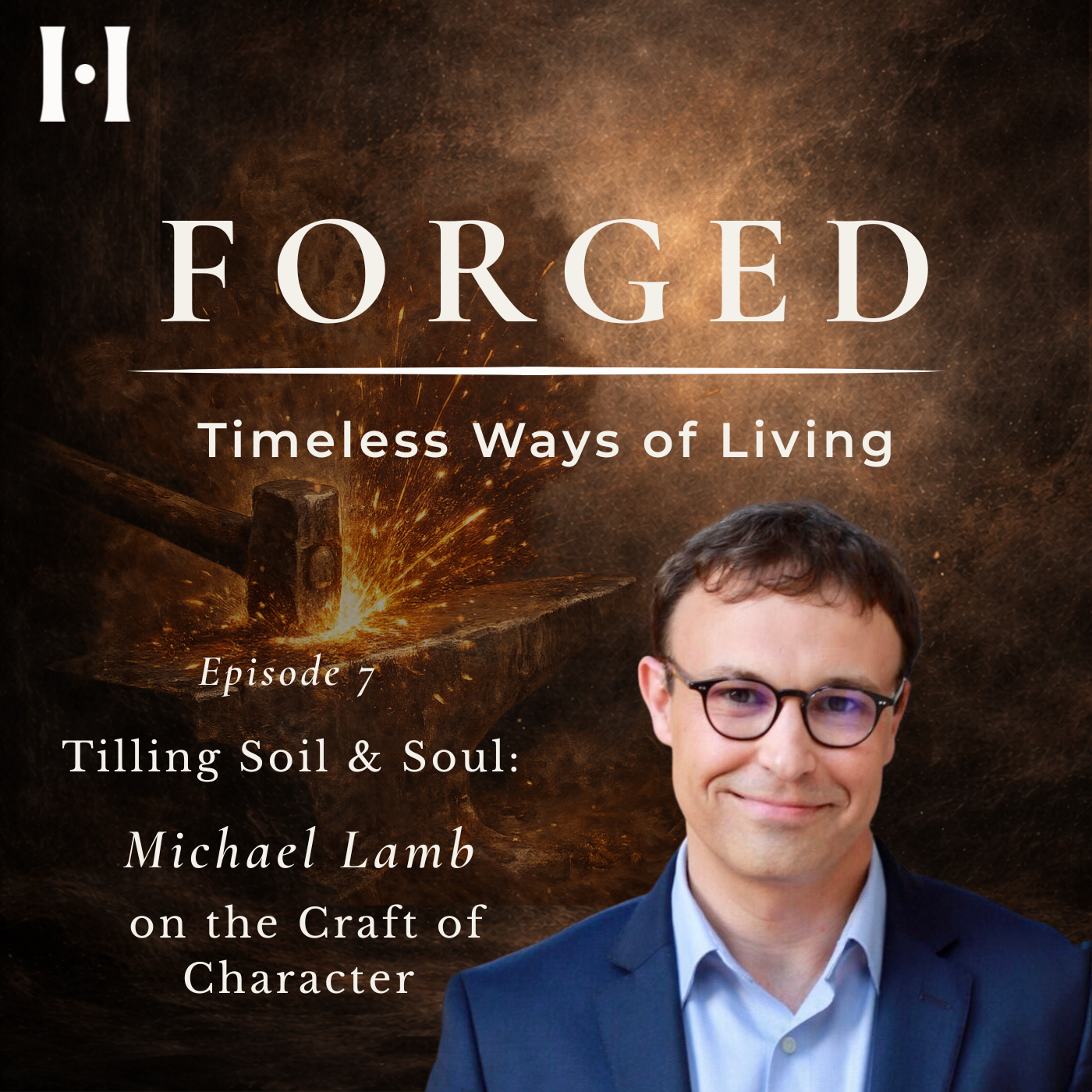
Forged: Timeless Ways of Living
Tilling Soil & Soul: Michael Lamb on the Craft of Character

What forms a life of character? In this episode of Forged, Brian Williams talks with Michael Lamb about the moral formation that happens through work, friendship, habit, and hope. From Lamb’s childhood on a Tennessee tobacco farm to his work helping universities cultivate virtue, this conversation explores how people learn discipline, responsibility, humility, and shared purpose. It is a rich reflection on education, moral ecology, political hope, and the slow work of becoming the sort of person who can love the good and pursue it with others. Along the way, Brian and Michael consider what today’s families and schools can learn from agrarian life, why friendship and accountability matter for both adults and students, and why poetry can train us to pay attention. They close with Seamus Heaney’s “Digging,” a fitting meditation on inheritance, vocation, and the probing work of the pen.
Contributors

Guest
Michael Lamb
Michael Lamb is the F. M. Kirby Foundation Chair of Leadership and Character, Senior Executive Director of the Program for Leadership and Character, and Associate Professor of Interdisciplinary Humanities at Wake Forest University. He earned a B.A. from Rhodes College, Ph.D. from Princeton University, and second B.A. from the University of Oxford, where he studied as a Rhodes Scholar. A recipient of teaching awards from Princeton, Oxford, and Wake Forest, he is the author of A Commonwealth of Hope: Augustine’s Political Thought and co-editor of The Arts of Leading, Cultivating Virtue in the University, and with Brian A. Williams, Everyday Ethics: Moral Theology and the Practices of Ordinary Life.
Featured Links

Host
Dr. Brian Williams
Podcast Host and Contributing Writer
Brian A. Williams (DPhil, Oxon) is Dean of the Templeton Honors College, Professor of Ethics and Liberal Studies, and Co-Director of the MA in Classical Teaching at Eastern University in Philadelphia. He is the founding editor of Principia: A Journal of Classical Education, speaks internationally on classical education, and serves on several academic and educational boards, including the Classic Learning Test (CLT). Previously, he taught at Cair Paravel Latin School and the University of Oxford. Dr. Williams earned degrees in theology and Christian ethics from Regent College and the University of Oxford, and his research focuses on education and formation in the Christian Intellectual Tradition. Brian is a runner, art collector, and traveler, having visited over 40 countries, often in search of sites and cities of the ancient world. He is married to Kim, a visual artist and teacher, and has three children: Ilia, Brecon, and Maeve.
Related Resources
More Than a Résumé: Classical School Graduates on Who They’ve Become
Classical school graduates reflect on who they’ve become and how their education formed them in mind, character, and a lifelong love of learning.
I home schooled my children till 16 — all four got into Oxbridge
This week my son Xavier will start his first term at Oxford University studying maths, my fourth child to get into Oxbridge. His older sisters, Olivia and Felicity, are Oxford graduates in classics and music respectively and his older brother, Max, has a degree in engineering from Cambridge. Two of them had choral scholarships; two had academic scholarships.

When It Comes To Choosing Schools, Families Are Mixing It Up
A New Study On Sector Mixing And Homeschooling