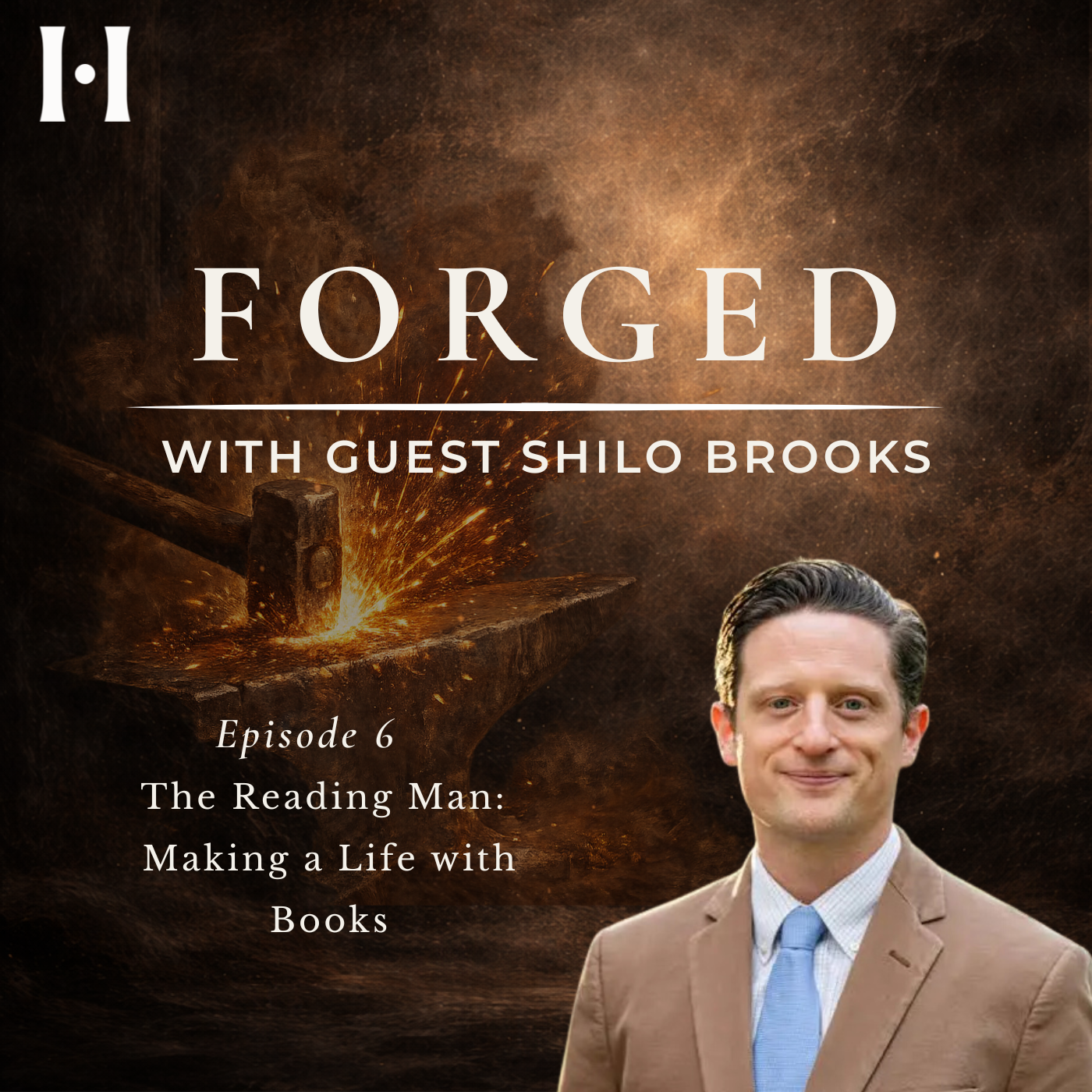
Brian Williams: Hey, folks. This is Brian Williams, host of Forged, a timeless way of living, a podcast of the Humanitas Institute about forging lives of discipline, delight, craft, and calling that draws the classical tradition into our contemporary times. Today, our guest is Shilo Brooks. Shilo is president and CEO of the George Bush Presidential Center, professor in the political science department at Southern Methodist University, and host of the fantastic podcast Old School, which I highly recommend to our listeners. But on Old School, Shilo welcomes men across different fields to reflect on one book that has shaped or informed their life, and I commend it to you.
So welcome to Forged, Shilo.
Shilo Brooks: Hey. Thank you for having me. It's a delight to be here.
Brian Williams: Man, this is great. Hey. Before we jump into things of real substance, can I ask about your name? I mean, is there a story Yeah. Better than that?
I mean, it sounds like it came out of a McCormick McCarthy novel. Right? Like, Shilo Brooks led his horse to the river two minutes before dawn Yeah. Or Is that right? Okay.
Well,
Shilo Brooks: I love Cormick McCarthy, but it didn't come My from father and mother love reading westerns and watching western movies. Yep. And so they named me Shilo because they you know there's this western author Louis L'Amour? Have you ever Sure. Heard of
Brian Williams: Totally.
Shilo Brooks: So, yeah, they would read Louis L'Amour, and I was told my dad I was like, where did this come from? And they were like, well, I think we may have seen it in a Louis L'Amour novel. If we didn't see it in a Louis L'Amour novel, then we saw it in a Western on TV Okay. That was like based on a Louis L'Amour novel. So short answer is, you are right.
It was a Western writer
Brian Williams: Okay. Who came
Shilo Brooks: up with the name.
Brian Williams: And what is it about Southern guys? Like, think of other friends I have, Wheeler Gum, Griffith Gatewood, Brooks Lamb. They all seem like characters that stepped out of, you know, yeah, a McCarthy novel or a Faulkner novel or something like that. So or maybe it sounds like they've got generations of stories embedded in their name. I'm always impressed by them.
So, yeah. There's something in
Shilo Brooks: the water down there, you know?
Brian Williams: Yeah. No, I think so. I mean, I don't know about you. One of the most profound acts I've ever performed was naming my kids, You know? It's like it's like the one of the most intimate things that they know about themselves and how they relate to other people is is naming our kids.
So Yeah. Anyway, well, there you go. Shilo Brooks. Alright. So, Shilo, you grew up in Lubbock, Texas.
Right? And then That's found found your way out to the East Coast. But first, what'd you love about growing up in Lubbock?
Shilo Brooks: Man, you know, I love the wide open plains Of West Texas. I don't know. I mean, not a lot of people go there. When you think about Texas, a lot people think about Dallas, Austin, Houston, but out in Lubbock, the horizon is infinite, and I can remember being 17, 18, and going for a jog, and just being like, man, what is this place? I've been here my whole life, but this is not normal.
It's like being on Mars, so I think that. I think the people obviously are really, really wonderful. I love Mexican food, you know, so that was a really good thing.
Brian Williams: Yeah, yeah, that's good. That's You know, some people write about the connection between landscape and soulscape, you know, that how where you grow up sometimes shapes how you relate to the world. I know my wife grew up on the Plains Of Kansas, and where we live now in Pennsylvania, she feels kind of claustrophobic because she can't see the horizon all the way around her. Yeah. But for you, what did that do for you growing up kind of on the Western Plains Of Texas?
Shilo Brooks: I mean, it was interesting. I think it did two things. One was that it was in some ways inspiring and in some ways isolating. I think it was inspiring because as we've said, the horizon is infinite. I mean, like I said, you could go for a jog, you get 10 miles, it feels like you haven't gone anywhere, so you just kind of get a sense of the size of the world, and I do feel like that reflects itself as you were saying in the mood of the soul.
Mhmm. The same way I suspect growing up in New York City would reflect itself in the mood of the soul, and they would they would both cultivate two different kinds of souls. So I think growing up in Lubbock, kind of gave me a sense that we were in the Wild West or something. Know, anything was possible. I kind of romanticized it
Brian Williams: lived Even in it at the same while you were there? Because I mean Lubbock is a place Well, I mean, everybody or lots of people want to get out of their place to go find a better place, as Wendell Berry calls it, but at the time, did you enjoy Lubbock?
Shilo Brooks: I did. Would go back. I mean, I still love it. I hope to go back in the next couple weeks. I mean, know, but I think it was isolating in the sense that one of the things that I realized pretty soon in my kind of mature years as I became a teenager was that there wasn't a lot of intellectual life.
Mean, Texas Tech University was there, but I came from a real poor family, so I wasn't real plugged into the university. I didn't know any professors. I didn't really like school. A lot of the guys I was hanging out with, you know, what mattered to them naturally, and I don't have a problem with this, was football and girls. Both of those things are interesting, but I also liked books, and so I think Lubbock was both inspiring and isolating for me as a young man because the culture, while I love it, I also thought there's got to be more than this somehow.
Brian Williams: Yeah. Yeah. So who put good books in your hands, Shilo, as as as a boy? I mean, who who turned you on to the the wonder of books and reading?
Shilo Brooks: You know, that's a good question. I mean, there was always some books in my home. I would have, you know, Louis L'Amour books and these sorts of things. I My mother I mean, I can get into this. My mother was divorced many times in my life, four or five times in my life, and I had a stepfather at one point who came through who was a reader, and he would sort of sit down and read books and listen to music and write music, and that was the first time I'd ever seen a man be literary, and so he introduced me to books, and then I had a male English teacher in about tenth grade who had us read American classics, The Great Gatsby, Farewell to Arms, East of Eden, and that was the second time that somebody really said to me, you know, these these are nourishing documents, and they can nourish you.
So those two men in particular had a real effect on me.
Brian Williams: Yeah. What were some of the early books you read growing up that you remember? I mean, you just listed a few from your sophomore English class, but are there some that kind of stayed with you? I mean, you know, some of the early books I read, like Madeline L'Engle's Wrinkle in Time, or the Narnia Chronicles. You know, some of those characters took up residence, I think, in my own mind.
Shilo Brooks: Yeah, there are. I mean, interestingly, I didn't know how to choose books, so I would go to Barnes and Noble. Barnes was and Noble in my hometown, and I would look at the classic section because I was under the impression, still believe this today, that if they've endured, they must be worth my time because I don't know the first thing about So I can remember going to that section and taking books off the shelf like Dostoevsky's Crime and Punishment, like The Grapes of Wrath. Mhmm. Right?
I can remember one time pulling down a book by Friedrich Nietzsche called Human All Too Human. Mhmm. And so I would just go to that shelf, and those are the books I remember the most are those that I just pulled off the shelf because I'd heard the name somewhere and it sounded famous to me.
Brian Williams: Yeah. Yeah. I think I did similar things at the library, though I also came back with like 80 of the Hardy Boys books that I read, you know. I don't remember a single one of them, but, you know, along with some of those great books, think there were others like that. So so then how do you make it from Lubbock to the East Coast?
You know, you end up coming to St. John's College out here down the road from me. Yeah. But, you know, St. John's, Indianapolis, Maryland from Lubbock,
Shilo Brooks: I mean, that's for a lot
Brian Williams: of people, that's a universal way.
Shilo Brooks: Yeah. It was for me, and I'll try to tell the story efficiently, but essentially, when I graduated high school, so I was not a good high student, and then I graduated, I never thought about college. I didn't apply to college. When the valedictorian of my high school told me that she got into Yale, I thought that was in England. I mean, I had never even heard of these places that these kids were getting into.
Yeah. So I bounced around. You know, I was told you should go to college. We couldn't afford going. I ended up enrolling at this small school in Lubbock called Lubbock Christian University just because it was cheap, and then, you know, it just wasn't doing it for me, and so the only other school I could get into in Texas was a school called Sam Houston State University in Huntsville, Texas where they do criminal justice, where the prison system is.
Okay. I showed up out there wanting to read philosophy. I get there. I try to register for my philosophy classes, and they look me in the eye, and they're like, we don't do philosophy. And I'm like, well, you have It's on your website.
And they're like, well, it's on the website, but we don't offer And so I was lost, and I was working retail at a shopping mall, and I was talking to a young woman from my hometown on the phone, and and she was real great, and she was at Baylor studying classics, and I told her, I'm not going to college, and she said, well, why are you not going to college? I said, well, you know, the one I want to go to where you only read the great books, I can't afford that. My family can't afford that. We can't do that, but I've applied there, I told her, because when you get into St. John's, they send you a free copy of Homer's Iliad, and I wanted Homer's Iliad, and I also wanted to know I wanted to know I could get in, and I wanted the book.
Brian Williams: So if nothing else, you get a free book out of the deal.
Shilo Brooks: That's get not free Iliad. So they sent me the Iliad. They told me I got in, and I knew I was going be working in the shopping mall forever, but I would know that I could have gone to St. John's if I had been a wealthier Yep. And so she tells her father, hey, Shilo is not going to go to college, and he calls me on the phone, and he says, look, I heard you're not going to college, and I said, no, The one I want to go to I'm now 20 at this point.
I'm getting kind of old, and he says, you can't afford it? I said, no, I can't. He said, well, tell you what. Send me those financial aid papers. I want to take a look at those.
I sent them to him. He called me back, and he said, look, somebody helped me once in my life, and they told me that I didn't have to pay him back, but that I had to do it for somebody else someday. So he said, if you can pay a few $100 a month, and your mother can put in a few $100 a month just so y'all have skin in the game, then I'm gonna pay your college tuition, and I want you to go to St. John's, and he did. So that's how I got to St.
John's was a man from my hometown paid my college tuition.
Brian Williams: Oh, man. That's really powerful. What a powerful what a powerful story. Have you stayed in touch with him, I guess?
Shilo Brooks: I I have. I just corresponded with him, and every month that I was at Saint John's, I wrote him a letter. Here's what we're studying, and to this day, we still write back and forth.
Brian Williams: You know, I think the same thing happened to young Augustine in North Africa. I think his parents could not afford his education, and it was a local patron who decided to, you know, to fund his education. So that's fantastic. I sometimes tell my students, we read, you know, The Odyssey, and there's young 18 year old Telemachus trying to find his way in an adult world and doing it poorly, you know, until Athena, Menelaus, Nestor come alongside him. And so I, you know, I often tell them, hey, you know, pay attention.
There are people that you might need who will kind of guide you forward. So that's pretty fantastic. So you go to St. John's. How'd you even know about St.
John's? Because I didn't either, you know. I mean, as a high school student, I mean, had one classmate who went to Bryn Mawr out here down the road, and I'd never heard of it before, certainly never heard of St. John's. How did it even come on your radar?
Shilo Brooks: Yeah, St. John's two ways. So one way was there was a teacher that I had who noticed that I didn't do any schoolwork, because I told you I wasn't I was a very middling high school student. But she said, you know, the one thing that you do always do is when I assign a full book, you read it. And so she said there's a college you can go to where all they do is read books.
There's nothing else that they're doing. Yeah. So she told me that, and then I got on their website back in the nineties. I mean, is like late nineties, and I entered my email address, and they sent me what's called the statement of the program, and it said on the cover, I'll never forget of this brochure they sent you. It said, the following teachers will return to St.
John's next year. Austin, Plato, Douglas, Euclid, Shakespeare, and I was like, wow. Those are the Homer, Aristotle, Locke, and so I couldn't believe it. So I heard about it, but first through her, and then once they sent me the literature, was like, man, this is awesome.
Brian Williams: Yeah. So how'd you do when you came out to Annapolis? You come from Lubbock. You come from Sam Houston. Did you come out to Annapolis, and and did you become a better student instantly?
Shilo Brooks: Yeah. So interestingly, I I did come out to Annapolis. Saint John's has two campuses, one in Santa Fe, New Mexico, one in Annapolis. I spent my first two years in Santa Fe.
Brian Williams: Oh, you did? Okay.
Shilo Brooks: And then the last two years in Annapolis because you can transfer back and forth. So, you know, a time I got out I'd never been on the East Coast before in my life, and I got out to Annapolis, and I just thought this is you know, it's like I'd read about the East Coast in novels, but I'd never been there. So once I got there, I kind of fell in love with the whole thing,
Brian Williams: and I
Shilo Brooks: I did become a better student, but it was because the college was uniquely tailored to my own instincts and talents.
Brian Williams: Yeah. Annapolis is charmingly old world. I mean, it feels like a small European village in in lots of ways. So you come to Saint John's. What was the biggest what was the biggest revelation for young Shilo Brooks?
I mean, what what what to you at Saint John's? Was there a kind of Yeah. Transformational experience?
Shilo Brooks: I would say so. I mean, you know, the thing that happens at Saint John's is you read the great books in chronological order beginning with the ancient Greeks and concluding in modern times, and you do this in every discipline. So you do this in philosophy, music, mathematics, science, literature, politics, and so I think being subjected to the success of over four years reading of primary source landmark texts in that kind of way. I would sit down with the book, so I would read Aristotle's Ethics, and I'd be like, It's true. He did it.
I can't believe it. Like, there's the truth. And then the next night, I would sit down with the next author, you know, and I would say, well, it's true. Aristotle was clearly wrong. This is true.
And then I'd progress, and so senior year, I'm sitting down with Hegel, and I'm like, well, Hegel did it. Hegel's got it. And then I sit down with Marx. I'm like, well, Marx did it. And then I sit down with Tocqueville.
I'm like, well, Tocqueville's got the truth. And so I think just the power of those authors against my 20 year old mind made me see that these guys all have powerful claims on the truth, and I need to figure out who's right. Okay. And that was really transformational for me.
Brian Williams: Can I ask you a question about that? So, you know, sometimes the word of Johnnie's, people come out of St. John's, you either come out a Nietzschean or a Catholic, you know? And so, like back in the 70s, there was a great integrated humanities program at Kansas University led by John Sr. And the other two professors, Nellick and Quinn.
And one of his criticisms, or concerns at least, about St. John's was that there was no kind of overarching moral framework within which students read these texts, and that sometimes He was concerned that, you know, 20 year old Shilo Brooks on his own is supposed to figure out who's right, as opposed to reading it within a particular culture, or like, you know, index a particular theological tradition or something like that. Was that your experience?
Shilo Brooks: I think that's an experience. It was not mine. I can see the risks there, and I agree that they are there, and there are risks. But of all, of course, you're not doing it by yourself. There's 18 other people in the classroom and a teacher, and you're all wrestling together, so that's important to remember.
The other thing, of course, is that, for example, the Bible, you spend a considerable amount of time reading the Bible, the New and the Old Testament, Thomas Aquinas, Saint Anselm. Yeah. So you're exposed to those things, but at Saint John's, they encourage you to think for yourself, you know, that you yourself need to weigh the arguments in the kind of most thoroughgoing liberal education that you can get. So I think that that's true. There's a kind of risk of relativism after St.
John's, and I know some people who did fall into that. That was never the case for me because the stakes were so high.
Brian Williams: What do you mean by that? The stakes were so high? Because I mean, the stakes could be high, and you could still fall into that relativism thinking, you know, scripture, okay, that's true. No way Aristotle's true. No way Nietzsche's true.
No way Hegel's true. Right? I mean, stakes could you could feel the stakes high, but still fall into a kind of relativism.
Shilo Brooks: What I have in mind is that the animating question of the curriculum in some ways was how should one live? What is the best way to live? And insofar as I knew that I had to live, that meant that I had to come down somewhere, and I also knew that if I didn't come down anywhere, that was also coming down somewhere.
Brian Williams: Right.
Shilo Brooks: In other words, that was also making a choice. Relativism itself asserts a truth claim about the world, and that truth claim wasn't persuasive to me. And so I think I took that possibility as just another one of the alternatives and then tried to consider which alternatives were the most persuasive based on reason in my case, but other people might say based on revelation.
Brian Williams: So it sounds like, is that part of the Saint John's model to help you see the living implications of these texts? Because you know, there is a way to teach texts, as you and I both know, where you're creating disciplinary specialists, right? You can teach Shakespeare to create a specialist in Shakespeare, or you can teach Hegel to, you know, create a specialist there. That's not what I do here in my institution. It sounds like that's not what St.
John's was doing either.
Shilo Brooks: That's not what St. John's does. So it's they are Books not at Saint John's and books for me now are not objects of mere academic or scholarly interest. They animate and inform the way that you live. And so at Saint John's, all of the books are thought to be raising in some way, whether it's in mathematics, whether it's in science, whether it's in in or literature, some enduring human question, which is perpetually relevant.
And these disciplines speak across one. So at Saint John's, when you're reading Aristotle, you're also reading Euclid. And when you're reading contemporary philosophy, you're also reading Einstein. So one of the things you begin to see is the way that these disciplines speak to one another and the way that the philosophy that you're studying in the nineteenth century is coloring and colored by the science that you're studying in the nineteenth century, and that some of the questions that they're wrestling with in the nineteenth century are the same questions Aristotle was wrestling with two thousand years prior. And so you you don't see these things as mere artifacts of scholarship.
You see them as somehow pieces of information in a great human endeavor.
Brian Williams: One of my concerns, the way we teach these kind of texts in college and certainly in high school, is that we kind of do teach them as if we're creating disciplinary specialists. I mean, always ask myself, okay, how do I teach this text in such a way that my students want to reread it in five years, want to reread it in ten years, want to read it in twenty five years? But it doesn't seem like that's the pervasive way most people teach texts, certainly in our high schools. I mean, that's not the way I was taught texts in high schools, some of these great books. Even here recently, I taught Nick McKean Ethics to my freshman, and one of them said, I read this in high school, but I was supposed to memorize all the terms and learn the virtues and vices so I could pass a test.
Where do we go wrong there, do you think? Like, why don't why don't we teach texts like, you know, how Saint John's does to you?
Shilo Brooks: I think that in large part, it's a it's a flaw of two things. One is that the education system in some ways, in many respects, sees education instrumental. In other words, it's not good for its own sake. It's good for the sake of whatever job comes after it, and the students begin to see that, and so they think books themselves are not good for their own sake. They're good for the sake of getting a grade, which is a currency, and then that currency can be exchanged for admission into a college, which can then be exchanged for a job.
That's a problem. I think we have to begin to think of and teach books as being good for their own sake, that there are certain things which are good simply in and of themselves. I think the second problem here, especially at universities, is that graduate programs cultivate the minds of young graduate students to be overly scholarly and obsessed with footnotes and contributions to ever more obscure journals. That cultivates certain habits of mind. The process of getting tenure cultivates certain habits of mind, and all of that leads in my view to a bad way of teaching and oftentimes a bad way of reading.
Brian Williams: Yeah. Because what happens, you're trained in a certain way in grad school, aren't you? Because you're trained to push forward, you know, a little bit of knowledge in your particular discipline. Fine, but then you bring that into the classroom and act like these students you're teaching, you know, who are gonna major in all kinds of areas, you're bringing to them that area of that same kind of approach to disciplinary specialization. I'm curious your thoughts, because you spend a fair bit of time in higher academia, higher ed, you were at Princeton before SMU now.
What do you think we need in our grad schools? Or, you know, to train our professors differently? Or I suppose, you know, in undergrad programs to train our high school teachers differently. I mean, there places doing that well, do you think?
Shilo Brooks: I suspect there are. I mean, I think graduate school is difficult, right, because the young people who are in graduate school are so concerned, and rightfully so, with they've spent five, seven years on this thing, and they want to get a job and that sort of thing. But I think teaching sort of falls by the wayside, and I wish and I hope that that can be revived, that the kind of teaching as itself an art, which just as research is an art, and I'm not trying to denigrate it at all, but attention should be paid to that as an art. It's not something that just happened, so I think that's important. With respect to k 12 and that sort of thing, I mean, colleges of education are oftentimes, to put it mildly, a mixed bag.
There are some that I think are doing good work, and those that are doing good work are those that are training teachers. I mean, from my point of view, there are a number of good ed schools that train teachers to go into classical education that really do put the emphasis on teaching, and really the formation of the soul is front and center rather than some kind of, I don't know, newfangled thing that's just whatever the latest trend in education is. So I think if there's young people out there who are interested in being teachers, think you need to find an ed school that is going to teach you to form a young person's soul. I think if you're going to go to graduate school, you should remember all the while that much of your career will be spent in teaching, and that teaching is an art just like painting, and that you ought to devote yourself to some of that too.
Brian Williams: I would love to see more programs develop, both in undergrad and grad programs, that introduced people who were gonna be teachers to this way of reading texts. You know, I mean, medievals might have called this a kind of tropological approach to reading a text, you know, an approach that treats text as wisdom literature, right, whether it's philosophy, theology, literature.
Shilo Brooks: Right. And I think there are I mean, I think the University of Dallas, for instance, I just think of it because I'm here. It's a Catholic school, but it has a teaching program that I believe approaches teaching in that way, and I know that there are some schools around the country that are either gonna start new programs or in the process of reviving old ones that would doing things that way because there's a lot of demand, it turns out, for teachers of that kind.
Brian Williams: Yeah, and this wasn't meant as a lead into promote my own program, but we also have a master's program here for classical school teachers where we try to do that same kind of approach. Perfect. So that we have high school teachers, know, like the one you had as a sophomore or maybe one I had as a senior who said these texts are important, yeah, but they're texts about, you know, living well. Texts that you kind of take into your own soul and kind of like, you know, allow it to like permeate your pores. So is this why you started the podcast?
I mean, this the story behind the old school podcast?
Shilo Brooks: Yeah. I mean, the the old school podcast was started for a number of reasons. It is in a way an attempt for me to recreate for other people the effect that books have had on me. The way of reading books that you've just talked about as guides for life rather than objects of mere scholarly inquiry. The impetus behind old school was all of those things, and it was really capped off by the following oddity that I started to notice in my own teaching career, which was I would teach courses which would deal with primary source text because that's all I know, and many times in such courses they're female.
In other words, you get a lot of women who will come to a Victorian literature class, say, Princeton. There's some great literature classes at Princeton. They're really good. And I would talk to faculty or other students who would say, you know, the overwhelming number of people, gender of people in Victorian literature is female. I would get to my own classes, and there would be men, and I mean athletes, I mean ROTC guys.
This had been the case through my whole career. Yeah. And people started pointing it out to me and saying, your class really does I mean, has, of course, plenty of females, but it has more males given its subject matter than most classes like it. And that was really what persuaded me finally to start old school was that men were coming to me, saying to me after they had taken my class, I have never read a book this way. I've never seen a man talk about a book the way that you do.
Thank you for giving this to me. And I thought, man, this is really something.
Brian Williams: Yeah. So what was it? I mean, as you reflect upon it now, what was it that was drawing guys into your classes, do you think? What what they see, or or did you create a kinda space for them that wasn't created in other places?
Shilo Brooks: I think it's all of the above. Think first of all, they saw a man on the stage
Brian Williams: From Texas.
Shilo Brooks: From Texas with the accent and the whole Yeah. But reading a great and beautiful piece of literature and being emotional about it and not being afraid to say, this moves me, and say why it moves me, and say, it should move you too, and then calling them in the way that you have to sometimes call a young man to say, be serious about this. Look at this with me. Like, is this I think just arresting that attention, and then some of the books had kind of certain masculine themes. A lot of the courses that I teach are on statesmanship and leadership and the great trials of leaders like Abraham Lincoln and Cyrus the Great, and I think the young men were attracted to those themes, and so I think just seeing a man who is not overly scholarly, and I've got a PhD,
Brian Williams: and I
Shilo Brooks: do the thing, but I'm not I'm not soft in the way
Brian Williams: that intellectuals sometimes are.
Shilo Brooks: I think seeing that person read a book up in front of the room and talk about it with articulate passion really arrested those guys.
Brian Williams: And it wasn't something they were finding elsewhere? It was
Shilo Brooks: not something they were finding elsewhere. And the other thing they weren't finding elsewhere was, as you and I have already spoken about, I would read the books not simply as objects for the passing of a test, but as guides for your life. And I think young men are looking for kind of guides for that reason.
Brian Williams: Yeah. So is that why old school is focused on men? I mean, your line in old school is that you say, I think reading makes us better men. Right? I mean, is there a crisis of reading among men, do you think?
Shilo Brooks: Yeah. So I mean, there's a lot of surveys that have been done and statistics that have been that show, first of all, that reading groups are overwhelmingly women. So if you go to a reading group, it's primarily going to be women that show that men buy fewer books than women on the whole and that men buy much less fiction than women do on the whole. When men read, they usually are going to read nonfiction although they read fewer books a month. There's of course various people on the Internet and other sorts of people who tell young men, don't read.
It's a waste of your time. So I think there's a kind of confluence of factors, whether it's people on the Internet who in my view traffic in cheap sophistry telling young men don't read. You know, a dominant man is out conquering and making money. Reading's a waste of your time. Or whether, you know, the young men haven't ever been introduced to books with masculine themes, and by that I mean, you know, when you read Jack London's Call of the Wild, when you read Hemingway's For Whom the Bell Tolls or Old Man and the Sea, those themes are masculine themes, and so I think it's a kind of combination of things that have pushed men away and that can bring them back, and so old school is really my attempt to show men what books can be for you in your life.
Brian Williams: Yeah. What do we lose as men with not reading? I mean, because someone could say, well, who cares? I'm fine. My dad didn't read.
He seems fine. Why why should I read? I'm busy. But what do you think? How do you explain that?
What do we lose as guys who don't read?
Shilo Brooks: So one of the things that I wanted most as a young man was to was to adventure. I think this is kind of native to the life of a man. Like, I mean, to go somewhere. When I was young, I'd heard stories of people who had been to Germany in the Second World War, people who had gone on all sorts of adventures by dent of either necessity because they had been drafted or because they were looking for money and going to find oil wells and all, know, whatever it was that And they were books, I could never do any of that stuff. Some of it was financial.
Some of it, you know, was family circumstance. Books provided me with the way to feel like I was experiencing some aspect of the world as though it were an adventure, that I could go with Hemingway to Spain, that I could go with Fitzgerald to the East Coast where I had never been, That I could travel back and see men scream and slit each other's throats on the battlefield with Homer and his Achilles. So I think there's this intellectual adventuring that's possible through reading. I think this is particularly good for men because what it provides you with is a kind of emotional athleticism. That is to say that you get a range of feelings can fill your soul, fill your body that you might not have cause to feel.
So I wasn't exactly mad as I wasn't raging with Achilles sitting in my room. Mean, a little bit, but when I when I read that book, I began I had access to that feeling. Or, you know, when I was reading F. Scott Fitzgerald on the East Coast and reading poetry and being at print, I didn't have any access to what those feelings were when the old man in the sea is struggling with the fish and these sorts of things. What it allowed me to do is feel feelings that I had no right to feel and give me an emotional education, which made me a fuller and more robust man, more capable of handling situations that were real in my life because I could always reference some episode or some lesson from a book and say, it's like Dostoevsky when Raskolnikov murdered the woman, and I can already find my way through because I have this kind of emotional adventure through books.
Brian Williams: Man, that's fantastic. I mean, think part of what it is. C. S. Lewis comments in one place.
He says, we wanna feel with other hearts. We wanna see with other eyes. We wanna act with other hands, and in a way, kind of step out of the immediacy of our own existence, step into the immediacy of those stories. And you know, you're living and dying alongside these characters, and I think it's the experience of stepping then out of the immediacy of that story back into the immediacy of my own life, and it's almost like I've been changed because I've had experiences I hadn't had before I read.
Shilo Brooks: Yes.
Brian Williams: Right? Because you draw some of that back with you, you kind of fold it into your being, and then you're kind of channeling some of those characters. Or you've actually earned some of those experiences through reading their stories.
Shilo Brooks: That's right. That's right. I mean, you asked me earlier about growing up in Lubbock. Yeah. I grew up in Lubbock.
Lubbock doesn't provide I mean, it's a wonderful place, but it doesn't provide the range of possibility that I was hungry for when I was 18 or 20, and so as you're saying now, those books took me all over the world. I didn't have access to I couldn't have gone all over the world. I didn't travel. My family didn't have money, but those books took me there, and I became a fuller, more robust, more emotionally, ethically confident man from reading.
Brian Williams: Yeah. And one of the things I'd love to know, have you read a book several times where you come to identify with different aspects of the book or different characters? Like, I read The Odyssey now, and man, I identify with Odysseus. He's a middle aged guy trying to get back to his wife and trying to figure out what do I do with his 18 year old son, you know? But I connect with him when I read it when I was 19 in the way that I do now.
Is there a book for you where you've come back to it and you think, oh, yeah, now I'm learning something new from the same book?
Shilo Brooks: Yeah. I think there's a couple I mean, think the starting point would be when I began reading Plato at Saint John's, Socrates used to make me so mad. In other words, I was like, this guy is just putting it on. Like, he's asking these people questions, and he's leading them on, and what up? And hey,
Brian Williams: where are the answers, man?
Shilo Brooks: Where are
Brian Williams: the answers, Socrates, right?
Shilo Brooks: Yeah. So I think I had a kind of emotional response to Socrates as I was morally indignant. As I've aged, what I come to see is the brilliance of the way that Socrates' questioning is revealing something about the longings of his interlocutor and the soul of his interlocutor to others. And so it's not Socrates being this irritating, mean man. It's Socrates exposing some vulnerability, some ignorance of the interlocutor, and I think it's a beautiful point you make.
Books stay the same, and we change, and so I do always encourage students and my listeners to go and read that book that you read at 18. Check it out again when you're 48. It will blow your mind. And I can think, I mean, you know, mentioned Plato. Yeah.
But there's all kinds of books that especially Shakespeare, you know, I come to believe one character is really attractive, and then I reread it and I think, man, that guy sucks.
Brian Williams: Yeah. That happens all the time. Mean, does doesn't Churchill have a line about 'tis a pity to read a book too young or something like that? Some books as well we're just not ready for. I remember teaching Francois Moriak's Viper's Tangle.
I don't know if you know this. Moriak won the Nobel Prize in Literature, and it has a central patriarchal character who's kind of created this like twisted scenario around him. And I read it as a 35 year old, and I had lived and sinned enough, I suppose, to identify with this character. I tried to teach it to 18 year olds once, and they just couldn't connect with him. And I said, oh.
Shilo Brooks: Yeah.
Brian Williams: Yeah. Come back to it in 20 For better or worse, you will connect with his character.
Shilo Brooks: Yeah, that's right. And there books like that that work in opposite ways. For instance, I know people who loved Catcher in the Rye when they were young, and now they reread Catcher in the Rye, they're like, Holden Caulfield. I
Brian Williams: can't stand it. Yeah. You know? Yeah. Yeah.
I have gone back to reread a few books like that, and I thought, what did I see here? You know? But it it spoke to my 16 year old self or whatever it was. Hey, so if you were on your own podcast, what what what's the book you would want to, you know, discuss with with the host? So for those of you who don't know old school, Shilo has a guest come on, a man, and and I guess your your invitation to them is choose choose a book that was significant.
Right? And they choose one book. You each read it, and then and then converse about it. Yeah. So so you come on your own podcast.
What what what's the book you'd wanna discuss?
Shilo Brooks: Yeah. So I ask people, tell me about the book that changed your life. Tell me about the circumstances that were going on when you read it. I I think for me, you know, I get that question a lot. What is the book that you would choose?
I mean, it's so hard for me to, you know, to say. I mean, I can think of two, but let me give you one, and maybe I can give you the other. But the one that I usually say is a book, and you've heard me mention the name, and the reason you've heard me mention the name already is because it was very formative, is a book by F. Scott Fitzgerald called This Side of Paradise.
Brian Williams: Okay.
Shilo Brooks: Fitzgerald wrote This Side of Paradise. It's his first novel. I'm not recommending it to you. You have to remember your favorite novel is not necessarily the one that changed your life. It's not his best novel even.
He wrote it at 23. It was his first novel. It's a book about a young man who grew up in Minnesota, had some artistic literary inclinations, some capacity, ended up going to Princeton, and ended up kind of mixing in with literary society and writing poetry and finding intellectual life and conversations about philosophy. I read that book when I was 18 years old. The reason it changed my life is that I never knew such places existed.
I saw myself in that character, but I didn't know what universities were. Mhmm.
Brian Williams: I didn't
Shilo Brooks: know that there were other young men in particular out there who were interested in reading poetry and having competition over essays and discussing late into the night That's merits of this or that philosopher. So when I read that book, and remember, I didn't want to go to college. When I read that book, it all became clear to me, and St. John's became clear and to everything that I wanted to do became possible because I saw a life that wasn't mine that I might be able to live, and that's why I said earlier, you don't know what you can be until you've gone adventuring with these books. They will present to you possibilities for your life that you never knew, and I would not be sitting here where I sit today, where I was at Princeton, none of that, without that book.
Brian Williams: Is that right? Because it helped I mean, it stretched your soul in a way, right? Because you were able to see something and name it as good, even though you didn't know it existed There's that sense that I'm reading something, and I want to taste this for myself. This looks like it's possible for people, maybe even like me.
Shilo Brooks: Yeah, it's possible for me, so that was my second thought. And my first thought was that it's even a thing. I didn't even know that it was a thing. So that it can be done, that there are such places on the planet where people have these conversations, and then the second thought is why not me? And that's what made it possible for me to do all that I've done.
Brian Williams: Yeah, so this makes me thinking. In education, sometimes we talk about the importance of poetic knowledge, as it's called, which is a kind of experiential knowledge of a thing, right? So it's like I sometimes think of Kenneth Branagh when he was in high school, a great Shakespearean actor, who says he hated Shakespeare. Because he said, all I did was we read it in class. He said, then I went and saw my first Shakespeare play performed, and he had this like, oh, that's what it is.
And he fell in love with Shakespeare. So it's sort of that knowledge that I can tell somebody something is good for them or travel is good for them, but you kind of have to experience it yourself. But in a weird way, that's what novels can do for you, right? Again, it comes back to that you could experience it through that character and you kind of had to experience it. Because if somebody had said, hey, Shilo, university's a great place and you could go, you might go, I guess, maybe, but then you almost experience it, and through experiencing it, you You have the kind of knowledge you didn't have before, I guess.
Shilo Brooks: Yeah. It's closest approximation you can have other than actually being there, and so I think, you know, insofar as you can't be there, it's the best you can do. And I sometimes tell my students, one of the reasons to read widely is that you live your one narrow and boring life, but there are a million lives that you could live, and you could become a million souls in one. Think about that for a minute, how full and large you could be, and so I think that's kind of the point that you're making and getting at, and and I would say to my students, you know, you're you're boring. You're 18.
Become fuller.
Brian Williams: Yeah.
Shilo Brooks: Be Yeah. A 100 people in one person. Yeah.
Brian Williams: That's what And here's a way to do it. Open this book. Turn this page. Yeah. Right?
Spend time living and dying and, you know, sinning and repenting with these these characters. So, okay, so this side of paradise, what's your second one though that comes to mind?
Shilo Brooks: There's a book that I teach every year that is always a hit, and in some ways it made my career. It was this big course at Princeton that I used to teach, and this book was a centerpiece, and it's something nobody's ever heard of unless you're a super nerd. It's a book by an author named Xenophon
Brian Williams: Okay.
Shilo Brooks: Who was a student of Socrates. Socrates had two students who wrote. One is named Plato, who everyone has heard of, and the other is named Xenophon. Xenophon was a general. He led 10,000 Greek mercenaries out of Persia, for example, but he had a Socratic education, and he studied with Socrates.
He wrote a number of books, some histories, one called the Hellenica, which is a sequel to Thucydides' Peloponnesian War. He wrote a book about Socrates called the Memorabilia, which is kind of a biography. Mhmm. But he wrote a book which in Greek is called the Cyropaideia, which translates to the education of Cyrus, and it's about Cyrus the Great, and it's a fictionalization of Cyrus the Great, so it's kind of a fictional biography of a great man. Okay.
And Xenophon uses Cyrus as a kind of beginning to talk about the perfect political nature, the perfectly ambitious person, the person who is cut out to rule just obviously from birth, and then he walks us through the life of Cyrus and walks us therefore through the perils of political ambition, the longing for greatness and honor, the longing to do justice and make the world better, the longing to be loved and praised by everyone. That book has meant a lot to me because I was a pretty ambitious guy. You don't come from Lubbock to Princeton to leading a presidential library if you're not ambitious, but I needed a teacher, a teacher to show me how to live my life in a way that was noble because your ambition can destroy you. And so The Education of Cyrus is a book that over the course of my life I've taught to all sorts of ambitious young people and whose lessons I've taken as I've built my own life, my own family, and my own ambition.
Brian Williams: So what'd you learn from the book? I mean, how did it shape you?
Shilo Brooks: I learned that many of the things that you think will be good for you and for others from the outset, that you're you you want to be ambitious. You want to change the world. It's going to make you famous. It's going be great for you. But as you change the world, you're going to make it better.
Right? You can do all of these things. I learned primarily the lesson of moderation with respect to those things, that there are limits to what we can do, that our hopes cannot always be fulfilled perfectly, that the world does not always admit a fixing in the ways that our longings hope that it is, that justice can't always be done in every single situation, and so I learned to calibrate and moderate myself. I learned also that the praise of people who are not wise people doesn't mean much, so that if you seek the honors of others, make sure that they themselves are men of honor because the honor from cheap people is no honor at all. You know, I learned that the excessive pursuit of the love and good regard of others can lead you to do crazy things.
Brian Williams: So what do you mean? Expand that last one. Unpack that last comment.
Shilo Brooks: You know, I would say this. In the education of Cyrus, Cyrus the Great, as Xenophon understands him, has this ambition to take over the world as we have heard Cyrus the Great did. The reason he seems to want to do that is because he's jealous of the gods, meaning when human beings look at the gods, they worship the gods, they praise the gods, they say, help me. I love you. Love me.
Praise you. Give me They seem to to give an infinite amount of love to the gods and expect something impossible from the gods in return and hold them high in that way. So Xenophon diagnoses Cyrus with a kind of divine pathology that he the reason he's pursuing the world is that he wants to be loved and worshipped like a god, and ultimately he wants to be immortal like one too, and I think that's the kind of danger that this longing unmoderated by xenophon can lead you to, and so a lot of people who have not been cured of that end up falling into all sorts of traps with respect to their ambition. You can see this in the pages of People magazine and all sorts of other things. Yeah.
And I think xenophon is a good cure for a young man, or at least a good guide for a young ambitious man who wants to do things nobly and see the world soberly.
Brian Williams: So do you have a side job where you take CEOs of major tech companies through Xenophon here?
Shilo Brooks: Yeah. I mean, I yes. You do. Okay.
Brian Williams: I mean If not, you should, maybe. We could use it.
Shilo Brooks: No. It's true.
Brian Williams: Too, but yeah. What have what
Shilo Brooks: you done? So I'm doing a book based on what I just said, which is Xenophon, but I'll tell you this. One of the places I've taught in my career is the University of Colorado, and while I was there, was asked to come to their college of engineering. Now, I'm not an engineer. Yeah.
But they said to me, look, we want to build a program for young engineers who are gonna go on to do things in Silicon Valley who haven't fully studied and aren't fully aware of the complexities of human nature and political life and these sorts of things. And so one of the books that we read on that curriculum that I would read, and this is to your question about tech executives, was The Education of Cyrus to try to compare Cyrus's longings for a better world and love and godhood with those of real CEOs in positions of power in, say, Silicon Valley. So to answer your question, yes, I've I've done that.
Brian Williams: Have you? Yeah. Because I mean, it's it's not a it's not too dissimilar, the ambition of many tech execs, if you will. There are tech companies right now. Right?
I mean, we're all trying to grapple with what do we do with AI right now? What do we do with, you know, social media right now? I mean, all of those were designed and introduced to the world to make it a to make it a better place. I mean, and maybe that's not exactly what Cyrus had, but the ambition seems similar.
Shilo Brooks: So Yeah. No. I think it's it's exactly the same, and I think in order to understand how to make the world a better place, I'm all for that very nobel longing. But one has to first understand the kind of place the world is, and that requires an infinite amount of study. As you know, a reading of Aristotle, a reading of Thucydides, a reading of John Locke, whatever the case may be, you can't just see what you see and say, and now I know the world.
It's infinitely complex, and that's why I think people of that kind could become better at what they do by first reflecting rather than, as Mark Zuckerberg used to say, moving fast and breaking things. Yeah.
Brian Williams: Have you found many people at that level who are readers? I mean, have met somebody kind of at that level and who's who's a really who reads seriously?
Shilo Brooks: I have. And I don't I don't wanna like toot my own horn, but the man who one of the people I most admire is the president for whom I work, President Bush. While he was in office, he read 14 biographies of Lincoln. Think about that. 14 biographies of Lincoln.
When he got out of office, had a reading contest with one of his closest advisers, and he lost something like I think the president read 95 books and the adviser read 104 books. To this day, he reads constantly, and I think of a man like that who I know in person who's just a voracious reader, but then I think of the long history of such statesmen, men like Churchill who wrote and Teddy Roosevelt who just constantly was reading books. You know, that kind of person is still a type. They still exist.
Brian Williams: And these are I mean, your examples right there, these are men. I mean, these are class these are these are successful men. These are accomplished men. These are men we think of as as men. Mean, Churchill and Roosevelt, you know.
Yeah. And they they had a rich reading reading lives.
Shilo Brooks: That's right.
Brian Williams: Let me ask a question about ambition as well. So so you you must teach a lot of, I mean, certainly at Princeton, a lot of students who have a lot of ambition. I was at Oxford for a time and was there when we began the Oxford Character Project, Similar kind of idea thinking, alright, these students are gonna have kind of outsourced influence in the world, so let's let's what can we do to form form their character? What about on the other side? I mean, you know, the the student who doesn't seem to be ambitious.
Yeah. I mean, is those people exist? Do do you have a message for them, or how how do you kind of stoke some of those desires?
Shilo Brooks: I always tell people part of the success that I've had in teaching is because I'm only half academic. The other half of me is motivational speaker and football coach. And, you know, by that, I mean, in order to get somebody moving who's not moving I mean, sure, I taught at Princeton, those kids were ambitious. Right? But I also taught at the University of Colorado, which had, you know, 35,000 students from all over, some of whom were amazing, and some of them were just there because they were trying to get a gentleman C and get a job.
Yep.
Brian Williams: That's right.
Shilo Brooks: But you have to arrest those people as a teacher. You have to get up in front of those people and call them to a higher purpose by trotting out, as I would do, examples of greatness in front of them and finding one with whom they might fall in love, and I think that's the key. I mean, you mentioned earlier that you have to read a book. Churchill says this. You have to read a book at the right time.
One of the things that I would always do when I was teaching students who I thought were not as ambitious, say, as my students at Princeton would say, I would say, what are the books that would get an 18 year old going? And as a teacher, you need to think about that. You don't just teach these books because they're the ones in the discipline. Teach books that are going to move the soul of the young people in front of you, and when you're reading those books, challenge them. I would constantly say to my students, even at Princeton, would say, look, if the greatest thing that ever happens to you is that you got into this university, and it says on your tombstone, so and so went to Princeton, and that's it, you failed.
You're a failure because that means nothing. Because I can name all kinds of people who got into this university, and the truly great people, like if I'm talking Theodore Roosevelt who happened to have gone to Harvard, nobody knows he went to Harvard, but all of us scholars, everybody else knows he was the president. You need to do something they put on your tombstone that's bigger than that you got in here, and so I would use the same thing with these students who are not at Princeton. I would say, look, you are a talented individual. This object that I'm holding This person who I'm holding out in front of you is a person who has capacities that are no different from yours.
Can become that person too. You have not convinced yourself of it yet because you haven't been exposed to the right things, and so I just think you have to inspire people, and this goes back to what we said about using books for the purpose not just of scholarly edification, but as guides for life.
Brian Williams: And this comes back to me for high school teachers, because I speak to a lot of high school teachers, and I sometimes tell them the same kind of thing, that if you think you've done your job just because your students got into the college or university of their choice or usually their parents' choice, you've aimed way too low because your responsibility is not actually to the 18 year old version of that kid's self, but to their 28, 48, and 68 year old version of that kid's right? And that's really what you're trying to teach, and that means you're trying to teach not only these kind of books, but teaching them in a certain kind of way.
Shilo Brooks: That's right. I mean, the line that inspired me to do I do a course on ambition, and one of the lines that inspired that course really echoes what you just said. And I think it's chapter 14 of Machiavelli's Prince. Machiavelli says that all aspiring princes should do as prudent archers do, and he says that what prudent archers do is when there's a target that's very far away, what they have to do is aim very high. If you aimed right at the bull's eye with your bow and arrow, you would come down halfway to that target that's far away.
But if you aimed way above the target so that the arrow would arch, you might not hit the bullseye, but you'll come down way closer to that bullseye than if you had aimed right at it. And so he says a prudent prince must do the same thing. Take as your model someone super high. Lincoln, Washington, you know, something like that. Maybe you won't be the next Lincoln or Washington, but you'll get a lot further in your life by emulating that target and aiming your bow high to hit it than you would have had you said, I'll never be like them.
I'm not going to be like them. I'm just going to be a middle manager of the HVAC company, which there's nothing wrong with that. But you should take as your model someone great so that you're sure to maximize that potential, so that when you get into that middle management position, well, eventually you go found your own HVAC company, and you take over the whole town's business. And so that's the kind of that's the kind of attitude that you have to have if you're gonna be ambitious. Aim too high.
Tell your kids, apply to colleges that you don't think you'll get into, and see what happens.
Brian Williams: Yeah. I don't know if Machiavelli was riffing on Aristotle, but you know, Nicomachean Ethics opens with Aristotle saying we're all shooting arrows of desire, and if you don't know what that target is, the chance of you hitting the target is nil. And so his whole book is like, what's the target we're all aiming at? Because we're kind of like, you know, so many of our kids, I think, have those desires, are shooting them around, hoping to hit some target, but they don't actually know. It's like they're blindfolded and been spun around and told to shoot an arrow somewhere and hope it leads to their satisfaction.
Right? Hope it leads to fulfillment or something like that. So a question about the kind of books you recommend people start with. Right? So John Sr.
At the IHP program at KU would distinguish between the good books and the great books. Sometimes we'd say, you gotta start with the good books. So I think a lot of our listeners, they've listened to us toss around lots of names. They're not gonna probably jump into Nick and Be Key and Ethics that they haven't started reading or Xenophon or something like that. But do you got recommendations?
I'm sure you're asked this question a lot. Where, if you want to start the kind of reading life, what kind of books do recommend?
Shilo Brooks: I mean, you know, starting with novels is a really good idea. And not every novel, by the way, is like I mean, you know, by all means, you should read War and Peace, but I mean, you don't have to start with War and Peace. I think you should read Don Quixote. You don't have to start with Don Quixote. I mean, for me, you know, I've mentioned a lot of great books, but I've also mentioned a lot of good ones, and meaning that I've mentioned a lot of American literature.
So like what I'm gonna say is start with, you know, a book that is widely beloved and widely read, like Mark Twain's Adventures of Huckleberry Finn.
Brian Williams: Yep.
Shilo Brooks: That's an extraordinary book that deals with deep and serious subjects, but it's written almost in child's literature, but it's not. I mean, you mentioned C. S. Lewis. Yeah.
I've mentioned people like Fitzgerald and Hemingway who had some commercial success. I think if you start with those books and you isolate what's enduring about them one of the authors you talked you asked me where my name came from, Cormac McCarthy.
Brian Williams: Yep.
Shilo Brooks: You pick up Cormac McCarthy's The Road. I mean, his other books we should talk about because, you know, maybe don't start with those, but if you pick up Cormac McCarthy's The Road, it will bring you to tears, and it is among the most accessible books written. It won the Pulitzer Prize. Oprah picked it for her book club in 2006.
Brian Williams: Yeah. Which is shocking. Yeah. Yeah.
Shilo Brooks: Yeah. So I think there are books like that. I mean, you know, McCarthy's The Road. Mean, on Old School, we did
Brian Williams: Man, I loved All the Pretty Horses and the Border Trilogy for Corbin.
Shilo Brooks: Those were That all
Brian Williams: was my introduction. I just just love those.
Shilo Brooks: People write me all the time because they saw the Old School episode on The Old Man and the Sea, and it's a novella. And so that's short. That's something you can get into, but pick something. I mean, Jane Austen. I mean, I love Jane Austen, so I think there are plenty
Brian Williams: of I have a lot I still need to learn from Jane Austen. Right? That's how I feel. I'm like, oh, I need I need to be retaught. Yeah.
Talk to me again. Exactly. So, yeah. Yeah. That's great.
Hey. So as as we near the end here, let me give you some some rapid fire questions. On Forged, we we we try to attend to discipline, delight, craft, and calling. So what's a discipline you've pursued over the course of your life that has sustained you?
Shilo Brooks: I mean, you mean intellectual discipline or some other
Brian Williams: I'll leave it open ended, What comes to mind? I mean, probably not an academic discipline, but like a discipline or a practice.
Shilo Brooks: Yeah. Okay. Yeah. That one's pretty easy. So when I was 20 years old, I started doing fairly intensive exercise, You know, high intensity multi domain exercise.
And one of the things that I found as I would do that exercise, and I mean, challenged myself to very grueling things, mostly in a gym. I was never like an ultramarathoner, was that I could do things that I never thought I could do, and oftentimes the things that I was doing in the morning doing that exercise were way harder than anything I was gonna do during the day. So I would step up in front of two fifty Princeton kids. That was really intimidating to me, but then I would remember that earlier that morning I had done x, y, and z in my gym, and I nearly killed myself, so this is not going to be. This fifty minutes is not going to be.
Brian Williams: That's right.
Shilo Brooks: So having that kind of discipline and the courage, it gave me a lot of courage. Know? If I could finish this, I can do other things. That discipline really did sustain me.
Brian Williams: Yeah. There's a little bit of I've suffered before. I've been here before. I've done hard things before when you're pushing yourself physically like that. Okay.
Yeah. So delight. What you especially delight in, Shilo Brooks?
Shilo Brooks: Beautifully written words, man. Yeah. I mean, I was reading Catch 22 today for a podcast I'm about to do, and I've never read Catch 22. Embarrassed to say. I have now.
I'm halfway through it, but I was like, my gosh. And the structure is brilliant of that book, and it's not chronological. So anyway, when I see a creative act by a writer that just takes my breath away like Blood Meridian, I just That's the most delightful thing Yeah. For
Brian Williams: remember when I first read Fredrik Beekner's book Godric, I got to the middle of the second page and had to put it down because I was like Yeah. I was like, I'm done. I just need to sit with that. It was so rich and so beautiful, you know? Yeah.
And then I came back to it, the same kind of thing. Okay. So what about a craft? Have you pursued a craft over the course of your life? And if not, what craft would you wanna pick up?
Shilo Brooks: Unfortunately, it's gonna sound samey, right? I mean, do you consider writing a craft?
Brian Williams: I do. I do. Yeah. Okay.
Shilo Brooks: That would be it.
Brian Williams: Okay. What about craft where you used not with not a pen in your hand? Is there like a like a craft if you're gonna become a craftsman at something? Is there is there one that you'd love to pick up if you had time?
Shilo Brooks: Do you consider the acoustic guitar a craft? It's hands.
Brian Williams: I think so as a craft.
Shilo Brooks: Yeah. Okay. Music. Yeah. The writing of especially acoustic folk music
Brian Williams: and Yeah. Okay.
Shilo Brooks: The playing of acoustic folk music. I think it captures the same sort of things that the great American literature that I was mentioning to you captured, so I think I have novice experience with that craft, and if I could live a different life, it would probably be as an acoustic folk singer.
Brian Williams: Hey, there's no reason. There's no reason. That can't be in the future. So all right. We'll look forward to that.
All right. So discipline, delight, craft. What about calling? What do you think of your calling? Recognizing that career and calling are sometimes very different, but what's your calling?
How do you understand that?
Shilo Brooks: You know, teaching. I mean, I'm a CEO and president of a big nonprofit now, but there is no question in my mind that I'm called to teach, and the reason that I'm a CEO and executive of a nonprofit is because the one that I'm leading right now just happens to need a teacher in its seat, Okay. In the seat of the CEO. Yeah. But I think when I get on that stage, you know, and the students are there, and the responses that I get, and the places that teaching has taken me.
In academia, most people go places because of the research that they do.
Brian Williams: Yep.
Shilo Brooks: Every good thing that I've done in my life, I got all the way to Princeton University and now all the way to the CEO of former president's library because of my teaching. I got a reputation for teaching. I got a book deal because I teach my podcast. People heard of me because of my teaching. Yep.
That's what it is.
Brian Williams: Yeah. Teacher. That's great. Yeah. Hey.
So I love to finish by inviting guests just to to share with us a poem or a paragraph that has been significant to them or either helping them understand their vocation or the world at large. Do you have something you want to share with listeners, a paragraph or a poem?
Shilo Brooks: I do. I do. There's an author who I love for reasons that I can go into if you want, but his name is Friedrich Nietzsche. He was really very effective on me because he challenged me in every possible way when I was young to rethink the way I had grown up. I'll give you this example.
Nietzsche is a critic of Christianity. Well, I had grown up a Christian. I'd never seen anybody make those arguments.
Brian Williams: He's a
Shilo Brooks: critic of democracy. Well, I'd grown up a real American patriot. I'd never seen anybody make those arguments. So for me, liberal education consists in taking your convictions and submitting them to the scrutiny of someone more intelligent than you to see if they hold water. If they don't, then you have to liberate yourself.
That's what the liberating education is about, and you have to adopt better reasons for what you think and better thoughts than the things that you thought. Nietzsche really called me to struggle with the things that I believed, and I'm grateful to him for that. That doesn't mean I agree with him about everything. It means that he challenged me. Okay.
So let me read you this paragraph. This is from Beyond Good and Evil, which is arguably his greatest book. It's the fourth aphorism. It comes from the very beginning. Okay.
He's talking about the difference between what's true and false, and he says this, We do not consider the falsity of a judgment as itself an objection to a judgment. This is perhaps where our new language will sound most foreign. The question is how far the judgment promotes and preserves life, how well it preserves, and perhaps even cultivates the type, and we are fundamentally inclined to claim that the falsest judgments are the most indispensable to us and that without accepting the fictions of logic, without measuring reality against the wholly invented world of the unconditioned and self identical, Without a constant falsification of the world through numbers, people could not live. That a renunciation of false judgments would be a renunciation of life, a negation of life. To acknowledge untruth as a condition of life.
This clearly means resisting the usual value feelings in a dangerous manner, and a philosophy that risks such a thing would by that gesture alone place itself beyond good and evil.
Brian Williams: Yeah. Okay. So reflect on that for just a second for us. It's it's a bold move to to read, you know, Nietzsche as your kind of formative paragraph, but why has this one been so important for you?
Shilo Brooks: The reason it's important for me is because we go through life, and I think very rightfully so, convinced that the pursuit of the true things is what is good for us and that being deceived in any way is bad for us. And here Nietzsche is saying the truth is harmful to human beings. If they could know it, it would be so painful that it might destroy them, and so what we do is that we create fictions that we baptize as truth and call truth which permit us to live more comfortably on the basis of. And so, for example, he gives the claim that the falsification of the world through numbers, right, that when you count something the way science does, the way math does, when we talk about statistics and big data, that we can extract from that something that's true about the world, and then we comfort ourselves with survey numbers and these sorts Those of sorts of things are mere illusions on the basis of which we think, well, now we are more familiar with our circumstances. Now we know things.
Right? He talks about the world of the unconditioned and self identical that when you look at a tree and you then look at another tree and you call them both tree, what you ignore is the infinite difference between the two things that you have now called identical in order to have your concept of tree. That all of human life is filled with these summaries and these sorts of things, these, in his view, falsification of the world that make it a more comfortable place to live. Now for Nietzsche, that would go very deep. It might go all the way to religion and other I had never heard anybody say those sorts of things.
I'd never heard anybody call me to consider why do I desire what's true, and am I merely making up false things so that I can live better and more comfortably? So that paragraph really animated my whole study of philosophy.
Brian Williams: Yeah. That's remarkable. And then your first book was on Nietzsche, am I right?
Shilo Brooks: That's right. I wrote a book on Nietzsche just because, again, I've never encountered an author who challenged me in so many ways and who was sort of the most profound critic of the Western tradition, which I had come to love, but who was himself an admitted product of that tradition, who was a critic of Plato, but read Plato, who was a critic of, you know, the Enlightenment, but had read the Enlightenment. I love that about Nietzsche.
Brian Williams: Yeah. Yeah. And he's a remarkable philosopher, obviously, remarkable to read when you're 18 or 20 for just that reason. And and I think somebody, because of because he's so bracing, he's somebody that many of us come back to again and again and again to experience that splash of like frigid water your That's right. To say, am I being honest with myself?
Am I being honest with my students? Am I being honest about the way life is?
Shilo Brooks: Nietzsche calls you to self consciousness in a way that no other does, and he also has this feature that we discussed earlier. His writing occasionally takes your breath away. He'll he'll there'll be a sentence, and you're like, oh my gosh. Like, it's beautiful. Yeah.
Brian Williams: Well, thank you, Shilo Brooks. Thank you for your time. Really appreciate it. I'm grateful for this conversation and looking for opportunities to carry it forward into the future, I think. So with that, we'll we'll wrap it up.
But wait, Shilo, before I let people go, where can they find the podcast or some of your other work? Where would you send them?
Shilo Brooks: You can find Old School if you just go to Apple Podcasts and type in Old School with Shilo Brooks. You can also find it on YouTube. We have a beautiful set on which we record. Old School is produced by the Free press, which you can go to the free press and check out a lot of their content. My podcast being one of the many that they offer.
Brian Williams: That's great. Alright. We'll wrap it up there. Folks, you've been listening to Forged with Brian Williams, a podcast of the Humanitas Institute about forging well lived lives of discipline, delight, craft, calling. Thanks again.
Forged: Timeless Ways of Living
The Reading Man: Shilo Brooks on Making a Life with Books

What do books do to a man? In this conversation, Shilo Brooks and Brian Williams discuss reading, ambition, teaching, and the making of a life. Brooks reflects on growing up in West Texas, discovering the great books almost by accident, and learning to read not merely for school or profession, but for wisdom, courage, and the ordering of desire. Together they consider why men stop reading, what is lost when they do, and why the best books are not simply objects of study or instruments of advancement, but companions in the long work of formation. They do more than convey information. They enlarge the soul, sharpen judgment, deepen wonder, and usher us into a richer and more serious way of being in the world. Along the way, Brooks discusses the teachers who first put serious books in his hands and the books that shaped him, from Fitzgerald’s This Side of Paradise to Xenophon’s Education of Cyrus. The conversation ranges from landscape and longing to teaching and apprenticeship, and from the allure of ambition to the discipline of moderating it through wisdom. This is a conversation about books as guides for life, about the formation of men, and about the kind of education that moves from the classroom to the soul.
Contributors

Guest
Shilo Brooks
Shilo Brooks is President and CEO of the George W. Bush Presidential Center and Professor of Practice in the Department of Political Science at SMU. He was previously Executive Director of the James Madison Program in American Ideals and Institutions at Princeton University, where he taught in the Department of Politics. Brooks is host of The Free Press’ Old School podcast and author of a forthcoming book on noble ambition from Penguin Random House. Born and raised in West Texas, Brooks received his Ph.D. in political science from Boston College and his B.A. in liberal arts from the Great Books Program at St. John’s College. He and his wife Siobhan have one daughter – Clementine.

Host
Dr. Brian Williams
Podcast Host and Contributing Writer
Brian A. Williams (DPhil, Oxon) is Dean of the Templeton Honors College, Professor of Ethics and Liberal Studies, and Co-Director of the MA in Classical Teaching at Eastern University in Philadelphia. He is the founding editor of Principia: A Journal of Classical Education, speaks internationally on classical education, and serves on several academic and educational boards, including the Classic Learning Test (CLT). Previously, he taught at Cair Paravel Latin School and the University of Oxford. Dr. Williams earned degrees in theology and Christian ethics from Regent College and the University of Oxford, and his research focuses on education and formation in the Christian Intellectual Tradition. Brian is a runner, art collector, and traveler, having visited over 40 countries, often in search of sites and cities of the ancient world. He is married to Kim, a visual artist and teacher, and has three children: Ilia, Brecon, and Maeve.
Related Resources

When It Comes To Choosing Schools, Families Are Mixing It Up
A New Study On Sector Mixing And Homeschooling
School-Choice Tax Credit Gets Big Boost From Treasury
Married couples can donate double, making tax break worth $3,400, not $1,700

Bessent Advances Divisive $26 Billion School Tax Credit Plan
The program, dubbed the Education Freedom Tax Credit, allows individual taxpayers to direct up to $1,700 of their annual federal tax bill to nonprofits that grant scholarships to students to pay for qualified educational expenses.