Jake Tawney: I think so often we're starting with small pieces and building them up instead of starting with the holes, the reality itself, so that students can feel the burning need to understand what a cell is. Why why would we start with cells? Why do we care about cells? We should start with the plant. We should start with the frog.
And we should only get into cells when students feel the burning need to say, oh, but why is this happening? What's happening underneath? What's happening at a deeper level? Right? We start with folds, with essences, with natures, with the relatedness of things.
That's the education I want for my kids.
Brian Williams: Hey, folks. This is Brian Williams, host of Forged, Timeless Ways of Living, a podcast of the Humanitas Institute about forging well lived ordinary lives of discipline, delight, craft, and calling that draws wisdom from the classical tradition into contemporary times. Today, my guest on the show is Jake Tawney. So welcome to Forged, Jake.
Jake Tawney: Thanks, Brian. It's great to be here.
Brian Williams: Great to have you, man. Jake spent many years in academic leadership at Great Hearts Academy. He's a classical charter network, and now serves as the chief academic officer for the Institute for Catholic Liberal Education. Jake is the father of eight children and a very recent grandfather of one, which is exciting news in the Tawney family, I know. And Jake recently published a book, Another Sort of Mathematics, Selected Proofs Necessary to Acquire a True Education in Mathematics.
And Jake is a frequent speaker on mathematics and education, and increasingly about the use of artificial intelligence intelligence in education. And Jake and I have been on a podcast together and done little forums together on AI and education. So I'm really grateful to have Jake on the show today. So if you're a mathematician, this show is for you. If you're not a mathematician, this show is for you.
So Jake, I'd like to start with a provocative claim I've heard you make in person and in writing. And here's the claim, and then let me invite you to reflect on it and and justify it for our listeners. You write this. There's something unique in the human soul that can only be satisfied by wondering about mathematics. That's a bold claim.
Jake Tawney: It's an audacious claim. It's bold. It's audacious. And perhaps the more audacious thing is that I actually believe it. Right?
And so if you think about it, that that also means then the negative is true. Right? That that if we don't learn to think and wonder about mathematics, then there's something missing in us. Right? And so when you state it that way, it seems to be even more bold and more audacious.
But yeah. I I mean, look. The the claim in some ways is a response to what I think is the more popular way of presenting something like the discipline of mathematics. Right? And that that usually goes something like this.
We study math because it's useful. We study math so that we can build bridges, so that we can discover the next technological innovation. And I think with that with that claim, I'm trying to push back against this. Right? I'm trying to say that that mathematical objects are real objects, and they are beautiful and deserving of our attention.
And and that there's something very natural in the human person that wants to think mathematically. Right? I mean, I think here even of just basic arithmetic, there's something very natural about the act of counting. I mean, one one sort of very popular fundraiser that that schools do is to have kids guess the number of M and M's in a jar. Right?
And what's so fascinating about a a fundraiser like that is it's not good enough in the students' minds just to say who won. They they actually wanna know the answer in the end. How many? How many were there? Right?
And and when we we think about mathematics as that that sort of those four ways, the quadrivial arts that are part of the liberal arts, we realize that along with language, which would be the trivium, that math is one of the the two basic things in the universe. We have language and we have number. And I think the the human person yearns to think mathematically. And and so what I'm getting at with that claim is that we don't study math simply because it's useful. It is useful, and that's a beautiful thing.
But we study it because mathematical objects are beautiful in and of themselves, are deserving of our attention, and that they they the the human soul wants to think mathematically. So there's something very satisfactory about wondering about these things.
Brian Williams: Okay. I'm gonna back you up here because you used lots of big words there. So let me back you up and get you to unpack it. So you made a claim a second ago early that on that mathematical objects are real things. But what what do you mean by mathematical objects?
Because I mean, one of my questions one of my questions is, know, what what what's a number? Can you explain like what a number is? But you you said mathematical objects are real things. So what's a mathematical object?
Jake Tawney: Yeah. Great question. I mean, the the the first thing I think of is a triangle. Right? And what's really interesting about the triangle is if if we never stop to think about this, we've never actually seen a perfect triangle.
Right? Anything that we draw on paper, anything that we see out in nature or see that we've constructed, that's an imperfect triangle in some ways. Right? You can't draw perfectly straight lines. Even even if you you were super careful in your drawing, the the fact that the the graphite is made of atoms and molecules.
Right? I mean, there's some imperfections in it. Or, you know, not the least of which is that triangle technically has no sort of height to it, no thickness to it. And anything that we encounter in this in this sort of material world does. And so that's really interesting to me as a mathematician that there are these things called triangles.
We've never seen perfect versions of them, and yet we can we can hold that reality in our mind. Right? And we can understand what a triangle is, and we can even say true things about it. So a triangle, a shape, is is a mathematical object. And it's a mathematical object that that finds an incarnation down here, but really in some ways exists in the heavens.
And the same thing would be true of number. Right? What what is number? It's the you know, the number three is the thing that all collections of three have in common. Right?
There's sort of this this purity of what three is, and we we come to learn about triangles, and we come to learn about the number three through our sense experience in the world. But but in some ways, then our our minds are brought up from that material reality into something that's that's that's perfect and pure. And those are the mathematical objects.
Brian Williams: Okay. But that suggests to me that they're not real because you just said a triangle no no perfect triangle exists on the earth, but it exists in the heavens. So does that mean mathematical objects are imaginary? Why why why make the bold thing that they are real?
Jake Tawney: Yeah. They're they're not imaginary by any stretch. They're you know, certainly, there are things that are real that are not made of matter. So we would we would never wanna make the claim that the only real things are the physical things that are made of atoms and molecules. Right?
The laws of logic, the virtues, all of these things have some some reality beyond the material world. You know, I do think we need to be careful. Even though I said we've never encountered a perfect triangle down here, I would never wanna make the claim that the imperfect triangle is somehow not a triangle at all. Right? It is.
It participates in some ways in that perfection. Right? And so I don't I I don't think that we can be, I don't know what the word here would be, purely idealists or something. But I do think that mathematics in this way is, I don't know, what's sacramental? That that somehow we encounter things made of matter, and that's how we come to know what a triangle is.
But then our our mind is lifted up from the material things into understanding what a perfect triangle is. So it's not imaginary by any stretch. It's the thing that all imperfect triangles seem to have in common and are reaching for.
Brian Williams: So what is that what is that process of the human mind or the human reasoning? That we see three sided objects, we see three sided things in the world, and then we say, okay. These all look similar. What do what do they all have in common? I mean, is that is that the process?
And then we then we posit this perfect triangle that these all imperfectly participate in somehow or imperfectly resemble.
Jake Tawney: Yeah. I think it's something like that. I think there's a very natural act of the human mind that abstracts. Right? That we we see different examples of something, and then we come to understand what it is that they have in common.
Right? It's super interesting to me that I can walk into a furniture and for the most part tell you which ones are chairs and which ones are tables. And yet I've never seen those chairs or those tables before in my life. Now I suppose there's some some modern furniture that makes me scratch my head a little bit, and I'm not entirely sure what it is. But for the most part, I think you can walk into a room and say that's a chair, that's a table.
And we understand the difference even though we've see not seen those particular chairs and tables before in our life. And I think the same thing's happening with these mathematical objects. We we see examples of triangles down here, and we come to understand the nature of what it means to be a triangle, which again exists in some kind of perfect perfection. Right? Perfectly straight lines and that kind of thing.
Brian Williams: But you made the claim to go beyond that that contemplating these kinds of things both satisfies the human soul and that the human soul will be unsatisfied, it seems like, unless we do that. Right? Because I'm not interested in in contemplating chairs. I mean, chairs are fine. If I'm gonna buy a chair, I'm gonna contemplate a chair.
But I don't know that I'm driven to contemplate chairs. But you're you're suggesting that, like, there's something in us that, wants to contemplate the triangle?
Jake Tawney: I think there is, in some ways, a difference between mathematical objects and and say the chair. Right? I think that math might be the language that god used when speaking the universe into being. Right? I mean, I I stand with Tolkien and Lewis that god probably sang the universe into being, but it's entirely possible that what he was singing was mathematics.
Right? And and modern physics, it has well, physics has kind of always known this. And and as we get deeper into our knowledge of modern physics, we're discovering this more and more, that the foundations of the universe seem to be mathematical. Right? And so this is why, you know, even though I don't think that we study math because it's useful, I also admit with great awe and wonder that math is useful because the universe seems to be designed using the language of mathematics.
We it it seems to be the fundamental explanatory language of all things that are material. And so that that seems to be different than a piece of furniture. Right? It seems to be that these mathematical objects are the the very foundation of how the world was designed.
Brian Williams: I think Galileo says something to that effect, doesn't he? Doesn't he say something about the the the the book of nature being written with numbers or or something to that effect? What do you know that quote?
Jake Tawney: I I don't know that quote, but I know that, you know, people like Francis de Sales have said that, you know, their god wrote two books. One is is the revelation is is scripture, and the other is is nature. Right? And and I think that underneath all of nature is that language of mathematics. You know, it it reminds me, at one point, Pope Benedict was asked by a 19 year old kid to, explain why mathematics is relevant, like why this is important, and and to and to explain what mathematics had to do with with faith.
And Pope Benedict said a lot of things because he's he's smart in that way. But he said something that was that really stuck with me that it's really it's always been remarkable to him, he says, that the the three things sort of cohere in a consistent way. One is the the laws of mathematics. The second is the way in which the universe seems to operate. And the third is the way in which the human mind reasons and understands.
And the fact that those three things, right, nature, the laws of mathematics, the human mind are consistent is is really important. Because if one of those links is broken, we would find the world not understandable. It would be incoherent. But then, of course, Benedict what Benedict says next is that in order to have those three things be consistent and cohering together, there must be something above them that's holding them in consistency. And so he uses that as proof for the existence of God.
And so I think that's getting at the same idea that's that that the laws of mathematics underpin the natural world.
Brian Williams: Okay. So give us give us those three parts again in case people missed them.
Jake Tawney: Yeah. The laws of mathematics, the way the the physical universe, the material universe operates, and the way the human mind thinks. Right? So if the human mind thought very differently than mathematics, we wouldn't be able to understand the world around us. But if the human mind thought mathematically, but the world was designed very differently, we also wouldn't be able to understand the world around us.
So if any one of those links are broken, we would find things incoherent.
Brian Williams: So could we say that the human mind was made or designed or evolved to want to know the world in which it lives, so that the world is familiar not foreign, and the way that we know the world in which we live is through numbers?
Jake Tawney: Yeah. I think both those things are true. I think that the world is ordered and knowable, and I think it's knowable so that it is, as you say, familiar and not foreign. I also think the material world reveals the nature of God. Right?
And so so the other reason why the world is ordered and knowable is because God wants us to come to know him through his creation. And then the second thing you said is that at the foundation of that is something like number. I would make a distinction. I think it's number and shape. I think it's sort of the discrete and the continuous.
But I think both of those things are the underpinnings of the design of the universe. They're the language with which the universe was spoken.
Brian Williams: And so if we want to know the universe in which we live, we have to learn its language. And you're suggesting that the language of the universe is numbers and shape.
Jake Tawney: I am. That's exactly what I'm suggesting. Okay.
Brian Williams: So so you mentioned a couple words here. I'd love you to unpack a couple medieval words. You you referenced the quadrivium and the trivium, and some people might not know what those are. So so tell tell us what the what those are.
Jake Tawney: Great question. So I think we have to first unpack this term liberal arts. Right? Because that's a that's a phrase. That's a a term that has, in some ways, kind of lost its meaning in in the last several decades.
There are I mean, I went to a school that that that claimed to be a liberal arts school, and I think what the school meant by that is some kind of well rounded education. Right? I got a a fine education there, but there there really wasn't much of the actual liberal arts. And so I think in order to understand the trivia and the quadrivium, we actually start there. You know, what what are the liberal arts?
And, you know, the the the term liberal means to set free. Right? These are these are the arts. These are the skills. These are the habits of mind that free the mind in order to to know true things.
Right? So so we do need to rescue that term liberal arts because I think in in a lot of these small colleges, it really just means kinda some well rounded education where you take some requirements.
Brian Williams: That's right. You take a history class and a science class and an English class and maybe a math class. Right.
Jake Tawney: That's right. But it turns out there actually were seven liberal arts. Right? And they were divided into three and four. And some of your listeners may or may not know this, but there's a symbolism to that.
Right? The three has always represented something of the eternal. And the three are called the trivium. Right? They were the three ways of thinking, the three arts of language.
And those three are grammar, logic, and rhetoric. And we're mostly familiar with grammar because that has sort of had a grammar's still taught in most schools. So we're mostly familiar with what that means. Most people know what the term logic means even if they haven't had formal courses in logic. But the the way that we string together arguments, sentences to make a coherent argument.
Rhetoric, so that third art of language, probably needs redeemed in some ways because we think of it as a negative term. Right? Rhetoric is an art of language because it's supposed to communicate truth to people. Right? Rhetoric is the way in which we convince an audience of something that is true.
And so I'll go out on a limb here and say, if you use words to convince somebody of something false, that's not rhetoric. That's not mere rhetoric even. That's what I would call antiretoric. And so so those are the three. Right?
Those are the eternal, the arts of language. But the other four are the arts of number, and they're what we call the quadrivium. Right? Quad, like quadrilateral, meaning four. And so four always represented the things of the earth.
And that's a really nice idea then when you bring those two things together because seven, the symbolism of seven, is sort of representation of all things. Right? So the four arts of of math, the arts of number, are arithmetic, geometry, music, and astronomy. And those last two might surprise people that they're thought of as arts of number. But music was really thought about as number in ratio to itself, in relationship to itself.
Know, guitar players know this, that if they cut a string in half, they go up an octave. But astronomy was seen as geometry in motion. Right? And I find this interesting that the actual liberal arts tradition seems to recognize that there are two basic things, language and number. And so this goes back to that original claim that learning math satisfies something unique in the human soul.
I think the those folks in the tradition, right, from from the ancients to the to the to the medievals who are thinking about liberal arts, kinda recognize that these are the two basic things that free the mind for higher things. Right? And those things are are language in number.
Brian Williams: And those things give us access to the universe in which we live?
Jake Tawney: Yeah. Actually, they do two things.
Brian Williams: Okay.
Jake Tawney: Right? They give us access to the world that we live in, which is kinda what we've been talking about. Right? That it it allows us to make sense of the world we inhabit. But they also prepare us for the study of higher things.
Right? Plato famously had an inscription at the front of his academy that said, and I'm paraphrasing here, like, let no one ignorant of geometry enter here. And what he meant by that is he he really understood that the study of geometry or the study of these mathematical arts generally prepared you for the study of philosophy. Right? I would say it prepares us for the study of philosophy and ultimately for the study of theology.
So I think these seven liberal arts, which include both language and math, I think they not only prepare us to understand the world around us, so that we can know about it and can communicate it, but they also prepare us in some ways to understand things even higher than the material world in terms of philosophy and theology.
Brian Williams: Well, that's another interesting aspect about these things that we call the trivium and the quadrivium because you pointed out the trivium has three, the quadrivium has four, but that word veeum comes from via, which means way. Right? So it's three ways three ways to knowing the universe, four ways to knowing the universe, three ways to begin your study of higher higher things, four four ways to begin your study of higher things. So that would suggest that the the liberal arts, the several liberal arts as we've inherited them, were never meant necessarily to be the end of education, but really the beginning that puts us on a path to to the education through higher things. Is that is that fair?
Jake Tawney: That's completely fair. That's exactly right. Even as a math guy who's trying to to promote the beauty of math, the reason that we study these things ultimately is for for our our contemplation of higher things.
Brian Williams: Okay. Let me let me pause on something you just said. You just referred to the beauty of mathematics. And I think many, many people would not use that word beauty with respect to mathematics. Certainly their experience of learning mathematics and doing worksheets ad nauseam through their schooling did not lend the them did not give them the same experience as hearing a beautiful piece of music or seeing a beautiful work of art or walking through a beautiful building or something like that.
So what do you mean by the beauty of mathematics?
Jake Tawney: Yeah. That's a great question. You know, in in classical schools and liberal arts schools, we often hear these three terms. Right? Truth, goodness, and beauty.
And and I I do think there's a way in which all disciplines have all three of those things. Right? All disciplines are true, they're good, and they're beautiful. But maybe you can think about this as a a an equalizer, like a a musical equalizer that some seem to go after beauty more directly than they go after truth. Right?
And so I I think you're right to raise the question of music, a piece of art, because I think the fine arts clearly disclose beauty first. Right? They come to disclose truth through their beauty. Right? They come to disclose goodness, the goodness of creation, the goodness of the human person through beauty.
But they seem to go most directly after that. I I might be on shaky ground here, but I've often thought that the study of literature kinda most directly goes after goodness, and then kinda through that also discloses truth and and beauty itself. There's no doubt that if you look at truth, goodness, and beauty, math goes after truth first. Right? This is one of my arguments for why this is one of the most important things students can study.
But when you encounter the Pythagorean theorem, you are discovering something that was true before you were born and will be true long after you are dead. Right? Right. You encounter objective truth through mathematics so directly. Right?
Objective truth exists in the other disciplines too, but it can be harder to see. Right? Even young kids wrestling with whether Robin Hood's actions are virtuous or vicious. Not to say that question is relativistic, but it's hard. Right?
But in math, when you encounter, even as a young kid, that two plus two is four, that's amazing that it's always true. So I I guess I bring that up because it's related to the question about beauty. In some ways, we get at the beauty of mathematics through the beauty of its truth. Right? Through through the fact that we can come to know that something is objectively true, and that's an amazing thing.
We can come to know general properties. I mean, I I find it absolutely amazing that no matter what triangle you draw in the world, if you rearrange its angles, it will always form a straight line. But that's that's really just remarkable to me, and I find that to be an incredibly beautiful idea. It's it's and so in some ways, the beauty of mathematics comes out of some of its surprising moments. Why would it at all be true that the angles of a triangle even add to the same thing every time, let alone to to that one thing that's a 180 degrees?
That's a straight line. I find that beautiful. Now, of course, there are mathematical objects that I find visually stunning, and so there's a there's a there's a beauty there as well. When you'll particularly here, I think of fractals. When you look at something like the Mandelbrot set or the snowflake curve, these are again, back to our first part of the conversation, these are objects that in their fullness could never exist in the material world because they're infinitely deep.
They're infinitely complex. And when I look at something like the Mandelbrot set, it's stunning. It's it's absolutely stunning. So I think there is visual beauty in math.
Brian Williams: For my listeners, let me just say I saw Jake make a presentation on this last month, and he had visuals of what he's describing right now. I think he left us for five minutes just in a stupor as an audience seeing a visual representation of what you just described. And there was a you induced wonder because we had the experience of seeing these fractals embodied images on the screen. But it was that experience of seeing them that I think induced that feeling of awe and wonder in us.
Jake Tawney: And I think there were two parts that were important to that. One is to have that embodied experience of visually looking at the actual mathematical fractals, actually looking at Mandelbrot as you zoom in. But the other piece of this was disclosing how lots of things in nature seem to to yearn to be fractal like.
Brian Williams: That's right.
Jake Tawney: I mean, they could never be completely fractal because they can't be infinitely detailed. But when we look at the way trees grow, how crystals form, how snowflakes are constructed, it it's like nature wants to be fractal like in in many ways. And so I think that's a different embodied experience that's there. When you see when you see the actual mathematical object, but when you also see the thing in nature itself. Yeah.
Brian Williams: Let me just stop you. Did you just say nature yearns to be fractal like?
Jake Tawney: Yeah. I think that's right. At least in some ways. Right? Yeah.
I think let me say it this way. I think growth in growth in nature wants to be fractal like. I mean, this is this is always a hard thing to do. You know, you're having a great conversation, but we have no visuals up there. Right?
Right. But if you take a look at fractals, they tend to be produced by repeated growth that gets smaller and smaller. Because the really, the nature of a fractal is that it's it's self repeating on a smaller and smaller scale. But if you think about the way that growth works as a tree branch splits, that growth mechanism seems to repeat. But as you get farther from the source, just because of resources, right, water, all the resources that are required for growth, you have less and less at the ends, and so the parts get smaller.
And so there is something in the in the way that nature grows that wants to be repeating, and as it repeats, gets smaller and smaller. And that that's literally what a fractal is. So I I think I'm not on shaky ground here. I think nature yearns to be fractal
Brian Williams: That's that's that's a great claim. I gotta I gotta kick that around a little bit. But when you see it, you you it does induce in you what a beautiful work of art or a beautiful piece of music I think induces in you, which is that feeling of elation, of awe, of wonder. But why didn't most of us feel that way in school? I'll say it for myself, I was a math guy.
I loved mathematics all through grade school, junior high, high school. One of my oldest friends, Eric Bowles and I, were kind of the math guys, and we loved it. But I would say most people, that's not their experience. My take on mathematics in high school, way we teach it so we probably teach it because it's a liberal art, but we teach it as if everyone is going to become a mathematician, and we justify it as if everybody's gonna be an engineer. So we teach so much of it, and then we try to justify it because people are gonna use it, But as you rightly stated at some point in time, most students will never use most of the math they learn in school, and I think students know that.
So they don't experience it as wonder. They don't experience it Actually, I don't know that they know how they're supposed to engage it.
Jake Tawney: I think the reason it has happened is precisely what you said, Brian, that that we we have taught math as a subject that is useful. Don't actually think that we're teaching math to produce a bunch of professional mathematicians. Actually, that's the problem. I think that mathematicians, this might sound shocking, I think mathematicians do math. And they do math as math.
I don't think that's what we're doing in k 12 education for the most part. I think you're actually right to point more towards engineering mathematics. I think what we're doing is presenting math as this collection of tools. Right? Facts and skills and application problems that that students can use in the event that they want to go into physics or want to become an engineer or really any number of disciplines.
You need mathematics to do economics as well. I think that's how we're teaching it. I think it would actually be better if we were teaching math in order to to help all students become actual mathematicians. Right? There's a fundamental difference between how mathematicians think about mathematics and how it's presented in k 12.
One of my one of my practical proofs for this is that if you ask the average person on the street what a mathematician does, they almost always get this wrong. They have no idea. They will give me one of three answers. One is something like a somebody sitting behind a desk finding unique ways to mouth multiply large numbers together. And we chuckle at that one a little bit, except that one probably is closest to correct.
Right? The other answers we get are something that involves an engine resembles an engineer or increasingly somebody that involves a statistician. Right? A data analyst. Mathematician examines mathematical objects, makes conjectures about their properties.
They want to understand them, and then proves their results. This became so clear to me my sophomore year of college when I finally had a math core course in proof techniques. I mean, I was like you. I always kind of liked math growing up. I mean, my my dad was my precalculus teacher.
Right? Okay. And so I I grew up liking mathematics. But when I took that course sophomore year in college, it turned everything upside down to me, or maybe it turned it inside out, Or all of a sudden, was looking at math from the inside out because I realized that what a mathematician does is to write proofs. Right?
Or at least that's the end of it. It's not not to suggest that they're only about the creation of the artifact, but what a mathematician does is to look at these amazing mathematical objects and to try to understand them, and then to argue and prove their results and write that down for all posterity. You know, occasionally, run into somebody who's who went to, you know, like a a Thomas Aquinas College or a Hillsdale where they finally encountered Euclid and learns to to to read through Euclid's proofs. And they'll tell me, I never understood math until I found Euclid, and I never loved math until I found Euclid. And what became clear in me after a couple years of talking to folks who've had this experience is and this is to say nothing against Euclid.
I love Euclid, but I don't think it's Euclid they fell in love with. I think it's math. I think it's that's that's the first time they had an experience with actual mathematical reasoning instead of the computation and application that they had really for for thirteen years of education, maybe more if they took a couple college courses.
Brian Williams: So you're saying that's how a mathematician thinks. And so if we were doing this right, we would help students come to think like mathematicians, but you're saying we that's not what we're doing. So how would you redesign what we're what we've typically done in our k to 12 math programs and what you and I probably went through? I mean, I went through, you know, the typical program and I enjoyed math because I enjoyed playing with numbers and it came kind of intuitively to me. But how would you redesign our math programs?
Jake Tawney: Yeah. I would I would redesign it first and foremost by just insisting that that we start with the object. We start with a thing of study. I mean, it's not math is different than science, but it's not different in that way. Right?
In science, we wanna start with the object of study. I wanna understand the frog. So let's look at the frog. In math, I wanna start with the object of study. I don't wanna start with a skill.
You know, if we're learning let's just take something from middle school. If we're learning about exponents and their properties, we start with that. What is the nature of what it means to raise one number to another? Right? Why is that not commutative, by the way?
Brian, have you ever thought about this? The fact that the that addition is commutative? And what I mean by that is the order doesn't matter. Right? So three plus four is the same as four plus three.
So it seems obvious. Right? Multiplication, same thing. Order doesn't matter. Three times four, four times three, they're both 12.
When we get to exponents, it matters now. Three to the fourth is not the same as four to the third, and that's mind blowingly interesting at this point. Right? Not all operations are commutative. Sometimes the order matters, and I like that example because we're just building up.
Right? Addition as a repeated thing becomes multiplication. As a repeated thing becomes exponents. So we should start with that, and we should let kids play with those. Play with those and discover those properties.
What are the properties of of exponents? Instead, what we're doing now is we're just kinda telling them, here's how exponents work, here's the rules, let's do a few together, you do some on your own, and now let's spend our time figuring out how that applies to things that we might find in in the world. Right? Now, again, I'm not opposed to applications, but I'm saying, like, we've missed the entire art of mathematics in that kind of presentation.
Brian Williams: Okay. Is there is there an analogy with literature here? I'm thinking when I used to teach Shakespeare, I guess my approach was to have students watch a Shakespeare play or act out a Shakespeare play before we ever backed into analyzing individual words or looking at his sentence structure or iambic pentameter. The opposite, I could have just given them a bunch of words they didn't know, and told them to define those words, and then told them to find those words, and scan a line. Then at the end of it, I'd be wondering, why don't they love Shakespeare?
I mean, is that a fair analogy? Is it something like that with literature?
Jake Tawney: It's it's a very fair analogy. My good friend, Andrew Zorneman, talks about the need to read literature from the inside out. Now I think what he means is something very particular about sort of putting yourself in that story and trying to understand those characters almost as if it's kind of real. But I think he also means you have to encounter the book. Like, have to encounter the whole thing.
That the the first thing you should do should not be to let's go through and learn some vocabulary that you're gonna see. Let's let's start the process of analysis. Let right? The very first thing you need to do is to experience it, is to encounter it. And and that's why I've referred to almost learning math from the inside out.
I wanna get into the actual objects and look at them from this direction, that direction, and try to understand them. Right? Same it's same thing with science.
Brian Williams: Same thing with science. Same thing with music. Right? We we wouldn't start with music theory with our third graders. Or if we did, we shouldn't be surprised that they don't really know how to do music or really wanna do music or really enjoy music.
But if you start with a song and then we have an experience, a song and then say, oh, what did we just experience? And why is it that we experienced it the way we did? And then we back into it, then we slowly say, oh, well, look at this. Look at this. Look what happens when you put your finger here on the string.
Look what happens when you put these notes together. Let's start to think like a math or a musician or a mathematician about what it is that we're you know, the the hole that we're contemplating here.
Jake Tawney: It's interesting you bring up music. Paul Lockhart wrote a book called A Mathematician's Laments, and he opens up that book by by imagining this nightmare dream about music, where, you know, students are only taught the rules and regulations of musical composition. They're only taught the number of beats in certain notes. They're only taught the names of the notes, but they never actually hear a piece of
Brian Williams: music. There you go.
Jake Tawney: They never actually experience it. And he says, would we ever want music presented in that way? And he turns around and says, you know what? That's how we're presenting math. That's what we're doing with it.
Here's the rules. Don't worry about understanding it, and then
Brian Williams: we'll we'll figure out how it applies to somebody later. What I'm getting. I haven't read that book. It's been on my shelf since it came out, and I haven't read it, but that's exactly what I'm getting at. And I think that's the experience for for many people.
So let me ask you two questions. Think about two different people in your mind. Okay? One is the the math teacher, the middle schooler math teacher, and I'm interested to know what you would say to them. The other person I I have in mind are my my wife and my daughter.
My wife is a is a artist and a fantastic art teacher. My daughter, very much like her. She loves art, and color makes sense, and line makes sense, and shape and shade makes sense, but numbers don't make sense to them. At least, they don't think they do. And you you write that everyone can train his or her mind to love the beauty of mathematics.
So I'd love to hear your your counsel to both of those people. What would you say to the, know, middle school and high school math teacher? Like, folks, this is what we need to be doing. That's not what we need to be doing. But then also to, you know, folks like my wife and daughter, Kim and Maeve, the artists in my midst, and say, you can love you can learn to love the beauty of mathematics.
And in order to do that, here's what you should do. But first, talk to me talk to the math guys, the math teachers, men and women.
Jake Tawney: The the advice I would give to any teacher, whether it's middle school math or high school grade books or elementary school Latin, is you you have to be passionate about your subject, and you have to be you have to be passionate about the beauty and the awe of your subject. You have to stand in great awe and wonder of it. I was on a panel once and somebody it was a panel of teachers and someone asked pretty much this question. Right? How do you get students to to really love the things that you love?
And I said, oh, well, I I mean, it's I'm not saying it's easy, but I am saying it's simple. And the simple answer is you have to fundamentally believe in the moment of teaching that thing that this is the most important thing your students could possibly learn. Right? So, you know, if you're if you're having students read the Iliad, you have to really honestly believe right now this is the most important thing for you to read. You it's it's it's critically important for your life.
And then you have to see no contradiction when next week you're having them read The Odyssey and you believe that's the most important thing they should read. It's the same in math class. If we're teaching middle schoolers about the Pythagorean theorem, like, you have to know it deep in your soul that this is the most important thing that students could possibly learn right now, that your life will be radically incomplete if you don't learn to love the Pythagorean theorem in all of its beauty and glory. And and see no contradiction next week when it's it's the laws of exponents instead of the Pythagorean theorem. So that's that's the advice I have.
And and I would tell them, you know, to remember that wonder is an act of the will. That you you there are moments, of course, where wonder happens to us, but but normatively, we choose to wonder about something. So that's the advice I would give.
Brian Williams: And and allowing students to therefore participate in your wonder at the mathematical object that we established earlier is a real thing. Right? That's what you're kind of doing. Right? It is.
You're you're saying, I let me invite you into the wonder that I have towards this thing. So let's behold it together and ain't that cool? Okay. So what about, you know, what about, you know, Kim and Maeve were sitting here, great, you know, artists and and lovers of word and story, but they find numbers difficult. How can they train their own minds to see to love the beauty of mathematics?
Where do they start?
Jake Tawney: I mean, I I'll make a a bold claim. Maybe it's not a bold claim, but there there's probably something a little bit presumptuous about this. But I suspect that what most people find difficult is computation. Right? I I think it's the the the the way in which we're being asked to sort of operate with numbers and to do those calculations, and then maybe to reason through some applications.
I I think I would my advice to the artist is to start looking at number as a beautiful thing of art, of music. Right? I mean, I I find it absolutely incredible that the intervals that sound good together are these these whole number ratios. Right? That an octave from one c to the next is a two to one ratio or a one half ratio, depends on on which way you're going.
I mean, that's amazing. Right? I think it's amazing that the perfect fifth is the next whole number ratio, is two to three or or three to two. And then here's where this gets wild, Brian. You know those same ratios are used in the construction of the world's most beautiful cathedrals.
But they were used in the construction of the windows. They were used in the the the proportions of the pillars. And and so then then we wonder why music sounds so good in those ancient cathedrals. And I think it sounds good because the the the the cathedrals are literally designed with the same harmonious proportions that sound good to the ear. So these sound waves are coming off the instrument or out of the mouth, and they're bouncing off this architecture that's been designed with the same ratios.
I think when most people hear that, they start wondering all sorts of questions. Like, I can even see it in in your eyes. Right? Like, well, wait a minute, Jake. Like, what what are those ratios?
What how how are those cathedrals designed? Are you saying that there's a way in which the wave come comes back to the the ears that that's that's that's done because of these proportions. Right? I I think when you start to describe those things and the the beauty of how numbers are at play in everything we do, I think people naturally start wondering about them.
Brian Williams: Yeah. And I will say, you know, that's where my wife does get really interested. When you think about the golden ratio and the Fibonacci spiral and these kind of things that you've you've just described and and how sound relates and how colors work together with the rods and cones in our eyes, which can be described mathematically. But it's starting from that experience of wonder, that experience of hearing the music, seeing the sound, seeing the fractals, then saying, what's going on here? And how do we back how do we back away from that to try to understand?
And numbers give us the language to understand what we've just experienced and what what we've just seen or what we what we've heard, I think. Okay. So so here's the question. So as a math guy, you must then love things like, you know, the calculator and the introduction of artificial intelligence into our schools because those are like cognitive extensions. Right?
And they allow the student's mind to do so much more with numbers than they could ever do on their own. Is that is that is that fair?
Jake Tawney: I what I'm really delighted at, Brian, is that you didn't just bring up AI, you you brought the calculator. Right? You're welcome. Here's where, again, I may I may not make friends with this comment. I think the calculator has actually been detrimental for mathematics education because I think it has reinforced the idea somehow that math is about computation.
Right? I mean, it's super interesting to me that most professional mathematicians are not using calculators. And that doesn't mean that that they're multiplying seven digit numbers by hand. What it means is multiplying seven digit numbers is not the essence of mathematics. This is not what they're doing.
Brian Williams: But then why did I do 10,000 worksheets over the course of my k to 12 education?
Jake Tawney: I mean, I think I think there is some value in doing, especially at younger ages, some of these these calculations because I think it allows you to intuit the nature of numbers Mhmm. Mhmm. That when you start to do these calculations by hand. And I think the use of the calculator circumvents that. Right?
And I think, again, what it does is almost give in to the myth that math is really meant for applications. So if we can shortcut the the calculations by hand, then we can free the student up to do higher level thinking. And what we have found over the years is that as as kids have used calculators more and more, they have less and less number sense. Right? Because they didn't spend those times in the in the younger ages multiplying numbers together by hand.
Right? That would suggest value in doing that.
Brian Williams: That would suggest that something like the calculator is not a cognitive extension, but actually a cognitive impairment going forward.
Jake Tawney: I think it is. I think it is. Now, again, do I think that it's a terrible thing that if someone's out and about and needs to calculate a tip or something, they they pull out a calculator to do that? That's not an awful thing. Right?
But we're talking about the use of the calculator in a student's education. And I think what it has done is has impaired their ability to understand the nature of numbers themselves. I'll give you probably an even more egregious example. The minute we had graphing calculators, we stopped having students do tables of values and plotting functions by hand. I mean, when I was in algebra, we did table after table after table to see what the different shapes were.
Right? All of a sudden when graphing calculators can do this, people said, let's not do that anymore. Instead, we can get to higher level ideas about the the the the properties of of of parabolas. And I think what we found was because you didn't take the time to really play with the shapes through those tables of values, you stopped understanding the nature of those graphs as well. I think they did become an impairment.
Brian Williams: Yeah. That's interesting. I never had a graphing calculator, but we did a lot of play. I mean, that's an such interesting word, isn't it? I think will be for people to think about mathematics.
Like, what we're doing, we're playing. We're playing with numbers. We're playing with these shapes. But we are the ones who have to do the playing. We are the ones that have to do the grappling as opposed to not extending our cognitive abilities, but turning them over to something else like the calculator.
When would you say as a calculator when would it be appropriate to introduce calculators into the the study of math?
Jake Tawney: It's not actually clear to me that if we change the way that we teach math, that they would be necessary in k 12. Right? Now, look, if if we're using let me just go to the extreme of of like twelfth grade calculus. If we're using a calculus book where a lot of our examples, you know, require students to do some multiplication, there is value in in not having to do two digits times two digits over and over again. But but I would then also ask, why are we doing a bunch of calculus examples that have students doing computation at that point?
Right? Shouldn't we be doing more examples that get at the nature of a derivative, the nature of an integral, you know, without having to do that? So it's not it's not clear to me anyway that in in all of k 12, it's it's necessary to have a calculator. Where I can see it being very useful is in some of the mathematics that you need for some of the science classes. Because now you are dealing oftentimes with with actual data that's being collected.
If you think of a a good physics experiment that starts with the the phenomenon. Right? If you're gonna start with the phenomenon of gravity, you better be making some measurements. And if you're gonna be making measurements, they're probably not very nice numbers. And so so there, it may be very helpful to not have to to do those calculations by hand.
Brian Williams: Okay. That's that's really helpful, I I think. So then so then what about artificial intelligence generally? I mean, is it in the same category as the calculator? Is it is it exponentially better, exponentially worse?
When is it when is it permissible? If it's permissible to use a calculator, say, in physics or certain science classes, would you say the same thing about artificial intelligence, generative AI? Is it is it permissible to use in certain subject matters?
Jake Tawney: So I don't think they're the same category. In fact, what what I actually think is the calculator is a category of artificial intelligence. The whole point of artificial intelligence is that it is is general. It's meant to to model all of human reasoning, all of human thinking. Right?
Whereas the calculator is only meant to model this very particular element of human thinking, which is is calculation. Right? And so I I think everything that I would say about the calculator, would say about AI, but but maybe even more more strongly. Right? I have this this basic premise for all technology that all technology will replace what it automates.
Right? My grandfather built houses for a living, and he could pound nails in by hand like there's none other. That skill has atrophied because of the pneumatic nail gun. Now that's not bad. I I love my pneumatic nail gun.
Right? But but it is worth asking for any piece of technology, what does it automate, and are we okay with that being replaced? So for the calculator, it automates calculation. Are we okay with that being replaced and at what age? Right?
And I've made the argument that for for most of k 12, I find that it's it's unnecessary and in in in most cases, detrimental. AI, from what I can tell, seeks to automate higher level thinking. And so again, we should ask ourselves, are we okay with that being automated? As we continue to use it as individuals, but also as a society.
Brian Williams: Yeah, and when we say are we okay with that being automated, what that really means is are we okay with humans no longer being able to do that? Or are we okay with me never being able to do that? Or are we okay with our students never being able to do that? I mean, this is Listeners have heard me say this before. I I had a long conversation with Andy Crouch about this, but I love the this progression, this this progression of dependency that I think Albert Borgman gives us where he says, with a new technology, what does it promise?
Well, now you'll no longer have to do this thing. You'll no longer have to do this long form calculation. And then that moves to now you'll be able to do this other thing, or when it comes to writing the essay. Now you'll no longer have to generate your own ideas. Now you'll be able to put a prompt in and it will do this for you, But then it gets sinister in that third phase, when you get to the stage where it's now you'll no longer be able to, because you've turned it over to this other thing.
And then finally, the fourth stage is now you'll have to. If you want this thing done, you'll have to have the machine do it for you. So it's not just we're automating it, which doesn't sound bad, but automating higher levels of thinking, higher Our ability to use language and construct our own ideas, what it means to automate those is to to really turn that over so that I'm no longer able to do it.
Jake Tawney: That's right. And the tricky thing with AI is because it is general, it's a general technology, We almost have to ask that question not just in the general, but also in the particular. And here's what I mean by this. I I gave a a talk about six months ago up at Northern Arizona University on AI, and I was making this claim that when you use AI for something, you will eventually replace in yourself the ability to do that. And a student came up afterwards, and I think asked a very good question, which was, you know, Jake, I don't I don't use AI to write my papers.
I write the first draft, and then I feed the draft in, and I let AI tell me how it should be improved and to have the grammar cleaned up. And I said, look, that's fine. I'm only asking a question. You should ask yourself, are you okay with that particular skill atrophying? Where all of a sudden you can't read over your own essay for for ideas for improvement, or you can't read over and catch the grammatical errors.
Now, again, I'm not saying don't ever use it for anything, but I am saying that's the right question to ask. Whatever you're using it for, are you okay with that thing atrophying in yourself? And then we should ask that broadly as a culture.
Brian Williams: That's right. Am I okay with no longer having the discernment or maybe never developing the discernment to recognize coherence and eloquence in my own writing.
Jake Tawney: That's right. And it's true on a societal level too because we we could ask, well, if I go to AI and have it give me ideas for improving my essay, why is that different than me going to Brian and asking for ideas on how to improve my essay? There's lots of answers to that, but one answer to that might be the more of us that go to AI to get improved ideas for improving our essays, the less Brian's there will be in the world that can do this. And that's what I mean by technology replacing what it automates. It works on the individual level, but it also works on the societal level.
And we should again just ask that question. Are we okay with that?
Brian Williams: Yeah. So on a more general social level, where do you see the the use of AI being? Like an appropriate use of AI being? And then you'd I'd ask the next question like, okay. Then when does whoever's gonna use AI in that humane beneficial way, when should they learn how to use AI in that way?
Because you have to back that up and say somebody needs to teach them how to do that, how to use AI for this. What kinds of things come to mind when I ask, okay, what what is the beneficial use of AI?
Jake Tawney: Yeah. So it's a it's a complicated question, and here's why. I will answer it. But it's a complicated question. Here's why.
The problem is the way that AI presents itself to us is not to be used for this purpose or that purpose or that purpose. It's to be used for all purposes. Right? So let me answer your question, but then give my caution. Right?
I think there is a world where AI's ability to crunch data, for example this is just one example. Seems to be pretty effective. Right? It's like, don't wanna sit down with a bunch of if I'm if I'm a an actuary. Right?
I don't wanna sit down with a bunch of spreadsheets and have to do all of this by hand. And if if AI can be reliable enough to do that on its own, that seems to me to be a good use of the technology. In in part because maybe that particular activity is way I don't know where it is, but way down the continuum on sort of human things. Right? I don't think of the the nature of the human being being crunching spreadsheets.
Right? My my concern, though, is at least right now, the only way of accessing AI is through these general chat interfaces. And and I actually do have concerns about that experience. Right? So if you were to tell me, let's take the the neural network, the the algorithm, the the guts of ChatGPT, and rip it out of the chat interface and have it, you know, for an actuary where there's a button that says load file, crunch file, here's your data.
I that starts to make a lot more sense to me. Right? If we're using the same technology to, I don't know, protect the Iron Dome or something, but it's not this chat interface, that starts to make more sense to me. My concern is that right now, our interactions are with this chat interface, and so it just comes with a lot of baggage. Because it because it appears to be this sort of human like communication without being human.
And I do get worried about that.
Brian Williams: And so then it it distorts my relation to myself, the self's relation to the self, and it can distort my relation to other human beings when it presents itself as an alternative to both of those kinds of things. Is that what you're saying?
Jake Tawney: It is what I'm saying. I I think that that whenever we have something that attempts to look human but is not, it will necessarily distort our, at least over time, our idea of what it means to be human. Right? And and that that will have impacts on the way that I understand myself and the way that I understand others. This might be this might be extreme, but I am reminded here of the scene from the Chronicles of Narnia from The Lion, The Witch, and The Wardrobe, where the the Pevensie children are in the beaver's house, and the beavers are recount recounting the history of Narnia to the four kids.
And they say, you you are the first sons of Adam and daughters of Eve. And I think it's Peter that's kinda scratches his head and says, wait a minute. What about the white witch? And mister Beaver says, oh, no. No.
No. She's she's not human. She's part gin on one side and part giant on the other. But he says that's actually the problem. And I think I'm paraphrasing here, but something like, if you ever run across something that seems to be human but is not, mark my word, you reach for your hatchet.
And, you know, I mean, it's it's Lewis is probably ahead of his time as he usually is. It's it's probably an extreme extreme statements, maybe, maybe not. I don't know. But I think he's hinting at what this what we're talking about. This this idea of encountering something that seems to be human but is not will have a detrimental effect on how we understand humanity.
Brian Williams: And you reach for your hatchet. I'm gonna engrave that somewhere in Templeton Hall here. I like that. That's great. Yeah.
So hey. Let let me let me ask you a question then about your own sons of Adam and daughters of Eve that are in your household. How have you and your wife fostered a rich home experience so that they do experience wonder and that they are fully human, and that they delight in in numbers and and and words. What's the Tawney household look like in that respect?
Jake Tawney: It's there's so much to say there, and I'm I'm just giddy. You know, obviously, like all dads, I I love my kiddos. I think, look, it it starts with the encountering of real things. And here, I I would point for our family, first and foremost, to the cultivation of the domestic church, of the liturgical life in the home. Right?
And, you know, obviously, we're we're we're faithful Catholics. We we go to Mass every Sunday. And then we we have, you know, all those things that that lots of of of faithful Christians, faithful Catholics do, praying together before meals and all of this. But we've also adopted the liturgy of the hours in the family. So every night, we say Kamplin together, and we chant Kamplin.
And so it's this it's this I mean, I hate to overuse the phrase, but it becomes this embodied experience where we're all in a room together, and we're praying together, and we're singing together. And so that's that's important because that's that's down here in some ways. Right? But it's also lifting our our hearts and our minds upward to God. You know, that together with, you know, celebrating the cycle of the saints.
You know, we have just my wife has been able to develop just so many wonderful traditions around the high holidays, around the seasons, you know, Lenten traditions and Advent traditions. All of that becomes sort of a a rich experience together
Brian Williams: Mhmm.
Jake Tawney: That helps establish their identity. Right? I and then then I would say, again, there's lots that we could say. But in addition to that, one of the more important things we do is just to read. Like, we read books, and we read books out loud to kids so they can hear the language.
Right? My wife homeschools our our young ones, and so I think it becomes a little bit more direct to be able to give them these experiences with number and shape and words and language because she is their teacher. Right?
Brian Williams: But I love all that because what you've just described in your home is of a piece with what you were describing in the math, in the mathematics classroom. It's that initial the experience. Right? It's being caught up in the thing itself, in the practice itself before we ever stop and reflect on it. Because one could say, I'm teaching my kids medieval doctrine, Christian doctrine, Catholic teaching.
And maybe you do that too, but that is bound up with the experience of worship in the home, and the experience of liturgy, and the experience of story, and the experience of words, and the experience of things before you reflect upon them in any kind of analytical way.
Jake Tawney: I would go farther and say maybe farther. I like the word experience, but I prefer the word encounter. I think we are called to encounter reality. Right? And, you know, in I don't think it's too much to say that, you know, even as as as Christ asked that question, who do you say that I am?
I kind of want the children to hear the triangle say, what do you say that I am? Yeah. Like, what am I? What what is this triangle? And and in order to answer that question, you're asking about natures.
Right? You're asking what is the thing? And so not certainly not to to to equate our lord with a triangle.
Brian Williams: Although No. But you're encountering the real. I love it.
Jake Tawney: I like to point out. But it's it's encountering the real. Yeah. I just want them to encounter encounter the real. Right?
Brian Williams: Yeah. No. That's so know how
Jake Tawney: you do science, for example, without actually encountering real scientific objects. Right? So, yeah. I mean,
Brian Williams: it's Well, and this this is a general principle of education. Right? To encounter the real, whether it's the real work of art, the real piece of music, the real story, the real frog before you've dissected it, the real mathematical object. It's that participation in and encounter with the real that I think allows us to feel more, as I've said already, familiar with the world so that it feels less foreign to us because we're actually encountering the thing as it is. And as you pointed out at the beginning, we have minds, stunningly enough, that can actually ascertain what's there.
And that's part of the that's part of the wonder and the mystery of being caught up as humans in this universe.
Jake Tawney: And and the pedagogical principle or the I don't what we might call it, the teaching technique to that is that you you really should always try to start with the real thing. Right? So, you know, Bishop Flores in a recent piece said that there's two ways to study a frog. You can either dissect it and look at its parts, or you can watch the frog jumping. And I think so often, even if we're not physically dissecting the frog, I think so often we're starting with small pieces and building them up instead of starting with the holes, the reality itself, so that students can feel the burning need to understand what a cell is.
Why why wouldn't we start with cells? Why do we care about cells? We should start with the plant. We should start with the frog, and we should only get into cells when students feel the burning need to say, oh, but why is this happening? What's happening underneath?
What's happening at a deeper level? Right? We start with holes, with essences, with natures, with the relatedness of things. That's just that's the education I want for my kids.
Brian Williams: Beautiful. Hey, Jake, on the podcast, we try to attend to the disciplines, delights, crafts, calling that constitute a well ordinary life. So let me run you through those and get you to respond to to each one of those. Discipline. What's a discipline you have pursued that has sustained you over the over the years?
Jake Tawney: The most important discipline for me has been that adoption of the liturgy of the hours. Right? So again, I grew up Catholic. We were always going to to mass every Sunday. My wife's brother is a Dominican priest in the Eastern Province.
And when we were visiting him at the seminary, we had the good fortune of praying the liturgy of the hours with the the Dominican friars over there. And that was I mean, it's interesting. You you mentioned the the the the term discipline. I think what I love about the liturgy of the hours is that it is it is this discipline thing. Right?
You say these prayers in the morning. You say the prayers during the day. You say the prayers in the evening. And that has been a way where I've I've kind of understood that the the practice of prayer starts with consistency, that we come into an encounter with our Lord through these these practices that discipline our habits. Right?
So at at least at least for me at this point in my life as I reflect back on way too many years now that I've had a first grandchild, having that practice that of the liturgy hours has been has been fundamentally important.
Brian Williams: Okay. What about delight? What is something you especially delight in?
Jake Tawney: I, probably for the last fifteen years, have come to delight quite a bit in wine. I started drinking wine a little more seriously. That that sounds like a problem. I started seriously drinking wine.
Brian Williams: There you go.
Jake Tawney: I started seriously attending to wine. Yeah. I about fifteen years ago, I started seriously attending to to wine by trying to learn as much as I could, and this is a particular passion of mine.
Brian Williams: A particular passion from which I myself have benefited. Thank you. Okay. So what about craft? Have you pursued a a craft over the course of your life?
Jake Tawney: I I think the craft probably goes in some ways with the the the passion of of drinking the wine. I have tried to some degree of success, maybe not always, to develop the craft of cooking. This is something I find just immensely therapeutic. My wife is a very good cook, and she often does the meals during the week. And then on the weekends, I'll take over.
Now there's a there's a difference between how my wife and I cook. She often looks at the the day long recipes that I use and says, I I don't I just don't know how you have the patience to do that. And I I find the whole thing to be very therapeutic. I I say this hesitantly. I would never want to to say that this is a craft that has been perfected or achieved in any way by myself, but but this is certainly something that I've tried to develop over the last several decades.
Brian Williams: We're all amateurs, Jake. Okay. So what about calling? What's your calling, Jake, Tawney?
Jake Tawney: Oh, I mean, my calling is to do everything I can to get myself and my wife and my children into heaven. This governs all that we do. This is this is what it means to be a husband and a father. This is what it means to give of yourself to the other. Why give of the self to the other if it's not for their ultimate good?
And so I first and foremost, you know, despite all the passion that I have about education and math and and and wine and food, my first and foremost vocation is to my wife. That's that's the capital v vocation, and then as a derivative of that, to my children. That's my calling. It's always as a husband and a father.
Brian Williams: Jake, I like to end our podcast episodes asking the guest if there's been a particular poem or a particular passage, passage of scripture, passage in a piece of literature, philosophy, or theology that has become meaningful to them over the course of their lives and sustaining in a similar way to their craft and discipline. What about you? Is there a is there a passage or a poem that has become significant to you as you understand your place in the world?
Jake Tawney: There's so much. I mean, this is, you know, for anybody that has has spent any amount of time in sort of this liberal arts classical tradition, there's so much in us that has formed us. Right? I think as of late, my mind has been drawn back to two passages from Gaudium et Spes. This is the Vatican II's constitution on the church in the modern world.
But there there are two passages that were favorites of Pope Saint John Paul the second. And and I'll I'll read them for you, but I'll tell you at the end why I've been kinda drawn back to them in recent years. So the first one is from paragraph 22, and the says this. The truth is that only in the mystery of the incarnate word does the mystery of man take on light. For Adam, the first man was a figure of him who was to come, namely Christ the Lord.
Christ the final Adam, by the revelation of the mystery of the father and his love, fully reveals man to himself and makes his supreme calling clear. It is not surprising then that in him, all the aforementioned truths find their roots and attain their crown. So I I just love that line that that Christ fully reveals man to himself and makes his supreme calling clear. A couple paragraphs later in 24, the document says, indeed, the Lord Jesus, he prayed to the father that all may be one as we are one, opened up vistas closed to human reason, for he implied a certain likeness between the union of the divine persons and the unity of God's son in truth and charity. This likeness reveals that man, who is the only creature on earth which God willed for itself, cannot fully find himself except through a sincere gift of himself.
What I like about these two paragraphs is in some ways, this is this is probably a reductionist. The first paragraph is about the the incarnation and what it means to have, you know, the second person of the trinity that's both divine and human, and and how we come to know what it means to be human because of that. And the second paragraph has something to do with God as a relationship, as a trinity, and that tells us that we find our supreme calling through a sincere gift of ourself. The reason why my mind keeps being drawn back to these two paragraphs is actually because of the AI conversation. I think AI, and maybe this is a good thing, is challenging all of us to revisit what it means to actually be human.
And for me, as a a faithful practicing Catholic, it will always come back to looking to to the person of Christ who is both incarnate and and and a triune God.
Brian Williams: Well, thank you, and I think we'll we'll close it we'll close it there. So thank you so much, Jake.
Jake Tawney: This is great, Brian.
Brian Williams: Thanks. Yes. Thank you. I've been talking with Jake Tawney about the contemplative beauty of mathematics and how the language of numbers can help us encounter the really real. So with that, we'll wrap it up.
You've been listening to Forged with Brian Williams, a podcast of the Humanitas Institute about forging well lived ordinary lives through discipline, delight, craft, calling. Thanks again, folks.
Forged: Timeless Ways of Living
Encountering the Real: Mathematics, Education, and AI with Jake Tawney

What if mathematics is not merely a tool for solving problems, but a way of encountering reality? In this episode of Forged, Brian Williams talks with mathematician and educator Jake Tawney about the beauty of number and shape, why wonder belongs at the heart of education, and what we risk losing when technology begins doing our thinking for us. From Euclid and fractals to calculators and artificial intelligence, Jake makes the case that education should begin with real things worth knowing and loving. Their conversation ultimately turns toward a larger question: What habits, practices, and encounters help us become more fully human? Jake and Brian explore why mathematics has so often been reduced to computation, how teachers can invite students into genuine wonder, and why AI raises deeper questions than efficiency alone. Jake also reflects on the practices that have shaped his own life as a husband and father, including prayer, cooking, wine, reading aloud, and the conviction that our first calling is to give ourselves for the good of others. Books & Resources Mentioned Another Sort of Mathematics: Selected Proofs Necessary to Acquire a True Education in Mathematics by Jake Tawney Euclid’s Elements A Mathematician’s Lament by Paul Lockhart The Lion, the Witch and the Wardrobe by C. S. Lewis Gaudium et Spes (Pastoral Constitution on the Church in the Modern World), especially paragraphs 22 and 24
Contributors

Guest
Jake Tawney
Jacob Tawney (Jake) has been enamored by mathematics for as long as he can remember, from kindergarten to calculus. But he truly fell in love with it during his sophomore year at Denison University during a course on mathematical proofs. After completing an undergraduate degree in mathematics and computer science from Denison, he continued his studies at The Ohio State University. There he earned a master’s degree in mathematics, submitting a thesis on the mathematics of juggling. During his time in Ohio, Tawney taught at Upper Arlington High School and the Pontifical College Josephinum, including courses in Euclid and the philosophy of mathematics. In 2014 he relocated his family to Phoenix, Arizona, to join Great Hearts Academies, where he most recently served as the chief academic officer. In 2026, Jake joined the Institute for Catholic Liberal Education where he currently serves as the Director of Curriculum and Academic Resources. Jake is the author of Another Sort of Mathematics, available through Encounter Books, as well as a primer on teaching Euclid available through Cana Academy. Jake is the proud husband of Christina and the proud father of eight children, all of whom have something unique in their souls that can only be satisfied by wondering about mathematics.
Featured Links

Host
Dr. Brian Williams
Podcast Host and Contributing Writer
Brian A. Williams (DPhil, Oxon) is Dean of the Templeton Honors College, Professor of Ethics and Liberal Studies, and Co-Director of the MA in Classical Teaching at Eastern University in Philadelphia. He is the founding editor of Principia: A Journal of Classical Education, speaks internationally on classical education, and serves on several academic and educational boards, including the Classic Learning Test (CLT). Previously, he taught at Cair Paravel Latin School and the University of Oxford. Dr. Williams earned degrees in theology and Christian ethics from Regent College and the University of Oxford, and his research focuses on education and formation in the Christian Intellectual Tradition. Brian is a runner, art collector, and traveler, having visited over 40 countries, often in search of sites and cities of the ancient world. He is married to Kim, a visual artist and teacher, and has three children: Ilia, Brecon, and Maeve.
Related Resources

More Than a Résumé: Classical School Graduates on Who They’ve Become
Classical school graduates reflect on who they’ve become and how their education formed them in mind, character, and a lifelong love of learning.

Something Bigger Than Myself
In Sarah’s words, her teachers taught her “how to know what’s right and how to do what’s right.” That is what we mean when we say a classical education prepares young people for real life.
Inside the Unconventional College That Blends Classical Building Trades With Liberal Arts Education
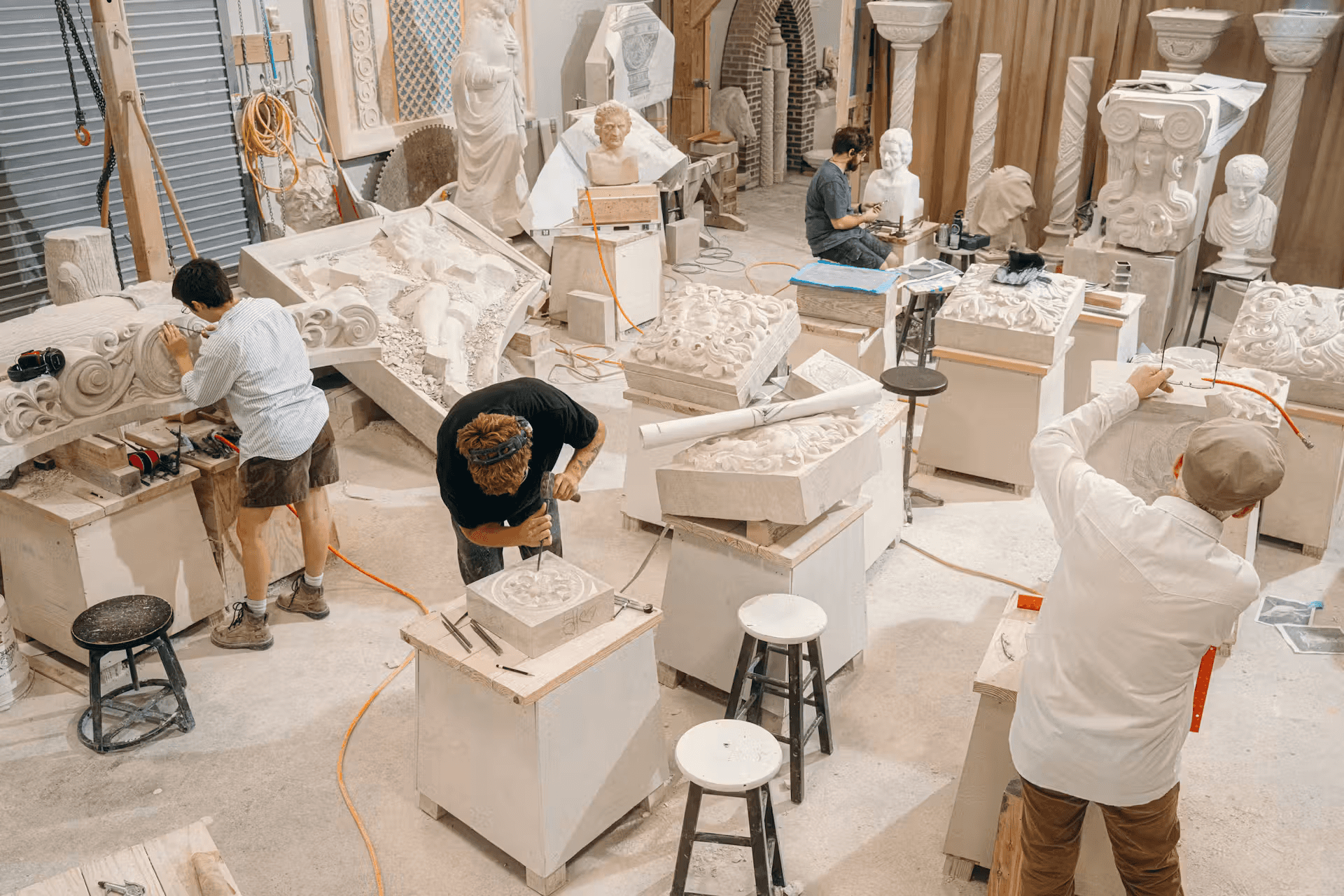
Students at Charleston’s American College of the Building Arts are finding hope for a stable future in mastering crafts like blacksmithing and architectural carpentry.