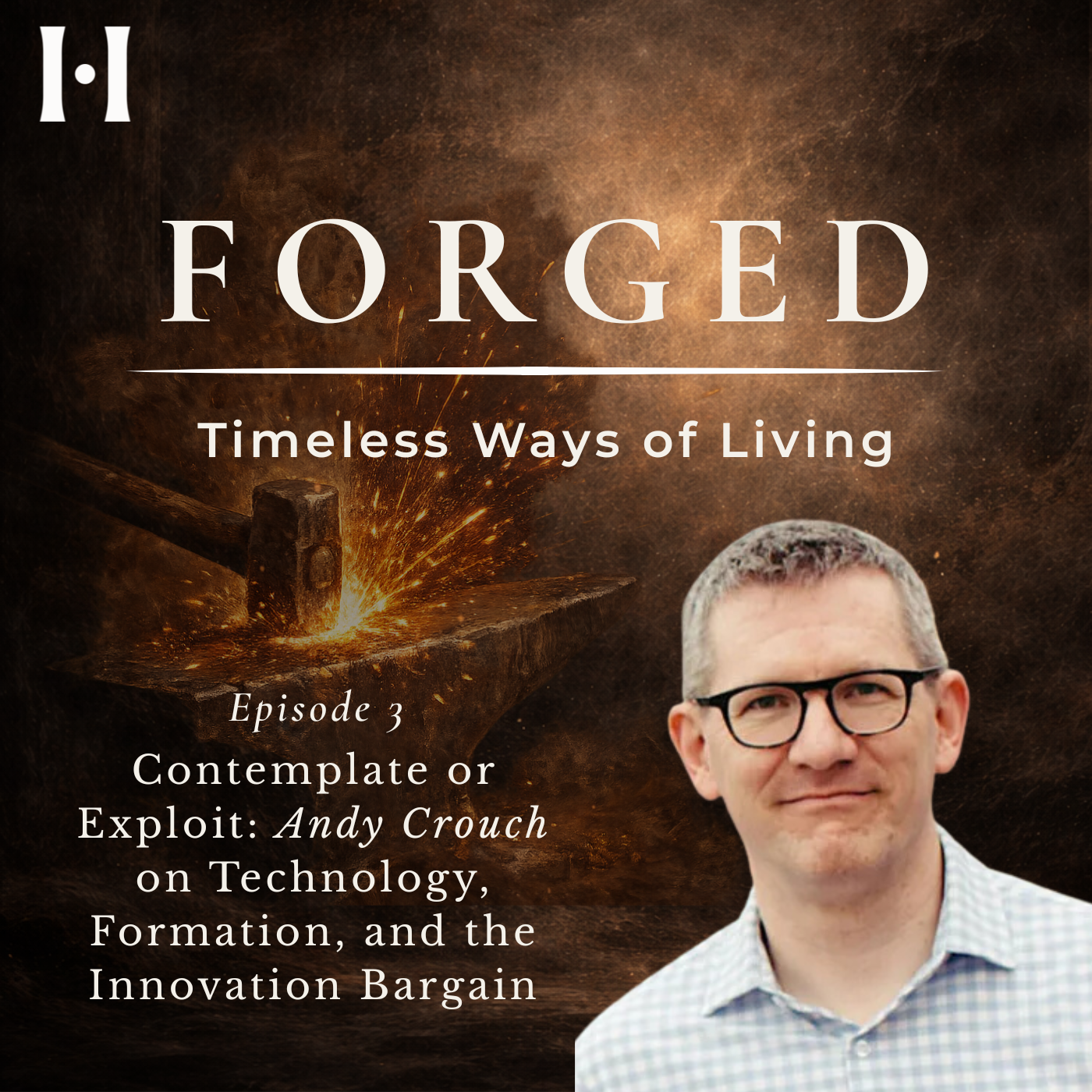

Brian Williams: Hey, folks. This is Brian Williams, host of Forged Timeless Ways of Living, a podcast of the Humanitas Institute about pursuing well lived ordinary lives through discipline, delight, craft, calling. Today, my guest is Andy Crouch. Andy is the author of many books, including The Tech Wise Family, Culture Making, and The Life We're Looking For, Reclaiming Relationship in a Technological World. Andy is the former executive editor of Christianity Today and a partner for Theology and Culture with Praxis, is a venture that advances and supports redemptive entrepreneurship.
Today, I'm interested in talking with Andy about his book, The Life We're Looking For, and basically where and how we can find that humane life in an increasingly inhumane technocracy. So no small thing, but welcome to the show, Andy.
Andy Crouch: Thank you, Brian.
Brian Williams: Hey. Before we jump in to talking about technology and household, I'd love just to hear what your household was like growing up. So where did young Andy Crouch grow up, and what was that like?
Andy Crouch: Right. So I'm the son of Wayne and Joyce. My dad was a university professor in the first part of his career, though never found his calling there and did not get tenure twice. So Good. My family was marked very much by a couple attempts at that career on my dad's part, and you kind of get two chances and then you have to find something new.
And he had to find something new in in midlife, when I was a teenager. Meanwhile, my mother was, trained as a pianist and taught piano, was my first piano teacher. One of my earliest memories would be lying under the grand piano as my mother was practicing scales or Scriabin or whatever. So raised by parents who loved us and struggled in a way to like find a way to be themselves in the world. My dad never found that until he retired.
Brian Williams: Oh, is that right?
Andy Crouch: He passed away a few years ago. It was only in retirement that he kind of found his calling.
Brian Williams: Which was which was what was his field? Was his academic field?
Andy Crouch: Trained in communication, had a PhD in communication.
Brian Williams: Okay.
Andy Crouch: Yeah. His calling was convening people Oh. But without commercial output.
Brian Williams: It's hard to monetize that, right? I'm very good at dinner parties.
Andy Crouch: Exactly, exactly. But in his retirement years, which were also his grandfathering years, was very significant for our family. He collected this group of people who loved to go on adventures in Central Massachusetts where they were living And at that just took people way out into the woods of Central Massachusetts to waterfalls and hiking trails, and he found what he was called to do. It just he never figured out how to make money at it.
Brian Williams: Amazing. So what impact did that have on you growing up seeing dad struggle vocationally? Did it were you aware of it as a as a kid and teenager?
Andy Crouch: Well, you know, when you're that age, I don't know how much comes to the surface that you can articulate.
Brian Williams: Yeah.
Andy Crouch: But I certainly wondered I wonder what it's like to have a successful father. Because we moved from my dad's second job to an affluent suburb of Boston where people generally were doing pretty well. Yeah. My dad was teaching at Babson College, which is right in the suburbs of Boston. And you know most of my friends, not everyone, but their dads were doing well.
And my dad was not vocationally doing well.
Brian Williams: Yeah. Loving
Andy Crouch: dad, more loving than some of my friends' dads but not successful. So I certainly wondered about that. What will it be like for me to like go through my life while I find my calling? The other significant effect this had in my life is that move for his second job introduced me to a community of kids, high school kids, who were following Christ. Oh interesting.
Father was not a believer. My parents were sort of mainline church goers but it wasn't practiced in our home when I was growing up. And I came to faith through that move. So that was the other significant effect was I discovered in Needham, Massachusetts, not the most bible belty part of
Brian Williams: the world. No.
Andy Crouch: No. Discovered these kids mostly and eventually some adults, but initially a bunch of like 13 through 18 year olds who loved Jesus, loved me, wanted me to be part of their world.
Brian Williams: How did you find them? Was this at school? Was this you wandered you got lost, wandered into local church on
Andy Crouch: youth group night or what? My parents dropped me off at the local Methodist church. They were like, this kid is going to need some friends first week of freshman year of high school. There were
Brian Williams: You're serious.
Andy Crouch: Oh yes. I'm serious. And there were good people in that church, but it was a mainline suburban church kind of in the liberal Protestant tradition that was not necessarily set up. It certainly was not set up to make converts or evangelize. That just wasn't the conception of what you did in this church I don't think.
Including in the youth group except about a third of the kids had mostly through the Catholic Charismatic Movement. This is in the nineteen eighties, a long ago. Had come to a living faith and I met some of these kids at that youth group. And then I met all their friends who did not necessarily go to that church. But on Tuesday nights in a basement of some kid's home, every other week, this group of about 20 kids would meet and for an hour share what was going on in our lives and then for an hour uninterrupted pray, with no adult supervision, no idea These are teenagers.
Right?
Brian Williams: We're still talking about teenagers in Massachusetts. In in Yeah. Yeah. In need of Massachusetts.
Andy Crouch: And it was the healthiest, almost healthiest imaginable introduction to Christian community. It was a genuine community of truthfulness, of love, of seeking God, with no adult supervision, which eventually some local pastoral folks found out about us and started leading us in some bible studies and so forth. That was my pathway
Brian Williams: What'd to find there you hadn't found elsewhere?
Andy Crouch: Well, honestly, I mean gosh. I mean, I found a sense that God was living and active even though mysteriously so. This was the era of the charismatic renewal in the Catholic and mainline churches and we were all like going for it. There have been other waves of this. The vineyard movement would have been the next wave in a way.
It was all with great perplexity and I faked speaking in tongues for like a year and a
Brian Williams: half because That's what the because that was the thing.
Andy Crouch: That's what you tried to do. Okay. Strangely later got the gift of speaking in tongues completely separately in a totally different way. But in high school, was just trying to make it happen. And yet, like, underneath the mysterious and is this real?
There was something real. So that would be one thing. And the other was friends. I I just had the great gift all of a sudden of having a group of kids my age who wanted to be my friend. I was not a socially adept kid.
I was kind of geeky. I'm sure that's very surprising to you, Brian. But up to that moment, just didn't really know how to make and keep deep in friendships, and suddenly, through four years in high school, really got to do that.
Brian Williams: Wow. So you this was freshman year of high school. That's a difficult transition no matter who you are and where you are. But was a
Andy Crouch: new In place for you case and just for me, for my sister and my parents, this move was very hard, very unfruitful. My parents eventually moved away. My sister would have a very different story to tell about her high school experience. But for me, it was this way into faith. And my sister later came to faith.
My mother came back to So her there's a whole
Brian Williams: family story. So hey, tell me just a little bit more about that. What was it like for mom and dad to watch 14, 15 year old Andy Yeah. Become, you know, a member of this community, I mean, of Right. You know, charismatic community, not just entering into a mainline church, but to kind of what was it like for mom and dad?
Was that
Andy Crouch: natural or terrible,
Brian Williams: I would say. Okay.
Andy Crouch: In two respects. One is I was unbelievably judgmental and harsh in certain ways in how I related to their own practice of faith. My dad never would have claimed to really believe in God but he did I go to mean this was a family that did go to church but in a very different mode than I was feeling was real you might say, authentic. So I was so judgmental and so immature and then I would also say you know having now parented teenagers and having them having had that whole story happen and they're now out in their twenties and on their own. In a way I couldn't even have begun to understand back then.
I found this living group of people to be part of and it took me completely away from my family and suddenly I was mostly absent. I did my own thing through high school. This was also generation x. This was the there wasn't a lot of like centripetal forces in families back then. Like kids kinda did their own thing.
But I think for my parents to both watch me become this very judgmental, slightly fair sake, elder literal elder brother.
Brian Williams: Yeah.
Andy Crouch: And to just have me disappear in significant ways from the home all of a sudden because I had places to be. I had friends to be with, and I was excited about all that. And they never I think that was sort of how parenting worked during that time.
Brian Williams: We call it parenting like the seventies. I mean, I grew up in the same era.
Andy Crouch: I grew
Brian Williams: up in the seventies and eighties, whenever we let our kids do things now that our friends might not let their kids go, no. We're just parenting like the seventies.
Andy Crouch: You know? No, would sit here
Brian Williams: for hours on my bike and come back for dinner. They would have no idea where I was. Yep.
Andy Crouch: So some of that is very healthy, and there were lots of healthy things about our family. But when I look back on it, I think, gosh, what a there was a real loss in that season for them of this kid who had been very much part of the household who now is off doing his high school thing.
Brian Williams: I don't know if you've had this moment, this experience, I have a couple times where I've thought, okay, how old was I when my dad was my Oh age gosh. And I think, oh, well, that's who my dad was, because my dad has always seemed like he's 80, right? But he wasn't, because there was a time when I was 15, and he was my age. That's so I much, thought, oh, this is what my dad was going through when I was doing my teenage thing.
Andy Crouch: Of course. And we never can conceive of the vulnerabilities of our parents. Until much later. I think I saw some of it because unemployment and losing your job, like you can't hide that and I knew that was going on. But even then I did not empathize.
Mhmm. You know, and of course now I empathize so much more with
Brian Williams: all
Andy Crouch: the ways my parents kind of held it together and found ways to be fruitful and faithful to each other and to us, it was pretty amazing.
Brian Williams: So what did you carry into your adult life from mom and dad? What you learn as a So kid from my dad was a professor and a music professor.
Andy Crouch: Oh, wow.
Brian Williams: So I grew up with a Steinway grand piano in the front room, sitting under the piano, dinking with the strings and that kind of stuff, and a very musical of rich home. So that was one thing that I took away, a love of beauty and music. Wow, amazing. From mom and dad. But what about you, what'd you learn or were there practices growing up that you think, oh, that was life giving, I'm glad for that.
Andy Crouch: Right. Yes, I mean two very clear things, one for each in a way. From my mother, I definitely learned the pursuit of excellence in music. When you live with a musician, you hear them practicing.
Brian Williams: That's It's
Andy Crouch: one thing to hear people playing. And I'm not the best practicer. I trained on classical piano. I'm decent. I'm not as good as I could be.
And the reason I'm not as good as I could be is I'm not as disciplined even as my mother was in that the rudiments, the daily like the scales, the arpeggios, the the very small a twos that you do over and over again that allow you to perform. I got to hear that every day. My mom did that every day. She taught it every day.
Brian Williams: Is that right? Okay.
Andy Crouch: So wish I had could say I completely lived that, but but it it was a real contribution to my life.
Brian Williams: But you did become a piano player. Mean, Yeah. So you know, my dad had three sons. None of us are musicians. We all did piano and I played sax and guitar but never well.
You know, part of it was that discipline thing. But you did pursue.
Andy Crouch: I I had an aptitude for it. I loved it.
Brian Williams: That's great.
Andy Crouch: I loved it enough to practice enough to make progress. I did not love it enough to practice enough to become a professional classical musician. But yeah, that was an incredible And the other thing I should say about my mom is she taught the Suzuki method which you may be familiar with. It was an innovation of a Japanese man, Shinichi Suzuki, who who took what at the time he would have been flourishing in the nineteen forties and fifties maybe or fifties and sixties. Took this very regimented rote way of teaching music.
And said, no. Music is another language. And children are primed in their very early years like three to eight to learn their mother tongue. And so why could you not make music the mother tongue for children? So he had this ear training method that that involved the presence of the parent.
Very interesting. Very relational. Very much about hearing in the in the loving presence of a parent the music you're supposed to make and imitating rather than reading it off the page.
Brian Williams: Right. Right.
Andy Crouch: And so I learned this way with with my mom that starts with the ear and therefore you absorb it as because language is learned by listening, not by reading. Reading comes later. And gosh, what a gift that was. Later in life, especially when I apprenticed, I ended up going to apprentice in the black church, in the black gospel tradition, which is a completely ear based tradition.
Brian Williams: Oh that's right.
Andy Crouch: There's no real music really to speak of. And gosh, if I had not had that formation
Brian Williams: That was that right.
Andy Crouch: Classical training starting with the ear that I could hear things, I would have been completely lost.
Brian Williams: Well, mean, it's just interesting because in education, I mean, there's massive educational implications for this. Right? To think how do I introduce someone to a body of knowledge or a skill or a discipline? And one of the educators I like has a wonderful essay called Educating by the Muses, and he says we should never introduce the young to reality except under the conditions of delight.
Andy Crouch: Oh, wow.
Brian Williams: I just thought that seems right, right? I can put Homer in front of a student or Shakespeare. This is the worst. You could put a Shakespeare play in front of a student and say, read it. Yes.
Or you can take him to a play. You introduce them to it under the conditions of delight. It sounds like that's what your mom used music and the Suzuki method. Church is the same. I can teach you doctrine, you can participate in an Eastern Orthodox or a Roman Catholic service or whatever it happens to be.
Andy Crouch: Then from my dad, I would say delight in the physical world. My dad, he loved people. He loved gathering people. The other thing he loved to do at a tinkerer level was just work with stuff.
Brian Williams: And he
Andy Crouch: yeah. He was a physical kind of
Brian Williams: Like what? Did he have a workshop? Did he have like a Workshop.
Andy Crouch: Wood. Lots of chopping wood. Not fine art. Just making stuff work well enough. He grew up on a farm with not a lot of resources.
And, yeah, so I you know, he'd be out doing stuff all the time. And it's amazing how much of my I mean, I spend a lot of my time in front of a screen and working with ideas and reading and doing geeky things like that. But the older I get, the more time I spend like chopping wood and doing things around the house and fixing stuff.
Brian Williams: What's that do for you? Why is that important do you think?
Andy Crouch: Well for one thing you know when you succeeded, which is never true in writing or more idea based stuff that I do.
Brian Williams: The water no longer leaks out of the pipe or, right?
Andy Crouch: Listen, I replaced a filter in our filter assembly. It's like a repair job. We would have paid $700 to have a technician come in. I did it the other day in our refrigerator. And at the end, you're like, it is done.
That's It's done. There are no leaks.
Brian Williams: It's
Andy Crouch: tight. Everything's flowing the way it's meant to. I mean, that's a very low level of artisanship. But, just being able to finish it. And honestly, it I I feel the pride of my dad when I do that.
I'm like, dad would be proud that I did not call the service tech, but I figured out what was needed and did the work and, you know, solved the problems I encountered along the way.
Brian Williams: Oh, that's amazing. Yeah. That's very cool. You know, and and living in the material world as material creatures, and there's there's this kind of connection. I don't care what it is.
Like, if you're just coming up against stuff. Mean, for some of us, you know, some guys, they live in the world of stuff. Like you and me, I kind of live in the world of ideas. Sure. So to be able to interact with kind of the really real material worlds is, you know, is
Andy Crouch: You may have heard it said that people who work with their hands need to rest with their minds, but people who work with their minds need to rest with their hands.
Brian Williams: Yeah, one of the best things happened for me in grad school, we lived with a family, we're kind of au pairs for them for several years, but she was a master gardener, the wife was. Oh, wow, yeah. So I could leave class and then go shovel manure and pull weeds, and it was such a gift for my mind to rest and just let my body do something that I still, I miss those days of shoveling manure around Julie Lane Gay's garden in in
Andy Crouch: Vancouver because
Brian Williams: that was a yeah.
Andy Crouch: I've been to that garden. Oh, have you? Yeah. Well and you know, it actually strikes me.
Brian Williams: You're welcome. I did a good job with it.
Andy Crouch: Sorry, Julie. You're you're part of this.
Brian Williams: Very little. I was grunt work.
Andy Crouch: Well, I was thinking about the the smell of the menorah. Right? Yeah. And I was thinking, it used to be that intellectual work had a smell. The smell of books is a real thing, the smell of
Brian Williams: a library.
Andy Crouch: But so much of our work now has shifted to these completely, sanitized, like inert things called screens. And we've actually lost even some of the sensorium of intellectual life, the flipping of the pages
Brian Williams: Well, that's why when you read something on a screen versus a book, you retain it much more when you read
Andy Crouch: it from
Brian Williams: a book than a screen, and it's that full sensory experience of the tactile holding the book, the smell, the turning of pages all contributes to that. So, hey, let me stick with that household idea, the household you grew up in and the rich household there. Because I know you're concerned, obviously, in so much of your writing about technology, about screens and social media and the kinds of things we've just referenced there and what that does to a household Yep. And how that negatively impacts a household. But let me start by asking you a huge question.
What's it mean to be human? Oh, And here's why I asked that, here's why I asked that. So because before we're able to critique how a technology negatively or positively impacts a household of humans, we can have some understanding of what it means to be human or to flourish as humans. Yeah. So I I know you reflect on this in some of your books, but Sure.
How do explain, like, what what's it mean to be human?
Andy Crouch: I do have a take on it, and I get at it by asking because I do anchor my own life and thought as much as I can in the life of Jesus, the life and teaching of Jesus. I I I had I have thought about the question. If you ask Jesus Mhmm. What is it to be human? Or to intensify it, and you use this word, what is human flourishing?
That is what what is human at its best? Because I think we can do some minimal specifications. Sure. It's a certain genetic inheritance. It's a certain but where we go meaning implies where are we going?
Where are we meant to go? And when we ask that question in terms of flourishing, we are, consciously in your case, unconsciously in others, drawing on the Greek tradition going back to Aristotle who asked the same question. And there's this amazing tradition coming out of and through Aristotle of answering it. But Jesus might have known of Aristotle, it's certainly, Aristotle was not the way Jesus thought. Jesus thought in terms of the Hebrew bible.
Brian Williams: Right.
Andy Crouch: So I wonder if you had gone to Jesus, who probably didn't even speak Greek. He probably spoke Aramaic and read the Hebrew of the Hebrew Bible, and you somehow got Mark or a friend of yours to translate, and you said okay Jesus, I really need to know what is eudaimonia? Yeah yeah right. Mark's like we don't have a word for that. Well tell him like what is it to be a human being fully alive?
Brian Williams: I
Andy Crouch: think, I really think I know what he would have said. He would he would have said, oh, well, he would have said, oh, oh, oh, you're asking the question all the rabbis ask. What is the greatest commandment? So the way into this question of what is it to be human for the Jewish tradition is we've been given this law. This law discloses to us what it means to be particularly the people of God in the world.
And then if you wanna find out what flourishing is, you ask, well, of the 600 odd, you know, commandments in the law, what's the greatest commandment? Love the Lord your God with all your heart, with all your soul, and with all your strength. Jesus, interestingly, when posed this question, the only time I think in all of the gospels that Jesus gives the expected answer to a question is when he's confronted with the question, what's the greatest commandment? All the rabbis would say it's the Shema Yisrael. Right?
Though he then quickly adds love your neighbor, as yourself. So he modifies it. He also modifies strangely the number of terms in the Shema. So the Hebrew text has three which we usually translate heart, soul, and strength. They're kind of mutable terms that don't map exactly on English.
Jesus for some reason in two of the gospels, the way it's framed is heart, soul, mind, and strength. So I sum up what is to be human as you are, we are a heart, soul, mind, strength complex designed for love. What what it is to be us is to have this mysterious, beautiful combination interconnected, though distinguishable of heart where we could talk about kinda how to cash out each of these words. But heart, soul, mind, and strength, all oriented toward love of our maker and love of neighbor. You are emotion, reason, physical physicality in your body and soul, whatever that is, like depth of self, the ability to connect to the depth that is in others and the depth that is God.
And your life is meant to channel all of those qualities or faculties in the direction of love. And this gets to what is family for? It's and what is the household for? Mhmm. It is one of the principal schools of being a heart soul mind strength complex designed for love, which is actually the context of the Shema.
It goes on right after that, you know, starts the Lord is the Lord is, one, alone. You shall love him with your heart soul and strength. And then it says as as you're getting up in the morning, as you're walking with your children, as you go in and go out of your home, bind these commandments on your forehead, fix them, you know, as an emblem on your house, your home is going to be a school of becoming, what you are. And so I see really there being three perennially formative institutions for human beings. The home is primary really.
The church, let's say in our Christian context, but religious community. The place where we're inducted into a community larger than just our own family that is oriented toward the God who made us. And then in most cultures and certainly in advanced cultures where things get really complicated and institutionalized, school. So the educational process, which is often done partly in the home but partly outside. And home, church, and school are the three kind of unmissable places.
If you want to fully become who you are, you're going to need all three. And it's in those places this is getting back to your setup for this that I'm pretty much uniquely concerned about what we call technology and just letting it in. Because I actually think technology has lots of uses. But the one thing I don't think it's designed for, I don't think it's ever no one has ever sat down to design a piece of technology and said, will this help someone grow in love through heart, soul, mind, and strength? I just guarantee you it's not in the design spec for your tablet, your your this microphone.
Yeah. Like, it's just not what we're aiming at. So these things are not designed for this prime directive of humanity.
Brian Williams: Right.
Andy Crouch: And in fact, I think, for reasons we could talk about, they are profoundly undermining of the formative processes that actually allow us to grow into what we're meant to be.
Brian Williams: Okay. Let Sorry.
Andy Crouch: That was a long answer.
Brian Williams: No. That's good. It's great. It's great. I knew you had given this a little bit of thought.
So let back up and take another run at this and cover some of the same ground just slightly slower. So heart, soul, mind, and strength. When I ask what it means to be human, you respond with Jesus' answer, to love your God with heart, soul, mind, and strength. Just unpack those four really briefly for us again. Yeah.
Well Or is it like in the Hebrew mind, they're not they're not Aristotelian. They're not medieval scholastics. Right? And and so there's much more fluidity fluidity between these four terms. Exactly.
They loved poetic repetition using the same word, using different words to say the same thing over and over.
Andy Crouch: That's right. So we shouldn't over distinguish in a kind of analytical or kind of maybe more Greek way. Though that's the gift of the Greeks is the kind of attention to find distinctions and we can I think apply that to some extent? The heart in Hebrew is always about the seed of the will, the kind of which is driven by emotion. So emotion and will, we think of the heart as more an emotional center and they include that for sure.
That is part of what the heart is. But it's the way your emotions shape what you go after and what you avoid.
Brian Williams: In an Augustinian sense, my desires. My desires, I pursue what I desire, what I love. So
Andy Crouch: I think it's really important to note this term all. So because it helps illuminate. Like, there's a way to live a half hearted life Sure. Which is a life of restricted and attenuated emotion and therefore restricted and attenuated choosing and pursuit of things. And those two are connected.
Like it's it's to the extent that you have the capacity to feel the fullness of what it is to be a person in the world. And then out of that to choose ideally the good because the right order in the heart should lead to choosing the good. That would be to live with kind of full heartedness and one way I illustrate this is I actually think it's a fair question. I'm not sure the right time horizon but let's say in the last four weeks, so the last month of your life, have you wept at something worth weeping about in your own life or someone else's? And have you, at some point in the last four weeks, laughed uproariously at something that's just hilariously wonderful that you're just like, you can't help but laugh.
If you have wept and laughed in the last month, you are living something close to a wholehearted life.
Brian Williams: Uh-huh.
Andy Crouch: But if your emotions have been constrained And the thing about a lot of media is it actually shrinks your emotional range. And you watch stuff. Now sometimes you will at a great drama. You'll weep and that's the appropriate response. It's meant to elicit that.
But there's a lot of stuff we watch on our screens. We're like, I liked that. Yeah. Or, I didn't like that so much. Know, thumbs up, thumbs down becomes like the whole emotional range of human beings.
Brian Williams: Yep. George Grant called entertainment the not disagreeable occupation of my attention. Wow. Which I think is fantastic. Yes.
Just the not disagreeable occupation of my attention. That's what a lot of entertainment, a lot of what you see on the screen is just like, I'm not offended. I'm not bothered. It's like what you watch on an airplane.
Andy Crouch: Yes. It an airplane movie
Brian Williams: where you're like, I'm just looking to something to occupy the time kind of thing. Yeah.
Andy Crouch: Yes. So this starts to illuminate I think. Technology is not neutral in the question of am I the kind of person who lives with allness of heart? And what would it be? I mean, how do I become that kind of person?
Because I'm not that person, certainly not every day. How do I move toward that?
Brian Williams: So what you're saying here, mean, if we just stick with the heart for a second, we could go through all four of these maybe and ask, okay, how does technology nurture this aspect of what it means to be human? But you're suggesting technology and certainly entertainment, maybe social media, actually constricts my emotional range in a way. So it's not like it's an inert tool that I can use. I mean, it does kind of dictate who I become.
Andy Crouch: Yeah. Say this
Brian Williams: it shapes me. Or how would you explain that?
Andy Crouch: I'd say there's two things to say. I mean, one is I don't I I really believe most of our technology can be an instrument of human flourishing. Okay. And can expand our repertoire, the allness that we have to bring to the world. Emotionally, spiritually, intellectually, yeah, physically.
You know, so just to pick a completely different one, like the bicycle is definitely modern technology in some sense.
Brian Williams: Right.
Andy Crouch: And has my bicycle, because that's one of my main forms of exercise, helped me develop actually, honestly, when I'm on my bike in a beautiful day here in Southeastern Pennsylvania
Brian Williams: What kind of bike is it? What do you ride?
Andy Crouch: I ride a Surly Crosscheck. It's like a road ish bike Yep. But a little more rugged so I can go on travel
Brian Williams: a little nice. I have a Trekamondo, which is a
Andy Crouch: Yeah, not actually so different. Okay. I actually think I am growing in all four to some extent, but most clearly in strength. My strength and flexibility are being enhanced on my 20 mile rides. Right?
So, I I think, you know, you this is a diagnostic question, not a diagnostic question, not a diagnostic statement. Is your consumption of technologically mediated, entertainment increasing or decreasing your emotional range? As you binge on Netflix, do you become more all hearted? It like, do an assessment of yourself. And if the answer is yes, then great.
And I think there are things that can come through our screens that can absolutely be part of that, of that expression of of heart and form our hearts. But this is the other thing. I think there are some media and then there are definitely some not all content is formative of allness. There's just a lot of stuff that the more time we spend with it, the more narrow our range becomes. And this is also true for mind, is your cognitive and reasoning capacity.
For soul, which is your ability to actually know the depth that is inside you and the way that connects to the depth that is God. That's the best way I've come up with defining soul in the Hebrew sense, not the Greek psyche sense. And then of course, I mean the big question for technology, the most obvious one because this is the first thing we replaced when we figured out the laws of physics and got going on the modern technological project. The first thing we said was, oh, stop having to work so hard. So our bodies now are not used in the world the way that they used to have to be and that there are some good things about that.
But the shadow side of that is that our bodies are so attenuated Mhmm. In strength and flexibility compared to what they're meant to be. And that is directly because of technology. But I think what we've done in the history of technology is first we we've, took over strength with machines. And so now human beings do not have to develop strength.
It turns out that's terrible for the lifespan of a human being to not develop the strength that you're meant to have. Then we had computers that take over mind.
Brian Williams: Yep.
Andy Crouch: And now they think for us and we've offloaded so much of our cognition to them. Not all bad. In some settings, very productive, but in informative settings, very damaging.
Brian Williams: That's right.
Andy Crouch: Then social media took over heart. So where is my
Brian Williams: Oh, that's interesting. Where is
Andy Crouch: the attention of my emotion? It is no longer when I going back to that high school experience, I mean, it is partly adolescence, like to be so emotionally invested in your friends. Yeah. Like the boys and the girls that I was friends with to this day like I have more emotional resonance when I think about their names and faces even though I'm not in touch with most of them at this stage of my life than almost anyone else I've been with in my life except my own family, right? But now adolescence is mostly mediated through extremely charismatic individuals who can present themselves on a screen in a very emotionally engaging way.
By the way, as media has progressed, it goes from what we call like wide shots in film where you see like a whole landscape and a human being in the midst of it to two shots which show two people interacting which is a lot of there's quite a bit of that in film. Television starts to do the one shot which is just the face. Mhmm. And then the vertical medium of the phone is like optimized to actually zoom in until the face fills the frame. The face is the conveyor of emotion.
We're recording this on video and it's actually a very frustrating experience for someone who's habituated to TikTok will find this video very frustrating because we're too far away. This is two
Brian Williams: shots that we're doing in this video.
Andy Crouch: And it doesn't give enough emotional information.
Brian Williams: Interesting.
Andy Crouch: So what you have on TikTok now are faces that are both naturally and they both have natural gifts, you could say, and then they've trained their gifts to be incredibly emotionally resonant in the frame of your phone, which you hold like closer than you're going to see And a normal
Brian Williams: by yourself without other people by yourself.
Andy Crouch: So And it's activating and channeling your emotion and forming your emotion, but in very attenuated ways compared to what it's like all the difficulty and drama of a real
Brian Williams: human Okay. So how does that hamper our ability to read the emotions of another human being? Because we've all noted, and anybody who has teenagers, when you and I were kids and you wanted to hang out with your friends, if I wanted to go see Chris Lewis or John Bemo, I had to be physically present with it. Had to get my car and drive to them. Now you don't have to do that.
Can sit in your room on your phone and text each other whatever. But you're taking this a step further and saying, actually, like what I'm doing on TikTok, it's just me and this person's face, and that's where I'm learning how to kind of read another person emotionally. So how do you think that attenuates our ability to be able to do that in person?
Andy Crouch: I think there's a couple things. As a side note, I want to always say the kids are not happy with this arrangement. They would rather be with their friends. It's that they find themselves in a world constructed by adults where it's very hard to get to your friends because you can no longer get on your bike and just go.
Brian Williams: That's right.
Andy Crouch: So when you ask kids and this we have multiple studies that have shown this, they want the embodied engaged world. But they settle for because they don't see a way to get that the way their parents have set up and their society has set up for.
Brian Williams: Oh, interesting.
Andy Crouch: But nonetheless, here we are in our bedrooms on our phones. First of all, mostly these days, you are no longer on social media. You're on parasocial media. You're no longer, interacting with videos of your friends or video representations of your friends or pictures or posts. You are interacting with people you've never met and will never meet who are TikTok celebrities or who have kind of, found the way through the algorithm to be presented to you.
Brian Williams: Okay, I didn't know that term. Parasocial Parasocial media. Right. So it's on Facebook where I'm interacting with people. I know where I saw some connection.
Andy Crouch: Some connection to. Now that's not what's happening. That's also not happening on Facebook anymore. Facebook changed the algorithm. It used to be they presented you things that your friends, posted in chronological form for a while.
When that got to be too much and they looked at where user engagement was going, now Facebook will will filter in lots of things that are not related. If you just let the algorithm do a thing
Brian Williams: Oh, it'll show me reels of TikToks or whatever, know
Andy Crouch: None of friends.
Brian Williams: Or ads or something. None of which come from my friends.
Andy Crouch: Posted them, right. Second, those things because they have succeeded on the algorithm's terms are actually overly emotionally engaging compared to Yeah.
Brian Williams: That's what I
Andy Crouch: your real friends.
Brian Williams: Right.
Andy Crouch: They are better at seeming interesting than anyone you've ever met. Now in real life, they may or may not be. But when they have the camera on and they've practiced, right? They've practiced how to be really, really emotionally salient. The problem is strangely, I think, that does not help us become ourselves more emotionally resonant with each other.
It This To use a musical analogy, I can listen to amazing music all day long. It doesn't make me a musician. Now what is amazing music? It's both tech There's some technical abilities you have to develop, but then it is emotion. Music is among other things, the channeling in amazing ways of emotion through sound.
To become a great musician, I have to spend so much time on rudiments that are much more difficult than just listening to something. And just listening to it, it can give me something to shoot for. It can give me a sense of, gosh, if I really work at this for twenty years, I might be able to do something like that. But it does not the the consuming of it first of all, def doesn't make me a musician. Like, watching the World Cup does not make me a
Brian Williams: soccer player. Only. I'd be an amazing soccer player if that were
Andy Crouch: the case. But but furthermore, the fact that at any moment, instead of sitting down and practicing the piano, I can just turn on piano music or whatever music I want is a massive disincentive to go do that very difficult thing called practicing the piano, and I can just have music in my home. Well, same thing with emotional maturity.
Brian Williams: Oh, fascinating.
Andy Crouch: Or emotional engagement. I can have any moment I want an incredibly emotionally engaging thing that is one way
Brian Williams: With whatever my mood is.
Andy Crouch: Oh, sure.
Brian Williams: Right? If I want something funny, if I want something silly, if I want something poignant, maybe I can find it.
Andy Crouch: So and it's it's unidirectional. I don't have to become anything. I don't have to give anything back.
Brian Williams: No. I can turn the person off when I'm
Andy Crouch: done. It's there's all this optionality. Right. So there's so many reasons I would prefer that. Right?
Or I can go have a very awkward encounter with another person, even my friends, we're learning how to love each other. We're learning how to read a much richer array of signals, than we get through the very narrow channels of social of of media. The other thing I'll say is the kids absolutely, because they're young and neuroplastic, they are adapting their communication to make it work, to have video conversations that are real. I'm not saying those aren't Right. If it's with your friends, it's a real social But the the strategies that sort of engage and keep the attention, We all know this from how if we if we are all self aware and we've been on Zoom ever since the pandemic, that there's ways you have to like comport yourself and engage with the camera and that are not actually don't lead to the healthiest range of possibilities.
You're very constrained. Kids have learned how to do how to make this work because it's the world they're living in. It's not the world they want and it's not the world that develops I think the allness that we're meant to have. I mean aside from the fact that as you sit there having maybe a very heart engaging experience, you are you're inert physically rather than being out on your bike or walking or even playing a game in person. Mhmm.
You're just lying on your bed. That's very bad for you not just physically but psychologically. That's also restricting your your
Brian Williams: heart in
Andy Crouch: a way. And so anytime you are tethered to a screen, you are narrowing your gaze, you're narrowing your body's kind of presence in the world in ways that actually are ramifying into all four of these dimensions.
Brian Williams: Yeah. So I love one piece. I love several things in your book, but you have this kind of progression that I found really illuminating where it's when a new technology is introduced. Correct me if I'm wrong here. First it says, look what you can do, and now you can, and then that moves to, now you'll no longer have to, but then that moves very ominously to now you'll no longer be able to to finally now you have to do this new thing.
Just walk us through those four because I think that's really fascinating. Yep. That sense, especially that third one, now you'll no longer be able to. So just take us through those four Yes. Real I think if we keep in mind these four dimensions of what it means to be human, heart, soul, mind, and strength Yeah.
This this kind of progression applies to all four of those, which is what you've just been describing. But describe those kind of four stages for
Andy Crouch: us. So I call this the innovation bargain. It's a bit of a remix. Others have observed similar things. Marshall McLuhan had a similar kind of tetrad, he called it.
But I I basically would put it this way. Technology is sold on empowerment and liberation. So these are the two now you now these good things are going to happen. So the first is now you'll be able to do something you were not able to do before. Technology absolutely opens up the scope of certain things we were not able to do either because literally like now you can refrigerate, which we couldn't do before.
Yeah. Or but also now you can travel very fast where
Brian Williams: That's right.
Andy Crouch: You know. So that's empowerment. Like opens up new abilities. And we're like, oh oh, I want that. Mhmm.
But then equally powerful and interestingly, by the way, when Francis Bacon, who's a very very important figure in kind of the history of how we've conceptualized technology, when he's thinking about this thing at the dawn of the enlightenment, the dawn of the scientific revolution, he says, if we could get nature to reveal her secrets, we would be able to and he says to engage in the relief of man's estate. The relief of the human estate. And what he's thinking of is all the burdens of being human. The burden of disease, the burden of work. And he's like, oh my goodness.
If nature would just tell us our secrets, we would we could be relieved. This is not empowerment. He's not saying think of all the things we'd be able to do. He's actually think saying think of all the things we would no longer have to do or suffer under. Many of which legitimately are suffering and we're grateful that some of them have been relieved.
Brian Williams: And this is kind of the vision of the common arts going way back. Mean, Hugh St. Victor talks about this, he says that the liberal and the common arts were developed to help us overcome three ills in human life. Ignorance, and so we have knowledge and we learn how to learn. Vice, and so we learn the virtues.
And then what he calls our vulnerabilities. He has this developed theology of the common arts, or what he calls the mechanical arts, meeting the real needs of real human beings who live as vulnerable creatures in a somewhat hostile world. So that's the long vision of the mechanical And common
Andy Crouch: I would say the mechanical and common arts, which is a term I have never heard before so thank you for illuminating something I missed in my education. They actually largely just do these first two things. That is they do make some things possible. Once you have a hammer, you can fasten things in a way that, is pretty hard without it. And they do really relieve us of certain real burdens.
Brian Williams: Well, a home, you know, furniture, clothes, food preparation, these kinds of things.
Andy Crouch: The distinctive thing about modern technology, and it's because of the way that we offload capacities onto technology in a way that we don't do to tools
Brian Williams: Right.
Andy Crouch: Is this this the next two. Yep. So you so we've mentioned the first two. Now you can and you'll no longer have to. But, if I get really good with a hammer, there is nothing that I'm no longer able to do because I can use a hammer.
I've just I've just expanded the things I can do. I can now use a hammer. However, if I, skip the hammer and just buy a nail gun, which is a very appealing idea. I mean, as a not fully red blooded American nail, but I mean, I'm interested in what tools are in my garage. Right?
And gosh, to have a nail gun in your eyes, that would be a level. I don't know if I'm ready. Right? What does a nail gun do?
Brian Williams: And a belt to hang it on as you saunter it around. Yeah. Oh, yeah. Totally. The beams.
Yeah.
Andy Crouch: Okay. So now you're able to hammer way faster.
Brian Williams: Right.
Andy Crouch: And you no longer have to exercise very much strength and skill in directing the force of the hammer with your own musculature, right? Now you just like put it where the nail needs be.
Brian Williams: There's very little hand eye coordination involved, right?
Andy Crouch: Exactly. And if especially if you never acquire the hammer and you skip to the nail gun. Right. So, you know, master carpenters obviously use both, but they started with a hammer. If you, an ordinary American consumer, go into Home Depot, you're like, I've got a lot of things to get nailed.
I am not very good with a hammer. Can you give me something that'll just get get it done? I'll sell you a nail gun. And you will actually, no longer be able to, use the same level of strength and skill that you would if you'd kept using a hammer. So the innovation bargain is turns on, okay.
We pro we're promised empowerment and liberation, but wait. Wait. Now we're, like, diminishing in our capabilities. The famous example of this is the Phaedrus dialogue of Plato, where as part of that Plato dialogue, Socrates tells a story of this king who invents writing. And he's like, we no longer have to memorize everything.
We can write it down. And the Egyptian god who's hearing this of this wonderful invention says, well, true, but you'll no longer be able to remember. So, yes, now you no longer have to, but now you're no longer able to. So this is never in the sales sheet. This is never in the ad for the device.
And not all, in fact, I would say tools, which I use to refer to pre technological human inventions. Okay. They don't generally do this. Now writing I would say is the first technology. I actually say writing and money are the primal technologies that empower and liberate us, but also actually, they're the first things that come into the human story that actually have these, knock on consequences that were not fully disclosed.
Right. And writing is clearly an example of something that does do this. But most tools, even a pencil, the fact that you can use a pencil doesn't mean you can't do other things. But a typewriter or a digital device, you start to lose capability.
Brian Williams: I was going say word processor, but that shows my age. A computer or something like that. Yeah.
Andy Crouch: Then there's innovation bargain number four is not just you're no longer able to do stuff, but now it becomes compulsory, coercive. You can't survive. This is how kids are feeling about social media. Tristan Harris, back when Snapchat snaps were a thing where you had or streaks, sorry, where you had to keep up a streak every day. You had to send a snap snap to your friend.
It would track how many days in a row because that real friends would send a snap every single day. And he would be with a group of high schoolers, and he'd say, how many of you, you know, keep up streaks with your friends? Almost every hand in the room goes up. Mhmm. Then he would say, okay.
Close your eyes. How many of you wish you could stop? Every hand goes up.
Brian Williams: Oh, that's amazing.
Andy Crouch: No one wants But to
Brian Williams: they felt like they had to. And so that's that final piece.
Andy Crouch: Now you have to.
Brian Williams: You have to.
Andy Crouch: Only technology, I would say, has this steep trade off, where yes, it does deliver certain kinds of empowerment and liberation. But it's almost definitional for technology that unlike traditional tools and the common arts, it actually robs us and coerces us. Robs us of things we once could do. It was it was once the case that most American families, middle class American families would in the evening sing together. Like Yeah.
You'd gather around the piano, someone would play, not necessarily that well, and you'd make music together. Most families now would be like, no way. Like, we can't possibly do that. We would feel so awkward. We can't sing.
We've never done it. You no longer can do it. And now to hear music, you have to subscribe to a streaming service. Like, there's all these coercions that come in. So this is the bargain.
Brian Williams: But now you can. Now you can listen to whatever you want to listen to wherever, but now you'll no longer be able to make music on your own. There's one more fascinating
Andy Crouch: thing about this, which is if you don't kind of buy all the stuff or you don't buy all the promises and you're like, no, no. I'm going to become formed. I am going to go practice the piano even though I could just press play. You will reach a stage in your life where you can press play and it doesn't diminish you. In other words So I watched this with my own son.
My son took music more seriously than I did. He got all the way to conservatory level professional training on the viola, which is his instrument, and he would listen to the works of the classical heritage, western classical music, And it was not consumeristic. He had done so much work as an individual instrumentalist, as a member of ensembles that when he, you know, at 15 years old in his bedroom, was listening to Mahler, you know, on his headphones. It's not background music. He's like deeply engaged.
He's not losing any He's developing capacity because he's crossed this threshold where he's the kind of person who can actually engage in this mediated way with music and have it enrich his life rather than become just sort of
Brian Williams: a truncation or something. That's right. That's right. That's right.
Andy Crouch: So if you build your life around formative things, Jesus says those who, you know, save their lives will lose it. Like, you you press play all the time, you'll lose your ability to be a musician. Lose your life, you'll save it. So if you, like, sit down at the piano and you're like, I'm dying here as I try to practice, eventually, you'll find you have the life of being a musician. But he also says to those who who choose that way, everything else is given to them as well.
Yeah. And so you actually get all the benefits of the technological world if you have read real books, if you have written in longhand, if you've done all
Brian Williams: If submitted yourself to the discipline to learn these kind of skills, gain this body of knowledge. I
Andy Crouch: mean, You actually they can go on Google Scholar and really benefit from it. Yeah. Or even go now to modern LLMs and AI and benefit from it in the ways that they're beneficial without becoming dependent and without becoming diminished.
Brian Williams: Well, as many educators, I'm concerned with and trying to help my students navigate the world of AI and LLMs. So your sequence there, look what you can do. You can have this computer program write your essay. You'll longer have You'll write no longer have to write it yourself becomes very, very quickly you'll no longer be able to generate your own ideas, organize them into a coherent whole, analyze and assess your own ability to articulate, and then come up with a beautiful product that communicates with another human being.
Andy Crouch: Exactly. And
Brian Williams: then now you have to,
Andy Crouch: because Now you have have to write with the author.
Brian Williams: Of thinking, speaking. I mean, I received an email recently where the student had forgotten to not copy the part from the LLM that said, Here's a good email for your professor. I thought, Write me a casual email, but you couldn't even do that. You asked AI at an LLM to compose an email for me. And so I thought of your sequence here.
Now you have to because you can't even write me an email. There's a great opening to, again, George Grant's Technology Injustice where he quotes this Spanish proverb that he says goes like this, Take what you want, says God. Take it and pay for it. Right? And it's kind of ominous, but it's like with technology, we don't actually know what it's gonna cost us, and it's probably gonna not cost guys like you and me, but cost the next generation.
Right? And it's probably not gonna cost the innovators of new technology, but it's going to cost the people who adapt it into
Andy Crouch: It their own cost, costs most. I actually think it's cost me a lot, frankly, more than I would like to admit or probably recognize. But it costs most those who it's in their formative environments
Brian Williams: That's right.
Andy Crouch: Often against the better judgments that everyone involved in got somehow, well somehow we ended up with Alexa in our house and we also ended up with Spotify. Know like, didn't have an didn't have an alternative and didn't have a formative experience before they
Brian Williams: invented Before that. That's right.
Andy Crouch: And the fascinating thing, Brian, I don't know if you know who this guy Clay Shirky is. He's been at NYU for a long time. He's an academic. He, I forget what he trained in, but he was one of the very early advocates for the digitization of university education in the nineteen nineties. Was he was He had a series of books and essays that said the the web, you know, which was the thing, is going to be this amazing like educational opportunity.
So he's been an advocate for tech and education in a way that I personally probably have never been as much. He published this fascinating essay in the Chronicle of Higher Education, a few months ago now about the use of LLMs Okay. That is pervasive at institutions like his, and he's now a And dean at the fascinating thing no. No. Think about all the liberation that's happened.
By the way, it's not just that students no longer have to write, it's professors no longer have to grade.
Brian Williams: Oh, yeah. Well, I told my students, if you use an LLM to write your paper, I'm going use one to grade your Then what are we doing We're relaxing. Exactly. We
Andy Crouch: have a life of leisure that human beings have always aspired to. That's right. Go, think of all the relief. And the fascinating thing is this, the main emotion when I talk to professors and students about this tsunami that's arrived on our shores is sadness.
Brian Williams: That's what I was going say. It's got to be sadness.
Andy Crouch: Sad. That's right. And this is the guy who two decades ago was saying, bring it on. This will be amazing because he saw all the empowerment and liberation that is genuinely available. But now he's looking at the next wave and he's like, everybody's just sad.
Why are we sad? Because we're no longer being what we're meant to be. We're no longer pursuing something worth pursuing. We're no longer being formed and indeed, we are in an institution that is the only reason these places exist is to form us.
Brian Williams: Is the formation of And my if
Andy Crouch: it's not doing that, then really why not?
Brian Williams: I tell my students, we are not an essay generating business. No. If we were, the most efficient way to pursue our business would be to generate essays through LLMs, but that's not what we're doing. Our product, if you will, is the formation of my actual students or the formation of kids in our in our in our homes. You know?
Andy Crouch: And so this is why I say technology there are two things technology, with all of its trade offs even, is genuinely good for. One is productivity. If you need to produce lots of widgets, if there were an essay there is no one. There are no customers for an essay generating business. But if there were, technology can do it faster, better, blah blah
Brian Williams: blah.
Andy Crouch: Right. And that's sometimes a really good thing. The other thing I should say it's good at is protection. Technology can take risks off the table that add nothing to human flourishing. When the airbag detects a collision Right.
And before I can even I even know the collision is happening, that airbag is rushing toward me to protect me from the collision. My goodness. That's an amazing thing. When when the IV intravenous, delivery Right. System can can deliver a precise amount of medication.
No nurse could ever keep up with it or keep that much close attention. Gosh. That's so good. It's great in those environments. Productive and protective, it's good for.
Formative, it's Terrible. Terrible Yeah. And we cannot analogize. Your home is not an efficiency. It's not a business.
Your school is not a business, and your church is not a business. We are not producing widgets here. We're performing people. So the the things that work great at the office are not great in the home or the school or the church. The things that are very valuable in a hospital, actually, you can't analogize from that to, well then, let's have, you know, I don't know, drug delivery devices in our home.
Brian Williams: Yeah. That's right. So Hey. So let me ask this question because I'm really fascinated by this. I mean, I'm a I'm a I'm an ethicist, you know, a theologian.
I'm really interested in human formation. You have referenced three formative institutions, the church, the home, and and the school. Those are the three places where most of us are formed and where we are formed in our youngest days, and in our most formative years, we are embedded in church, home, and school.
Andy Crouch: Right, that's right.
Brian Williams: So if that's the case, then it would make the most sense to try to create a common culture, a common formative culture between those three places so that kids are not being formed one way in one institution and undermined in another one. So think with me about this, because I think this is really interesting for all of us to think about educators, priests and pastors, and parents. How could we go about forming a common culture between church, home, and school so that when my 10 year old, my 18 year old moves from one to the other, it's not a, if you will, disjunctive
Andy Crouch: It's a coherent
Brian Williams: experience. It's a kind of coherent, and so I feel like I'm being formed. Now each of those institutions, I want to say, has different gifts to give.
Andy Crouch: Definitely. Right? For sure.
Brian Williams: How could we go about creating a common culture between those three institutions?
Andy Crouch: Wow. Well, you know, when I think about culture, I'm always I resist idealism kind of with a capital I. The the thing that the sort of way of thinking that says, well, we have to change people's beliefs and then they'll behave differently. Sometimes it's better to change people's behavior then they believe differently. Yep.
So I'm always thinking about the material side. When you're talking about creating a calm culture, how do you create actually an embodied physical material reality that then shapes our imaginations? You can also start So my first thought was well, we need to have a consensus that what we're here for is to learn to love the Lord our God with all our heart, soul, mind, and strength and
Brian Williams: love And apprentice our children to
Andy Crouch: do Yeah. I actually think there's a kind of round robin sense to this that in a way pastors need to be telling, need to be exhorting parents you might say. Your home is not a place of leisure and it's not a place of efficiency. It's a place of formation. And that's hard for you and your kids, and we're here to help you.
But go home and be formative, not be relaxed. Or you know, because this is the post industrial conception of the home is a haven in a heartless world. Like, oh, I can finally just sit on the couch and not have to work. No. This is like the hardest place you'll ever be.
Brian Williams: That's right. Recognizing that part of your job as a parent is to apprentice your child to living well. Yes. Right? That idea of apprenticing and all that goes on with that.
I'm observing and assessing, helping, instructing. It is a lot of work.
Andy Crouch: It is a lot of But
Brian Williams: because I have a device. I can go sit in my office and my bedroom and they can sit in theirs and have the not disagreeable occupation of our attention. So
Andy Crouch: in a way, the pastor needs to be exhorting the parents. Like, okay, go back out there again this week. I know it's been hard. Know? Here are some resources.
Brian Williams: And holding out that vision of what it means to be human. Right? Mean, coming back to that that vision you explained earlier, like, this is what it means.
Andy Crouch: But then the parents need to go to the school and say, we are behind you in the hard thing of education that is difficult for children and teachers, and we are especially behind you in not taking shortcuts that make it easier for the adults but at the expense of the formation of the kids. Right. Because I I say we introduce technology into children's lives not to solve children's problems but to solve adults' problems. Yep. And this is true both at home where we need some quiet, you know, get out the iPad.
It's true in the school. I've got such a big classroom if I could just give them all a tablet, you know. And we need the parents. The parents are the constituency of the school in the end. They have got to give the leaders of that school the backing to do the hard thing, which is the formative thing rather than the easy thing.
And then I don't know, does the loop close? I mean ideally, we can't do this in our public schools for good reason. But in other school settings and in higher ed where we can have more points of view you might say, then the job of the church is to point back to the religious and say, yes, you began in your home but you're going to culminate your existence in a family much greater than your own, the father after whom all fatherhood is named, has claimed you, loves you, wants you as part of his family. And and there's an account of the world emerging from that family that makes more sense of everything human beings have ever done and thought. And we're here to help you make that connection between what the church teaches and what you're learning in school.
That would be like the ideal virtuous soul.
Brian Williams: And even in a non religious school, you have a lot of classical schools that do nod to the classical tradition and another kind of Aristotelian understanding of virtue formation and character. So we get Plato and Aristotle, not religious believers, so to speak, not Christian, not Jewish, observing how life goes well when you cultivate the virtues and you order your affections and you develop character and how it goes poorly when you give into your passions and drives, right? And so it would seem like so much of that starts with some overlapping understanding of what it means to be human and how we are formed as humans and then the parts each of those institutions have to play. And then ideally, we are working together.
Andy Crouch: And we should do this. That is we should form homeschools and churches that operate in concert. And we should also recognize to a first approximation, it's probably never really been done. So the history of education in America, my potted understanding of it, I'm not an expert on this, is we really were trying to form citizens of a republic, which is a slightly and importantly different thing. I think in the in the paradigmatic '19 the postwar paradigmatic nineteen fifties, I think homeschool and church did operate in concert to form a certain kind of human being.
Unfortunately, it was a kind of citizen subject of the American empire
Brian Williams: Mhmm.
Andy Crouch: In its militaristic and expansionistic kind of ambitions over against the Soviet empire. I mean, I'm not saying it was all bad. I'm just saying from my point of view, looking at the world as much as I can with the mind of Christ, I'm I think we can, with all respect for the goodwill of people of that time, say that harmonious cultural consensus where the mainline church and the public school and the kind of university system had kind of were pulling in the same direction. It was not exactly towards love the Lord your God with all your heart, soul, mind and strength. Though it had overlays of that.
Brian Williams: It's beat the Soviets to the moon. It was too pragmatic.
Andy Crouch: It was too modernistic. It was it was infatuated with what technology was allowing us to do and what was going to allow us to do. It was the machine age in its fullness. It was the age of the corporation as machine. It had a very attenuated understanding of a human being.
On the back of tremendous success deploying that model in World War two and winning.
Brian Williams: Well and this is Joseph Pieper's book Leisure where he's concerned in the rebuilding of Germany after World War II, and his whole concern is that our identities will be collapsed into worker. He says, because everybody, we need workers to support the economy and our technological advance, and he says what that's going to create is depressive, what he calls acedia, and these kind of very flat people who respond with despair. You're like, yeah, that's the rational response to having your identity reduced to worker, and so he wants to put his elbows up and say, hold on, there's this thing called contemplation and leisure and festival, and that's what he calls the basis of culture, of human culture.
Andy Crouch: Well, that's so interesting because I think in the fifties it was like be a citizen of this kind of dominant power in the Now the church has been marginalized, and so now we've got school well, the school knows what it's trying to do. It's to produce economic units. It's consumers and producers.
Brian Williams: That's right.
Andy Crouch: To prepare people for a career, which is defined as something that makes the maximum amount of money
Brian Williams: Gainful employment.
Andy Crouch: Given their skills.
Brian Williams: That's right.
Andy Crouch: And then the home becomes, you know, whether it's the Tiger Mom version of like, okay. We're all in on making you economically viable throughout all your extracurriculars, or the home is the place of consumption. Like, we now have a world that prepares people to be economic units. And I guess that's what people saw, long ago. And that's just not you're you're right.
Just and, well, gosh, what word better describes, the daily
Brian Williams: or worker or whatever it happens to be because this is not attending to the nurturing of my heart, soul, mind, and strength. It's a rational response to be sad about that. So what's the Crouch family look like if I can bring it, you know, like, into your home? Okay. So you understand all this.
What kind of practices have you and, Catherine, your wife is a is a physicist down the road at Haverford who does some really amazing things. Yeah. And so how did you attempt to resist this encroaching or in framing of technology in your own family's life?
Andy Crouch: Well, we didn't do it perfectly, and my wife had a lot more insight. Strangely, my wife, strange as an experimental physicist, had a lot more sanity with technology than I did. But what we learned over time was get the devices to the edge of the home, get the formative things to the center. Yeah. You come If you come to visit, you'll walk into our 1st Floor.
We had a contractor come in and was like, where is the TV? Because there is none. There's one in the basement now, but for years there wasn't one at all. And you come into our home and really the center of our home has no, almost no visible devices. There's a fridge and refrigeration is one thing that has very little innovation bargain, a bad side.
Yeah. Because we really couldn't do cold before. Now we can. That's pretty good for you.
Brian Williams: For me, refrigerators and espresso machines. I'll take one of those. Yeah. Well,
Andy Crouch: is yours like one of those fully automated robots? No. So it's crafts.
Brian Williams: Yeah. Grind it. I dose it. I tamp it. I adjust it.
Andy Crouch: Yeah. That's not that's not a device. It's an instrument. You have my
Brian Williams: full Thank you. Have my blessing. Years as a barista.
Andy Crouch: So Oh, yeah. There you go. So we try I mean, when the kids were small, there was a craft table in the middle of the living room. It was always a mess. Yep.
There's a lot more cleaning in a in a formative house. But you get the kids to help, and that's formative for them.
Brian Williams: It's formative. Yeah.
Andy Crouch: So you know, we have a fireplace. We would gather around the fireplace. We would read aloud. I mean there's nothing, there's a lot
Brian Williams: of Which as I pointed out in Latin, the Latin word for the
Andy Crouch: is Focus, the center.
Brian Williams: The hearth.
Andy Crouch: It's meant to be, and the most influential really non biblical writer in my life is a philosopher Albert Borgman who wrote about the focal things.
Brian Williams: That's right.
Andy Crouch: The focus like things, the hearth like things that if we center our lives around them, actually they guide us to the transcendent, but they also anchor us in the very particular and mundane.
Brian Williams: Yeah, mean I ask about practices because of Borgman who has this concept of Focal practices. These are the kind of What do we build into our lives? What practices can we build in so that we ensure we are pursuing the good things so they don't just happen episodically or haphazardly? So
Andy Crouch: you invest in those things. We installed a wood burning stove at some expense but so worth it because it creates a place where everybody can gather. And the natural thing to do there is not stare at your screen. It's to read a book or to talk. We Yeah.
There's a there is a Steinway. We took our children's college savings when they were like three and six years old and we're like, any kid can go to college. How many kids got to grow up with a Steinway app? So there's a large, awkward, very large instrument taking up a big part of the living room. Like, it's sitting there every day saying, would you like to play any?
Yeah. Wanna try?
Brian Williams: That's right.
Andy Crouch: And, you know, it wasn't magic. It wasn't perfect. But I you know, then all the devices sleep in the kitchen. They don't they don't go to our bedrooms. None of us.
I I always say you should not have different rules for parents than for kids. Yep. Everybody puts their phone to bed before they go to bed.
Brian Williams: Yeah. I I often tell teachers that teachers need to be the kind of people they want their students to become. It will never work. Because they will unless they unless they do. And it's the same way with parents.
You need to be the kind of person you want your child to become.
Andy Crouch: We first. We do the hard things first. And it's hard for us to, but it's also formative for us. So yeah, our our kids, it was awkward. They were a little awkward just by who they were.
But you know, my son would bring eight to 10 year old boys over to friends from school. There are no video games in Yeah. Our And it might be an exaggeration, but it sure felt as a parent like none of, not one of those boys with one wonderful exception ever came back. One time they were so bored, they were so disoriented. My son at eight years old was not like maximally fluent in how to make it fun for some random boy from school.
Like they were like, I'm not going back there. And so that was hard. My kids in high school, I think, often felt out of step with just the entertainment that their friends knew about, that they didn't know about. Today, they're in their twenties. My son and his wife now have a child of their own, a little baby of their own.
And they wouldn't have it any other way. In fact, they're more radical than we are on this day in their own homes and their own practices. And they would just say, thank you for giving us a little window into life. So gosh, are there days when I end up on the couch with my glowing rectangle? Yes, many.
So I mean but there are some anchor disciplines that kind of ground your life in formation, and I think those have borne some fruits in our home, though we have a long ways to grow.
Brian Williams: Yeah. But I do think that idea of practices is essential. How do I practice this? So it's not simply generating the will, like, oh, just like, okay, I'm going to do this or I'm not going to do this. It's how do we build these practices into our lives that orient us as a family or as individuals to this kind of flourishing, fully human
Andy Crouch: And the beautiful thing so one of the most fundamental practices for me for the last almost ten years is in the morning, the first thing I do after I make some tea is go outside. Okay. I certainly before I look at an ice cream. And the beautiful thing about that practice, which is super simple, like I'm not necessarily out there for a long time. This morning I was probably out for twenty seconds.
Brian Williams: Yeah.
Andy Crouch: Is it's so rejuvenating. Yes.
Brian Williams: It's a reset. It's like when I wake yeah. That's right. That's right. Yeah.
Yeah.
Andy Crouch: But for the first the reason I started doing it is I was getting up in the morning, going down while my tea was brewing, picking up my phone. This was when I had a lot of notifications that I turned off. I'd see all this stuff that was interesting or informative or outrageous or whatever all like showing up.
Brian Williams: As your blood pressure sure, your anxiety Exactly. Rises, right, your anxiety.
Andy Crouch: This is not healthy. So I decided, okay, before I look at that, I'm going to go outside. Fine. But the first two weeks, it was ridiculously difficult. It's so embarrassing.
Like, I it was like this spiritual battle. It was like the phone was speaking.
Brian Williams: Andy, step outside. I don't want to step outside. Step outside. No.
Andy Crouch: Don't the phone for me, it felt like the phone was like calling.
Brian Williams: Oh, was.
Andy Crouch: It is. You want to
Brian Williams: check me? Demands how it's to be used.
Andy Crouch: So I would be like, get thee behind me. Two weeks of that. And then one morning, I get up and the switch is totally I'm like, why would I look at the screen I can go outside? I can smell the morning air. I can hear whatever birds are in our neighborhood.
I can, yeah, feel like a small little creature in a beautiful big world that I'm not totally responsible for. Whereas on the world of the screen, I'm this big creature who's totally responsible. And ever since, like, it hasn't even been a temptation to look at my phone. But you do have to go through that that disorientation and dysregulation where it's like, oh, no. I I don't know if I can do this.
No. You can. And on the other side of it, you'll wonder why did I ever
Brian Williams: It's actually liberating. Yeah. That's right. Hey, as we close here, let me ask you a couple rapid fire questions, Andy Crouch. So on Forged, we reflect on discipline, delight, craft, calling.
So what's a discipline you have pursued in your life that has sustained you? You've mentioned a couple, but I'm curious to know what what comes to mind. What's a discipline you've pursued?
Andy Crouch: Well, I mentioned there are musical disciplines that I take pretty seriously. I mean, I came late to it, but just every day, strength and flexibility. Like Okay. I'm, I never thought of myself as an athlete. I'm very sad about that.
I I wasn't probably gifted in the way that I could've, like, been on the varsity team probably. But I'm really sad that I didn't sooner think of myself as, yeah, I'm training my body. So in the winters I row and the summers I bike, and it's pretty hard work.
Brian Williams: Yeah.
Andy Crouch: And last yesterday on the rowing machine, I'm like, why am I doing this? I hate this. And then there's
Brian Williams: Then you're done though and you're Yeah.
Andy Crouch: You get endorphins.
Brian Williams: That's And
Andy Crouch: so yeah, I would say late I mean in my thirties before I figured this out. Okay. I'm just so grateful I realized, no, no, I need I am an athlete. I'm not a professional athlete, not a varsity athlete, but I am training my body, and it's been so good for my health in every sense.
Brian Williams: And we've got such a great area here to cycle through.
Andy Crouch: Right. So I'm much happier in the summers when I'm outdoors. Yes. Mean, on a like erg in the winter. It's just sheer torture and or tedium.
The days Yeah. The workouts alternate between torture and tedium. But, yeah. Okay. Seven months of the year, it's it's just beautiful
Brian Williams: It's not bad.
Andy Crouch: On a bicycle.
Brian Williams: Okay. So that's a discipline. What do you delight in? What brings you delight?
Andy Crouch: I delight in art and design wherever I find it. So I'm constantly noticing when somebody paid attention and made a a wise and beautiful decision. I mean, I'm sitting here, we're in your office and you have, these, I don't what they're called, valences or something, and there's this little band of gold foil ish Yep. I don't know the technical terms for this stuff, on the bottom of the valence, and it it reflects the light and it frames the window, and I'm sitting here this whole interview like, that's awesome. Like, there's not this is not like
Brian Williams: I think I looked at 30 of them before I chose that one.
Andy Crouch: So, yeah. Exactly. So whenever I feel like, oh, someone was intentional and brought beauty and purpose. Beauty and usefulness go together. The truth of
Brian Williams: the garden are useful. Yep.
Andy Crouch: Yeah. I go through my days. Honestly, I drive a car. It's not like an exotic car, but it's really well made. Yeah.
And I I was driving up here today. I was like, I love the design. There's all the design aspects. It's like are just really good. So, yeah, I delight in when people have made something well.
I usually notice.
Brian Williams: Yeah. Oh, that's great. What about a craft? Is there some sort of craft, handicraft or something like that that you have pursued?
Andy Crouch: Fewer than I probably would like.
Brian Williams: Or if not, is there one that you would love to pick up?
Andy Crouch: Well, I had a dream in my twenties. My friend Dave Evans says there are lots of you in there. There's more than one of you in your own life. You'll never live all possibilities of your life. This I almost certainly will never do partly because of its danger to the hands as a musician, but stone working.
Brian Williams: Okay.
Andy Crouch: If I could live an alternate timeline, I would learn to build a cementless stone wall. Okay. I think the work that masons do with stone, I wish I could.
Brian Williams: That's great. Another guest I had on here, Doug Woolery, was a former army ranger who became a junior high teacher and a farmer and now is learning to build stone walls and stone barns. So there you go. There
Andy Crouch: may be still time.
Brian Williams: There you go. Then calling, what's your calling, Andy Crouch?
Andy Crouch: I've never come up with anything much better than my definition of journalism even though I'm not really employed as a journalist now, which is to make complicated things clear quickly for people who could be doing something else in the service of truth. To make complicated things clear. Listen to that Yeah. Make complicated things clear. So the world is is genuinely complex and you can't be too simplistic, but there is a clarity on the other side of complexity that's worth having.
And I I try to take very complicated things but make them clear quickly. Yeah. Yeah. So you as a professor may have a whole semester to unpack a set of concepts. I have podcasts.
I have an essay. I've got a a little book. I've got a thirty minute talk. Like, how do you quickly make something? So that's part of it.
That's what journalists do. For people who could be doing something else Yeah. So how do I address an audience that has lots of things to think about, lots to genuinely care about, but maybe there's something I think could help them. How do I do that? Yeah.
And then advertisers actually do all that. They they make complicated things very quickly for people who could be could be doing something else, but in the service of selling your product, not necessarily a bad thing. But journalists and my own sense of vocation is I have to do this in the surface of what's true. I've got to be just relentlessly truthful with myself, with others as best as I can. So that's still pretty much every day what I'm doing.
Brian Williams: Yeah. Well, we're grateful that you have been called to that and you've faithfully pursued that calling, I think, for a long time now. Hey, as we close, is there a poem or a paragraph or a line that has been significant for you over the years or that has captured maybe your posture towards the world that you share with us?
Andy Crouch: There is. It's I often say it's the most profound thing I've ever heard spoken aloud in my presence. Spoken aloud by a teacher of the spiritual life named Leanne Payne, though I think she got it from someone else. But, it's one sentence. We either contemplate or we exploit.
We either contemplate or we exploit. And I think it's a challenge. It's a warning. It's an invitation. It's a promise in a way.
Brian Williams: What's the challenge there? How you hear that? We either contemplate or we exploit.
Andy Crouch: What I take it to mean is that if I do not first behold without the question of use. That is not the question, how will this benefit me or what can I do with this? Or if I don't just behold either a thing or above all a person, I will jump to the question, how can I make you useful to me or make this thing useful to me? And that is the root of exploitation is like you are a means to my end. So it's above all with people.
But I actually think with all of creation, I knew a woodwork, a very very fine furniture builder who contemplated a tree before he cut it down and started seasoning it. Like, before I use this for furniture, I should behold it as a tree. And our whole world in in modernity is like set up to have us ask, how well, how's this useful? If it's not useful, I discard it. If it's useful, I use it, including people.
And I just see this as a kind of relentless invitation and challenge to not look at the world that way. Well,
Brian Williams: we'll leave it there. Thank you so much.
Andy Crouch: Thank you, Brian.
Brian Williams: We've been talking with Andy Crouch about technology and the focal practices that lead to a holistic human flourishing in our individual lives and our households. So, I'm grateful for the conversation, and thank you.
Andy Crouch: Thank you so much.
Brian Williams: With that, we'll wrap it up. You've been listening to Forged with Brian Williams, podcast of the Humanitas Institute about forging well lived ordinary lives through discipline, delight, craft, and calling. Thanks again, folks.