Christine Perrin: This is Christine Perrin, host of Composed, A Timeless Way of Living, a podcast of the Humanitas Institute that explores living patterns of virtue, craft, community, and delight, and draws the classical tradition into contemporary times. Welcome to Composed, Nadezhda. I'm so glad you're here today.
Nadezhda Gribkova: Thank you so much for having me. It's so wonderful to see you.
Christine Perrin: It's wonderful to see you again too. I'm gonna just read a sort of stock bio, and then I'm gonna ask you to tell us more about yourself. Sure. There's nothing stock about your bio, but I'll read it anyway. Originally from Moscow, Russia, Nadia is a PhD student in the Slavic department at the University of Chicago.
She holds a graduate degree in art history from the University of Illinois at Chicago, where she studied modern and contemporary art. At UIC, she worked as a lecturer before beginning her doctoral research at the University of Chicago. Her current work focuses on the interrelation of ethics and aesthetics in Soviet art and literature, tracing the formal and philosophical influences of prerevolutionary religious traditions on the development of Soviet cultural practices. She's published on Soviet modernism, Eastern European conceptual art, and crypto art. She's currently working on two articles devoted respectively to Dostoevsky and Tolstoy, examining the relationship between the ethical and aesthetic in their literary practices.
She's the creator of the museum fatigue YouTube channel, an ongoing project dedicated to Russian literature, art history, and the role of aesthetics in contemporary life. I can see that my children wished that that YouTube channel had been available when they were growing up.
Nadezhda Gribkova: Oh, that means so much to me. You have no idea. Thank you so much. That's such a kind thing to say.
Christine Perrin: Can you just give us a little bit of the human part of that background? When did you leave Moscow? Yeah. What drew you to these studies? How did your life unfold?
Nadezhda Gribkova: Of course. I was born and raised in Moscow, Moscow, Russia, Russia, and I lived there until I was 15. Until at the age of 15, I moved to The States, The United States to begin my studies at a boarding school in Connecticut. So I moved alone, my family stayed in Moscow and I would go back home whenever I got the chance. And that decision came about for many different reasons and one of those reasons was that my mother, you know, wanted to give me the best education she could afford at the time, and learning learning English was something that was really important for her because, you know, she wanted me to be part of this like new big global world.
Mhmm. So I moved to The States. I spoke English pretty poorly, and then through kind of just being in this really robust all girls school, a really, like, robust academic environment. I learned the language and I really developed my love for Russian literature in America with my American teachers, which Fascinating. Sometimes which I sometimes feel a little self conscious about saying because, you know, I I do think that, you know, coming from where I come from, the literary tradition is so alive in the everyday world and in our understanding of the world.
And I think I I definitely had that without really realizing it before I came to The States. But meeting my, again, my high school teachers and speaking with my fellow, you know, female students about the Staevsky and Tolstoy, you know, reading books that were way over our heads at the time, but still finding kind of confidence in speaking about those topics and being gently guided by our teachers was Mhmm. It I mean, it changed my life and I think that age is usually when people are very open to those kind of big changes in the world view.
Christine Perrin: I love the some of the things that you're saying. I'm very curious about what the educational classroom experiences were like, the contrast pre 15 and post 15.
Nadezhda Gribkova: Oh, the That's yeah. That's a great that's a great question. And I and I do think about it a lot now that I begin to teach myself as a graduate student, but also as a as a lecturer. I give lectures sometimes. And I think what I learned about teaching as much as I did Russian literature in my American high school is something that really formed the way I teach about teaching today.
The experience in the classroom in my Russian school, just because the educational system is just radically different from one in The US, There were larger classrooms and it was a kind of really strict core curriculum. Right? Like you start taking biology, chemistry, and physics from like grade five onwards. You don't really get to choose the classes you take. You get a you get a schedule and then you just move through it.
So poor me had to struggle for physics and I mean, you know, the the inhumanity of having to learn equations. And for someone who's just my brain is just I I appreciate the beauty of physics, but it's like my brain really struggles for that. Anyway, so in The US, when I came to The US, because the classrooms were much smaller and I had that privilege of having been able to build personal relationships with my teachers as well as my students. It was just a very different experience that allowed a very a very special kind of proximity to the material that we were studying. I think the small classrooms allow you to get closer not only to the people you're reading with, but also to the text that you're reading.
And, you know, I mentioned that we were reading books that were well over our heads. Like, think I the first time I read Brothers Karamazov's, I think it was I was 16 or something, which is and and I have say, you know, it is part of it. It was my intellectual pride. I thought it was a cool thing to have read Brothers Karamazov at 16, you know, having understood probably nothing.
Christine Perrin: Good when that's the cool thing. It's very good.
Nadezhda Gribkova: Yeah. I thought I thought that was I thought this would just, you know, make me so cool at all the parties. And but but in terms of teaching, what what the the the question you asked about the sort of classroom experience, I realized now in speaking with my high school teachers who I'm still, you know, friends with and in touch with, which is I find to be such a great gift, is that they were teaching us and and in in the classroom, they were speaking not necessarily to the fifteen year old children that we were then, but to the adults that we were going to become. Like, they respected us for the adults that we were growing up to be. So when my when my English teacher was talking to me about, you know, or the the the Grand Inquisitor poem, they weren't necessarily they weren't dumbing anything down.
They weren't unnecessarily complicating things. They weren't like bringing in Nietzsche where you don't need Nietzsche. You know, like they were they were working with the material and honoring its truthfulness and trusting that I will be able to get it. And that trust that that personal investment in of a of, you know, like an educated but also like a gentle and and generous person, which I find my teachers were, just made made all the difference for me at that age. And made me feel like it gave me confidence, and it also gave me humility.
You know, it gave me humility to say that I don't know, but it also gave me confidence to know that even if I say I don't know from that point on, it's it's a beginning of a of a journey, not like us, not a roadblock. And that's something again, like I find to be such a gift.
Christine Perrin: Yes. That's beautiful. I you're leading me to another book that we share that we we've discovered, which is The Ethics of Beauty by Timothy Petitsis, an acquaintance of both of ours.
Nadezhda Gribkova: Yes.
Christine Perrin: Beautiful. What strikes me about what you're saying as we kind of pursue, what is a pedagogy of beauty? What is a beauty first pedagogy like? How do we learn to live into beauty first? It strikes me that part of what you're saying is beauty first, is relational education.
That the relations among students and the relationship between the student and the teacher is enormously impactful in your relationship to the text, the ideas, your development. What a lovely thing for you to say they were teaching to the adult you would be. I think most people might not ever be able to say that about their education. So could you comment on this aspect of beauty first teaching?
Nadezhda Gribkova: Yeah. I think I think what you're saying is is correct. Like, there is a kind of yeah. The relationality of it is so important. And I understand that it is something that you have to be consciously moving towards.
It doesn't just something that just happens. You know, even if the classroom is very small, if you approach the the process of teaching as just a transferring of facts from your head into another person's head is not will not take. Right? Because our minds are not computers. Right?
Like, we don't just download information and then just keep those facts, and then when something comes up, we just click on the right folder and it open right? Like, they're very complicated, messy, alive, beautiful, idiosyncratic systems, right, that we have. And so for me, beauty first pedagogy does start with with a kind of feeling. Right? Like Patitzis talks about in the book, in The Ethics of Beauty, he talks about the way in which the beauty first approach starts with a sort of like purified feeling.
And it is not a feeling that displaces logic or displaces reason or displaces morality, but it is a feeling that grounds, that gives foundation for your future inquiries. Right? So it it it provides this sort of solid ground on which you can stand and build. And that solid ground has to come from these interpersonal relationships that are very maybe humble in their scale. And I think sometimes we run the risk of thinking that because they could be humble in their scale because you're just talking to one person and you're not, you know, addressing thousand people all at once, that you're not making as much difference.
But that that humility of scale actually points to such a not a grand use, but such a such a huge possibility of impact that does not only affect the person you're speaking with, but also like people around you. So this kind of modeling of of care and attention and and listening is really important. And the last thing I'll say is that it has to be a Beauty First Way has to be a kind of an org an organic process. Again, it's not just transferring of of information. Because anyone can Google anything right now, you know.
I can I can Google any quote? I can like, an AI can give me an argument for, I don't know, for socialist politics or against socialist politics. Like, it's not about even that. Like, it's about a modeling a kind of way of being in the world and with the world that you have to embark on with your students, I think. I think that's what my teachers did for me, that they did not come in and say, okay, I'm just gonna tell you what this book is about.
Are you ready? You know, take your pants out. I'm just gonna this is the truth and you better know it. No. They they treated and in part, of course, because of the the material that we were working with, but they were treating it as this this rich and endless and generous and generative thing that education in and of itself can be.
Does this make sense?
Christine Perrin: Oh, it makes so much sense. And there's so many things in what you said that are stirring me with more questions. I love what you say about a humility of scale. I think that is a remarkable statement in terms of beauty first learning and education. Also of this organic process and way of being in and with the world.
I I want there's two directions I wanna go in, so I'll say them both, and then we can take them. One is to talk about Jane Jacobs in the book, The Ethics of Beauty, because she's someone that he spends a 100 pages on. And one of her main ideas is look at where that gratuity, generosity, that generativity is happening already, and add your efforts to that instead of trying to dismantle and come up with some abstract blueprint that you impose. And, of course, Jane Jacobs was working in cities, in New York and, in other cities, but she was kind of countering the city planning, energy that was going towards, like, wiping the slate clean, starting over again. And, I think that that concept of where is the generativity?
Where are things happening? Where are those organic processes that you talked about? The ways of being, flourishing and giving life, and how do we add our efforts to that and kind of harmonize with that instead of tear downs, essentially. So that's one idea. Yes.
Excellent. I also really loved the way that another favorite book of ours, our favorite writer, Rowan Williams.
Nadezhda Gribkova: We're so embarrassing. We have the same bookshelf.
Christine Perrin: Did we did not even plan this. This just happened.
Nadezhda Gribkova: Plan this.
Christine Perrin: But I I really love he he says something like this. Our problem if we believe this is how to live so as to allow that resonance to shape what we say and do. In other words, what does it mean to believe something? Here's some other language around it. And I would say this is kind of one of the things that I'm hoping to get at in this podcast is what are living patterns that come from these convictions?
So he's here talking about Elosha, and he says Elosha's uncertainty about whether he believes in God is an uncertainty about whether the life he leads and the feelings he has are the life and the feelings that would rightly follow from belief in God. God exists, but I'm not sure whether I believe in him may sound an absurd statement, but it reflects a serious spiritual perception. If I live like this, can I really claim to believe? And then laid a little bit down the page, he knows the difference between self destructive activity and the life of genuine belief, but he cannot truthfully say that he has yet committed unreservedly to the latter. So those are just two directions that come out of what you're saying.
I'll say again that I think you're describing a pedagogy of beauty and commitment to the human, that's reflected in what you say about humility of scale, about, organic processes, about teachers embarking with students, about teachers speaking to the adults they know the students will be, about you even mentioned, like, the process of learning that is complicated and alive, you know, all that that language. And it these are just two directions that my mind goes in response to that in these two books. So take it wherever you would like to take it.
Nadezhda Gribkova: Well, Jane Jacobs in Patitza's book, and I just want to echo what what you were saying about this approach to to cities as as an as an organism. Right? Like it's as a as a system that holds living things that that in its their term form that system. And, yeah, like to me, the the whole, you know, Jane Jacobs part of the book for me is was so exciting to encounter, not only because it it's just an account of such a beautiful friendship for me, the way that Positas just writes about their their relationship. But it was also a kind of testament, not that it needs to be proven, but it it was a kind of interesting case study for these living patterns that Patitzius identifies within the Orthodox theological, you know, liturgical rhythms of that the church gives us.
Recognizing those patterns beyond the walls of our churches or beyond the the the immediate pages of our scriptures coming, like those insights, those spiritual insights coming from surprising places as he says. You know, and Jane Jacobs being, you know, a secular thinker, still recognizing those living living patterns, those logics that are that are true, you know, is just, you know, for repetition, like, for for some of us, the Orthodox theology just gives it a a very beautiful living shape. But you can find and and recognize that shape in the way in which we live our lives. And this desire that I think we sometimes have to go in and in reaction to a slight imperfection say, well, we're just gonna have to, you know, like materially course correct. Right?
Like we're just gonna have to put it in a corset. You know, like that's the only thing that that that will fix it. We just need to materially change the way we'll live, and then obviously, if we materially transform our surroundings, our it's like we as people, we as organisms will transform as well. And that's just not never how it works. And so this is just another testament for in in defense of that organic relationship that I think Jane Jacobs recognizes within within the life of the city that we recognize as educators and that Pititzis in his book recognizes as a theologian.
Is does this resonate with what
Christine Perrin: Very much.
Nadezhda Gribkova: You had in mind? Very much. Okay. Good.
Christine Perrin: Yes. I I love the way you're taking this notion of flourishing or vitality or generativity across domains and showing how it's a principle that we can look for again, in different domains. We can say, well, where where are things living and growing? And like you said, messy and complicated, but still Yeah. Alive and flourishing.
And and she talked about something as concrete as sidewalks, you know, that were wide and city blocks that were wide where there were kids playing, and shopkeepers there, and people passing through, and how that street activity kept people safe. And, even belonging, even in really small ways of belonging that, you know, kind of a a park that you create that might be beautiful, but and clean Yeah. But not alive, can become a dead pattern. So that messiness and aliveness is part of the living pattern.
Nadezhda Gribkova: Yeah.
Christine Perrin: I I like the fact that you mentioned that in your speaking about it in education, that this was not Yeah. Simple. This is not a here's the principles. Here's the outcome.
Nadezhda Gribkova: And and also, you know, you have to be sympathetic toward our our desire to have a simple simple answer to a complicated question. I mean, isn't it so satisfying? Right? Like it promises such a quick fix, you know. How do you solve homelessness?
Oh, you just make the the benches in the park, you know, unsittable. You know, and then they will not be you know, and that will solve it. And we know that that's not quite how it works. But another way another thing that I always connect in in the the beauty in the Ethics of Beauty book to the conversation of the living patterns and the difference between the beauty first approach and, like, the truth first approach or the goodness first approach is somewhere in the book, Patitza draws on already existing scholarship, and he talks about the difference between a living system and a mechanical system. He talks about, like, the difference between the cat and the toaster, which I really love.
Right? Like, he says, like, how do you learn how do you learn about a toaster? You take the toaster apart. Right? You take it apart.
You take you know, you learn about the buttons and the little cogs, and then you know what the toaster consists of. And now you can put the toaster together, and it will still be a toaster. Will work. Right? And then he's like, can you do the same thing with a cat?
Probably not. Right? Like, if you take the cat apart, you will learn very little about the cat. To learn about the cat, you need to live with the cat. You need to observe the cat.
You need to, you know, feed it. You need to get scratched by it a few times to really learn what a cat is. So it's a very different it's a very different approach to and and really an answer to a question of what kind of life you want to live. Do you want to live a kind of life that does unfold and does have capacity for surprise and does have room for other people? Or do you want to have a kind of a very a kind of a predictable miracle less universe that you inhabit.
Right? And I think that, yeah, as Jane Jacobs, that draws its our attention to the messiness of being with other people. And that it is actually it is it is life giving and life sustaining rather than an unfortunate distraction, you know, of our living together. Because it's it's it's also way harder. It's way harder.
Christine Perrin: It's harder. It's so complicated. And we live in complicated times
Nadezhda Gribkova: Yes.
Christine Perrin: Where I think we're all kind of saying, what are the fundamentals? What do we anchor in? I'm wondering how do you apply this insight that you just gave to your lived life in a week or a month or a day? What are the things that you do? You you mentioned, do we allow our lives to unfold?
Do we allow for surprise? Do we give capacity for others? Could you name a pattern or two that you've committed to as a result of these thoughts?
Nadezhda Gribkova: Yeah. There are several things, and one of them actually leads me back to Williams and then through Williams to Dostoevsky. So maybe I'll get there as well. But in terms of humility, I think I think there are ways in which, especially today, what is so special about our time is that we are we are very easily distractible. And I find myself, and I don't know if it's true for everyone, I know there are other people who feel like that as well, but I find myself sometimes forgetting simple truths.
Like, I forget things that work. Like, I forget you know, like, I don't forget it as a truth, but I forget it as a feeling. Like, for example, I know that attending liturgy is just is every time is the highlight of my week. Like, time just being in those spaces and being with these people and participating in this thing that is just so much larger than me and is so not about me and yet at the same time so deeply and intimately about me, Like that magic, I know that it grounds me and I know that it gives me like it both humbles me but also gives me a kind of strength. But I I but I also but I still I tend to forget it just because so much is happening and, you know, and I am and I'm very good at coming up with excuses for myself.
So there's ways in which I'm very good at that, you know. But but so so there are ways in which anything that can bring you back to that sort of place of remembering of of, like, the things that work and the things that are true, that something that that makes you stand still is something that it just works every time. And, like, in terms of, you know, a pattern of engaging with beauty, that is one that, you know, we are we are given and we are gifted. And it is ours to to partake in. But but the struggle is, and it is it is one that, you know, is worth working through is that, like, we do sometimes forget forget the things that work.
Like, I don't know if that makes sense, but another way which another way in which I in in my life, you know, like living living away from home, and I now have lived outside of my home country for half of my life. So, you know, I don't I have a very difficult relationship with the idea of a home country. But there is something that happens when you live outside of the home when you don't have this daily interaction with your family, for example, which really is a loss. And I think but I think more people today have that experience. Right?
Leaving home, you know, in The US for college or losing touch with family members for different reasons. And what that does, I think, it it's it gives us a very peculiar picture of ourselves. Like and what I mean by that is I remember in in high school and college, I have had very good experiences with my roommates. I now understand that I got lucky, but in those eight years of living with other people, I I think well, I didn't think myself saintly, but I definitely thought myself angelic. I thought I was so patient and so accommodating.
And I I was very good at solving conflict and I was very, you know, diplomatic. And then I had a roommate who I disagreed with. And boy, did I meet myself at a different level. Wow is my fuse shorts. Wow am I, you know, judgement you know, in all these ways.
But this is just to say that, you know, being around people that being around groups of people that you don't immediately curate by yourself, that you don't yourself think like, oh, that's the kind of person I wanna be around and that's the kind of person, you know, who thinks a different way, so why would I, you know, waste my time? Or like they make me angry or, you know, my grandmother has different political beliefs than I do. Shocker. Right? So why would I waste my time?
Right? So and and so we no longer feel we don't we don't have that experience of being molded by or at least I haven't had as much and I'm just only growing into kind of, you know, again building that for myself. But we don't have that experience of of of of being molded by people that are different than ourselves. And that I think creates an illusion of a kind of beauty because it's it makes you feel, like, very comfortable and very, like, very content with yourself. I mean, I'm speaking for myself.
You know? But in terms of I I I do think that that has something to do with a with a certain kind of pattern of being. And the reason that I think it it connects to the and to Williams is that I always think about that the woman of little faith at the beginning of Brothers Karamazov, you know, the woman who comes to father Zoysima and she says, I love humankind. Humankind, I love. I would die for humankind.
But my neighbor my neighbor, you know, like, they breathe weird. They do something weird on their, you know, in their house. Like, why do they have to be like that? Why can't they allow me to be a good Christian? Why are they in the way of my you know?
So there is a kind of, I think, a little bit of that that Dostoevsky is very good at pointing us towards, like reminding us, you know, and kind of satirizing it that it's very easy to love an ideal. It's very easy to love the people. But, you know, how about you build a relationship with your grandma that thinks that, you know, thinks different things that you do. So
Christine Perrin: Yes. Actually, that reminds me of Yvonne too who it's so, you know, dramatic in that he's always talking about he's charging God with this lack of, you know, love
Nadezhda Gribkova: Oh, yeah.
Christine Perrin: For mankind and humankind.
Nadezhda Gribkova: And Mhmm.
Christine Perrin: And then he's, you know, saying he gives his ticket back. He he doesn't want a part of this corrupt system, and yet he cannot be loving towards a single real person. And he, of course, goes crazy. Loses his mind because of the like, so I mean, I think Dostoevsky, you're right. He shows it everywhere.
But in that case, we see it so dramatically. And, I mean, I I'll I'll tell you a little funny thing, which is that when my son was coming with a band name, one of the things I recommended was Alosh's kiss, Like, as a name for Ben. Because Yes. This is like in high school, but because, you know, that kiss that Alosha gives Ivan
Nadezhda Gribkova: Yeah. Is
Christine Perrin: so much the thing that you're talking about, which is the antidote. You know, it begins in just bearing with someone else's bad ideas and weird practices and and bodily needs and, you know, all of that. Mhmm. Mhmm. But that beautiful manifestation of I'm not going to rebut you.
I'm not gonna enter into an engagement. I'm gonna kiss you. Seems Yeah. Like another symbolic, you know, very large moment in the story.
Nadezhda Gribkova: Yeah. Yeah. Certainly. And to be to be with someone and yeah. To stay with someone and to like to sit with someone as opposed to, you know, argue and persuade them.
Like I feel and I don't know, maybe this is just because I'm not I'm just naturally not a very good debater, but I I don't know just how much impact well, not debating ideas, but kind of like this this striving to convince someone through reason actually has. Like like the most meaningful truth in my life I know that I've gotten not necessarily through an argument. I mean, they're all, like, they they they always have a kind of philosophical and historical and scholastic whatever, you know, underpinning. But it's never but it's never that. It's all it's always been through the way that, like, I I felt, like, the way that I've felt towards that thing.
And it's not necessarily a feeling of of comfort or, you know, that I'm such a good person. But it is a it is a very a very very particular kind of feeling of like truthfulness. Mhmm.
Christine Perrin: And And intuition. Like,
Nadezhda Gribkova: this is a real factor. Yeah. And and also and also, like the the not a promise of a of a simple solution because because also doesn't give a solution. Right? Like as you said, like he he kisses and and and also is also.
Right? Also, like they share that blood. Yeah. Exactly. Exactly.
Exactly. You know, he also struggles like the the Karamazov curse. Right? It's this this this fleshy desire. Right?
Like, they all struggle with it in their own different ways. Like, they're very earthy. They're very fleshy. They're very fleshy people. Passionate.
Christine Perrin: Very passionate. Yes.
Nadezhda Gribkova: In a bad sense. Exactly. Exactly. And that, you know, creates all sorts of, you know, problems for all of
Christine Perrin: them for all of them. Yes.
Nadezhda Gribkova: You know? But but that kiss coming from someone who does not share your struggle theoretically, but someone who understands himself as standing on the same ground. Right? Like, or or or it's a co not a copilot, co companion, like a companion in a journey rather than rather than a god.
Christine Perrin: There you go. You know, you and you feel that in the book so often. Feel, oh, what is it to sit with Theodore in the same room and just suffer his clowning. And then you have to suffer Dimitri's, you know, passionate, you know, being carried away into foolishness, and you have to suffer Ivan's contempt,
Nadezhda Gribkova: and you have
Christine Perrin: to, you know, all these things you have to suffer. And Yeah. And I love what you're saying about Alosha's, you know, Karamazovness, his blooded red bloodedness, his ruddiness that he
Nadezhda Gribkova: Yeah.
Christine Perrin: Has to learn to do it with them. And and you even
Nadezhda Gribkova: Yeah.
Christine Perrin: Mentioned that with your teachers, that they they embarked with you, you know, and that Yeah. Withness is a distinct anthropology of the human. We don't pour in content. We don't clean up the sidewalks. We don't, you know, there's a kind
Nadezhda Gribkova: of Yes. Exactly.
Christine Perrin: Entering in and dwelling with.
Nadezhda Gribkova: Yeah. I agree with that entirely. And the best, again, the best teachers, people that have made the most impact in my life, some of them were students too, you know, and I think that's another thing that in teaching, I feel it to be such a yeah. Just such a privilege to be able to learn from your students. And I think when I was a student and I heard teachers say, oh, my my students teach me, I would be like, yeah.
Well, you have to say that. You know? Like, you can't just you can't just really own the just the level of authority you have in the classroom. Right? And then you become a teacher, then you realize that, oh, no.
They're these kids actually teach me so much. You know?
Christine Perrin: And it's a synthesis. It's a dynamic It is. Unfolding Yeah. Of us together and of, like you said, that kind of messy generativity,
Nadezhda Gribkova: the overflow,
Christine Perrin: the abundance. I what is gratuity is is a word that I love that, you know, the French like to use. Teeming with abundance, teeming with a gratuity that and I and I think another I mean, don't wanna get into too much theory here, but Bakhtin also speaks a lot about that dialogical perspective of, like Yeah. Seeing it from here, seeing it from there, seeing it from here, seeing it from there. It's not one Yeah.
Perspective.
Nadezhda Gribkova: Yeah. It's so interesting. You you read a Bakhtin. I'm reading I'm not gonna pull up another book. I feel like I'll be just a caricature of myself.
But there's a there's a book I'm currently reading, and it's Bakhtin's Bakhtin and religion or Bakhtin on religion, and it's just a compilation of essays on the relationship of of Bakhtinian theories and and his reading of Dostoevsky to an orthodox Christian worldview, which he had. He was a very he was a he was a religious person and he he was he took Christian teaching very seriously. And and these essays and I'm still working through the book, so but these essays are outlining the ways in which Bakhtinian reading of the novel and all these patterns that he identifies in Dostoevsky are they are connected to this sort of like Trinitarian relational nature of truth within, like, the Orthodox Christianity values so much. Right? Like, this the the mystery of the trinity, this endless conversation and Mhmm.
Unfinalizability of a human being, which is what Dostoevsky is so wonderful at outlining, which in part what makes him so so frustrating to read sometimes. So hard. But but that is that is precisely what Bakhtin recognizes. Dostoevsky is is is better at doing, as opposed to, for example, something like Tolstoy. Mhmm.
Yes. That that Dostoevsky understands that an idea can be its own thing, its own discrete thing. But once it's dropped into the stream of history, once it's dropped next to a bunch of other different ideas or into a certain particular set of, like, material circumstances, it it changes and it and it has its own life that is not necessarily yours to control. And this is just, you know, one way in which he also comes to criticize the sort of like nihilist and to become socialist political orientation of of, you know, the young people of of of his time. But Bakhtin is definitely someone that, like looks at that dialogical nature of our lives, this continuous conversation that has that like messiness in it as something that is just generative and true and conducive of a Yeah.
Of a of a true life, of a real of a real life.
Christine Perrin: A Jane Jacobs vitality.
Nadezhda Gribkova: That's right. That's right. That's right.
Christine Perrin: I wonder if this leads us back to Rowan Williams because of course in this book that we just shared, he speaks about this a lot. But he also talks about it in his other books. He he on his book, on Augustine, he talks, about the confessions in such a wonderful way. He says, you don't have to make a good story of your life for it to be a faithful life. For there to be a pattern of God working in it, and of you leaning Godward.
And that one of the things that Augustine shows us, even though it's highly rhetorically stylized and carefully curated, in the Confessions, he shows us that, you know, of course, famously, he wrote it on his knees and but in an act of prayer. But he also shows us his wrong and his corruption and and the the parts of the story that don't fit, especially for a bishop, you know, or that you might say not don't fit. And so I anyway, I wonder if this is a pathway back into Williams that you were gonna take us to about this notion of living a certain way if you believe a certain thing.
Nadezhda Gribkova: Yeah. One thing that for me was helpful in reading Williams on on Dostoevsky and yeah. What hasn't that man written a book on? You know, I feel like I feel like every topic I I find myself being interested in, Rowan Williams has written a book about it. But one thing that has been so helpful for me is him pointing out that the question of existence of God is not really one that Dostoevsky grapples with.
Like, Like, the the question whether or not god exists is not really something that Dostoevsky as an author grapples with. Like, for him, the idea is there's that if I if I believe, what does my what does it mean for me to say that I believe? What does it mean what exactly what you were saying, like, does it mean for my life? That's why it's so scary to admit that you believe because if you say that you believe, your life has to it would appear or like you would feel that your life has to unfold in a very specific way. Like, what does it mean for my life to say that I am a follower of this or that?
And so what what Williams points out, and I think it kind of it was a very comforting thing for me to kind of learn in my reading of Dostoevsky, but also more more broadly is that he writes about the way in which it would be a mistake to think of the question of existence of nonexistence of God as the question of whether God is just one thing in the list of things that exist. Right? Like the the lamp exists, this room exists, the, like, the the sidewalk exists, God exists, the sandwich exists, you know. Like, so it's not it's not like one thing that just among things. Right?
It exists outside of that kind of list that we can, you know, make up about, you know, our lives that actually allow us to kind of build that linear story that you perhaps are are referring to. And then the question is not necessarily like where do I fit my belief into, like where do I is there a space for my faith in my life, but rather like how does my life change when like in its totality, when it is already something that I understand to be in relationship to the other. And the idea that you brought up that I'm completely forgetting now because I started making lists of things, that maybe you can remind me of saying sorry.
Christine Perrin: Oh, so yes. One of the connections I'm trying to make in this reference, which is if you believe something, then what does it mean you live? And Elocia's kind of, you know, of course we think of Elocia as this beautiful Christian, and yet he is uncertain about the status of his belief because of the way he lives. And he's honestly saying something would have to change in the way Mhmm. In my patterns if I actually believed that.
And then I'm just interested in your connecting that to to the subject that the podcast is pursuing, which is, you know, what are living patterns? What are dead patterns? What do we put into place in our life if we believe a certain thing or if we see a certain thing or hope for a certain thing? So that's a broader application, but just the narrow one was just Alosha realizing the radical relationship between a a conviction, a thought, and an action. And, like, the action being the thing that finishes the thought.
It's not just a thought. You you don't really believe something if you just have a thought.
Nadezhda Gribkova: Right. To me, attention plays a really important part into all of this. And I think that there is something in that obviously, you know, him being open and him being yeah. Him being receptive of another's suffering and him taking another suffering seriously. Right?
Like the way that he approaches children for example. Right? That is is a particular kind of disposition to the world. Right? Like, thinking that even if even if that child throws a stone at me or, you know, there's still something, there's still a human being that like his his life and his suffering for a moment can be larger than what I'm feeling.
And that my attention will be directed towards that person. And I think, yeah, what does it mean? How do I behave if I believe a certain thing? I think, and perhaps this is again just colored by, you know, me being me living in the twenty first century, but it is it it does have something to do with with our ability to to direct our attention in in a kind of in a gentle but firm way towards things towards things that matter to us and towards things that are not necessarily jumping out at us. This sort of kind of ability to quiet the noise.
And in terms of a pattern yeah. That's really interesting. What kind of what can I ask you what what kind of patterns do you find to be, yeah, to be to be generative of that sort of being in the world, of that sort of relationship to yeah? To, you know, both faith but also teaching and
Christine Perrin: Wow. You're turning it back on me, which is fine. I I have thought about this a lot, and I I love the answers that you've given. I would say a couple of patterns in relationship to teaching. One is I think it's really important for people to take words into themselves and give it back to others.
So I almost always start class with either a reading from a commonplace notebook or a recitation of something that students have memorized. And that is a pattern in all my classes. The commonplace notebook is obviously a lot lower stakes, but it is Uh-huh. Their tracing of their own reading. And often, our conversation begins so wonderfully from that organic relationship that they've established to the text.
Nadezhda Gribkova: Yeah. Also,
Christine Perrin: I grew up in a time when we studied literature in college in very theoretical ways, and made the critic the artist in some ways Yeah. Of which I despised from the beginning. Always smelled it as a rat. But this honors the artist. It honors the text.
It says, no. The seed, the care care how do you say that word? Care kergama? Kergama. The kerygma.
The seed Uh-huh. In the thing is the thing. And if we Right. Honor it, study it, take it into ourselves, give it to ourselves with our bodies, it will be a generative thing because it's alive. Yeah.
And so that practice has shaped my classroom enormously. Another one is I have a method called participatory reading, where I have people say back we'll read aloud poetry or even fiction, and I'll have people say back something from what they heard that Mhmm. Brings that language back in the exact formulation. No comment. No, like, oh, I liked this.
Not now even that. Just Right. Brings it right back. And so we're steeping again in it. And I find that that attention, that level of attention and immersion, it's so simple, but it changes the relationship, and it changes the room.
Nadezhda Gribkova: Yeah. Were you gonna say something else?
Christine Perrin: Oh, no. That's those are just two. I mean, next would be narration. But
Nadezhda Gribkova: Oh, well, I find I found both of them really beautiful. So because first of all, do you make your students memorize poems?
Christine Perrin: Yes. I do.
Nadezhda Gribkova: That's amazing. That's amazing. I, you know, I find that, like, memorizing poetry is just such yeah. It's such a beautiful and just liberatory practice that I don't think enough people do. I find myself, like, in the in the moment of, like, in anxiety or crisis, if I just divert my attention towards memory memorizing, like, a verse or a poem Yes.
It's, like all this all this pumped up energy is devoted to some like, this thing of beauty that I'm making my own, and I I find that the ability to to to develop that practice in school, you know, with with with, you know, among classmates and also like under under the guidance of a teacher. Think it's just such a gift to give to your students. So that's that's just something I wanted to echo that.
Christine Perrin: Oh, that's so helpful. This beautiful thing that I'm making my own. And I I wonder if you would you know, thinking about our listeners, maybe they've never memorized a poem or or something. Is that a place that you would encourage them to begin? Absolutely.
Nadezhda Gribkova: Yeah. Last last poem I memorized was If by Kipling. And that was and that was a long one, and I think I don't remember what I was going through, but I I definitely thought that I needed, you know, this kind of prolonged period of time where I would just, you know, like listen to it on repeat. And and it's it sharpens your attention in a very different way, and it makes you more sensitive to the language that you use. And it makes you more it it attunes your ear, especially if you memorize it not only by reading it, but if you find, like, a good actor reading it out.
Like, I think there's several recordings of If. Michael Keaton, I think, did one of them, I want to say. But but but you kind of train your ear to be sensitive to, like, the melody of the of of of the language that we speak, which is just a very beautiful way. It just deepens your world and, like, widens it a little bit and and and makes the colors a little bit brighter. You know?
Like, it's it's just this really great way of encountering language, but also it it forces you to in in memorization, it forces you to make these associations between stanzas, you know, and and kind of tell yourself a story of what's happening in the poem. So you're not just reading it as something that, oh, like, here's here's the story and, you know, that's that. Like, you you make it your own by building associations that are unique to you or kind of building a little, like, logical bridges that are special to you. And I find that to be a very exciting experience. And, yeah, again, just feeling like you're that much closer to yeah.
I think of great beauty and it beautiful things always make us less make us feel less alone and less confused in some way, like they're they have the ability to ground us. But another thing that you mentioned that I now realize I also do in my classrooms, and that could be also a pattern for for me, you know, in the classroom is in teaching art and teaching art history. The reason I love art history as discipline with all of its, you know, flower language and and heavy theory is that at at its base, it's a very simple humble thing of describing what is it's saying the obvious thing out loud. It's pointing at something and saying it's blue, or it's pointing at something and saying it's deep or shallow. Right?
So saying those, like, obvious things. Right? When when I when I when I whenever when I was teaching art history, we would I would encourage students to do this formal analysis. This is how I was taught to teach art history. Like, we just you just look at an artwork and you just describe it.
And at first, it sounds like a very hideous boring task because it's right there in front of you. What am I gonna I mean, isn't it obvious? Right? It's like, here's a, you know, here's a man holding holding a guitar and he's sad and he's blue and the guitar is also blue. And then you start and the the longer you look at a thing, the more life it becomes to you and you start paying attention to line and you start paying attention to shading.
And all of a sudden, you noticed how the, like, the ear is rendered different from the eye and how the guitar's, you know, curve echoes the curve of the back. And then it and then again, it just it's like putting on three d goggles on. Right? And it just it just it it becomes so much more alive to you, and there's this joy of discovery that you have when you look at a thing. And when you do this in the classroom, when you have this when altogether you get over this hump of like, it's obvious, it's there, and then when you start talking about it, you realize that it's not at all that obvious, that actually we see different things and they all exist in conversation.
And there is this possibility again of of of discovery and of unlocking something within the obvious or within the mundane that art gives us this ability to to practice. And speaking with students about that, just looking, again, very simple and whenever I started, there's always like a small, you know, voice behind my hand like, you are a charlatan. Like this, how is this even a practice, you know? You're just asking them what they see, like, the simplest question in the world. But then from that simple question, like, things bloom that, again, I would never I cannot calculate or I cannot predict.
And that's also part of that, like, of organic unfolding within the classroom that I think in in my experience, art history and also literature, of course, but art history is a little bit easier because students, I find today, are more responsive to visual material. Mhmm. And so it's easier for them to they're they're more they're more eager to to engage with it because they we I mean, we all think that we're experts experts because we live in the visual world. We know how to approach an image, and then you realize that there's more to it than that. But it's yeah.
It's that's like that's I would say that's one of the patterns of just looking and kind of slowing down your perception perception in that sense in the museum, in the classroom, in office hours. Yeah.
Christine Perrin: That's incredibly helpful, and I feel embarrassed that we just stumbled upon this because this should have been the first thing I asked you. So No. Could you elaborate just a little more, especially for people who would like to begin this habit of looking? Looking at art. Maybe looking at landscape, looking but particularly at art because that's what you do.
Yeah. Could you just give them some more I mean, what you just said was, tell us what you see. What is the color? You know? But maybe a few more things that they could begin with.
And then maybe you can also share some of your museum fatigue episodes that focus on this, and we can link them in the notes.
Nadezhda Gribkova: Yes. So one thing that I believe to be an absolute gemstone that I took from my graduate art history education is the question that my professors have taught me to ask before I stand when I stand before a work of art. And the question is is not even what you see, but the question is what is the feeling of this work of art? Right? And and it is an important question because it's not the question of how does this work of art make me feel.
It's not a question of how do I think the artist was feeling at the time that they made it. Right? Like it's it's kind of it takes both me and the, like, the human maker of the work out of the equation. It allows me to get out of my way and attend to an object. And and, you know, and it can be an answer like, oh, maybe it's so sad.
Or, you know, it can be it start it can start simple, you know. Like, I I think it's also okay to kind of lean into the embarrassment of looking at art because I think, like, looking at art is always kind of embarrassing, you know. Like, and it I think it should be, I because it's such a it's both it's a very subjective thing, but it's also an objective engagement with a with an object in the world, and it should make you feel a little yeah, like like you're looking at an obvious thing, but actually it knows something you don't know. Like there's it's a very it's a very it's a very interesting dynamic, you know, between the viewer and and and the artwork. But the question of what is the feeling of this work of art and why you say that, then leads you into thinking about forms and colors and lines and a certain curvature of, I don't know, of a table or of a of a cloud.
It makes you and then it's and then once you ask that question, in my experience, and I've seen this happen to students too, so it's not just just me. It that question begins to kind of choreograph this dance of you moving away and moving closer, you know, being annoyed by a person who also decided to look at the same artwork as you, and then going to the right, going to the left, looking at an artwork as you walk this way, looking at an artwork as you walk that way. And it and it becomes this, yeah, this this this alive thing that you are engaging with both through the affect, through a kind of an aesthetic quality that the artwork has, but also through your reason because you are looking at an observable thing in the world and you're evaluating it through your senses, through your sight, you know, some artwork through your smile, through your earring, you know. And so I think that while the question what you see is really helpful, I think because sometimes it sounds a little too simple or a little too boring. I don't know if that, like, fires up a person when they stand before a work of art.
But the question, what is the feeling of this work of art is kind of a more abstract. It is still dedicated to a single object, but it kind of gives you a permission to think abstractly and then kind of bring it down to the material, like, concrete thing of a work of art. Am I making sense? Does it make sense what I'm Okay. Good.
Good.
Christine Perrin: Absolutely. And you're recalling to me several significant experiences that I've had teaching in this Gordon and Orvieto program, where they spend a semester learning to see and to make art. And it's in Orvieto, Italy. And in that program, we have often, as a group, gone and looked at things together and pooled that kind of collective observing. It's they're one of the most significant experiences of my life.
I love doing that. I Yeah. Absorb so much. I, you know, but I love your saying it's it's awkward. It's uncomfortable.
It has a life outside of you, and you're trying to enter it, you might fail, and you might fail in front of other people. I'm wondering if there's anything you do. Two questions. Do you do anything to protect your sight, you know, your your observation in this world is full of images? Mhmm.
And do you do anything where you kind of transfer what you've learned in this realm of looking at art that is of museums, etcetera, of of also institute art, and I would like to talk about that more as well. Do you transfer that to any other area of your life? How do those skills function for you in other realms? Because that is a pattern that you've just spent so many years working on.
Nadezhda Gribkova: Yeah. That's such a great question. And you know, I think studying art, if nothing else, made me realize just how important it is what we look at. I've spent a lot of a big portion of my studying of art history, studying modern and contemporary art. I wrote my master's thesis and then my my graduate perspectives on conceptual art and on the theme of emptiness that I kind of located within late Soviet art, late Soviet conceptual art.
And for me, was so, you know, exciting and interesting. Like, oh, there are all these empty spaces and these funny people walking across fields and doing weird things that are useless, but also just, you know, really beautiful. But they all exist in these emptinesses. Like, what is this? Why by the end of the twentieth century, this technologically enlightened and philosophically robust journey that we've been on, what we arrive at are these empty spaces.
What is that about? So that was kind of my question when I was in in in, like, studying art history, and I spent a lot of time looking at conceptual art. And I spent a lot of time, you know, learning about postmodernism and modernism and all that all that history. And and I I think maybe this is and I don't want to make a make a claim kind of as a just an universal truth statement. This has been my experience.
But that encounter with with emptiness and that kind of encounter with structures that were intentionally or unintentionally hollowed out did have did feel an effect on me. You know, like I did feel it's being not as generative as I thought they it would have been. And what I realized later is that perhaps I wasn't asking the right questions about those emptinesses. And now the way that my project unfolded, the way that I kind of pivoted in, you know, in my graduate work was still staying with this material. I'm still writing on late Soviet period, but I now look at it through the history of spiritual thoughts in Russia because it is just such a big part of cultural, political, and philosophical heritage.
And these patterns of of belief that are outlined in in orthodox theology, which of course brought me to the icon, and I now I spend a lot of time looking at icons, which is so much better than looking at emptiness. So I recommend that's another thing I recommend. Memorize poetry and, you know, have an icon. Jane Jacobs had an icon, you know, and she's
Christine Perrin: so Talk more about that. Yes. About Jane Jacobs, but also about your recommendation of looking at an icon. And go go a little bit in that direction if you have just as we close out our time together.
Nadezhda Gribkova: Oh, yes. Of course.
Christine Perrin: But don't let me interrupt you. Finish your thought.
Nadezhda Gribkova: No. I'm I think that yeah. Like, this this this just different relationship with, like emptiness in in in my like art, yeah, art history work as a formal thing that led me to pay an attention to the way in which aesthetic forms or like art objects, which an an icon is not an artwork, but it is a thing that directs our attention and gives us a a particular sense of the world. And in looking at icons and I like, the the way that I've been thinking about it a lot has also been, you know, through through Dostoevsky and through some of the contemporary instances of engaging iconography. But I'll think I'll just focus on on on the Dostoevsky example because it's just fresher in my mind.
But there is a sense in which I think, and this is something that Rowan Williams writes about in in his book, that icons I think Williams writes that icons remind us that our lives are are serious and that there are high stakes at what we do in the world. And that, like, there is a possibility of failure, and the failure is will cost us greatly. You know? Like, that there is a sort of like kind of a possibility of coming short of of an ideal, which like we always do, but still this ability to direct our attention towards a certain kind of beauty that our lives unfold around. And I feel like like for me, an icon is something that is is is an object of of beauty that has the capacity to organize our lives around it.
And, you know, and we see it, think like, Dostoevsky writes about it as well, and he's one of the most kind of striking instances of that in in Brothers Karamazov is the earliest memory where his mother holds him up to the icon. And that is the memory that he carries out throughout his life, throughout throughout the book, and it's something that he kind of gains his I would say, yeah, strength from. Right? So it is this his earthly mother holding him up to the the mother of God. Right?
And there's this this relationship that he builds with this image by understanding the life that unfolds around it. Right? Because he that kind of I feel like solidifies this idea in him that we come into this world through another's arms. And an icon as an object is not only just an object of beauty, but also an object that calls us for calls us to a personal relationship, like a personal accountability. It kind of it faces us, like, frontally.
Right? It's if it does not speak to us, but it listens. And there is a way in which engagement with icons, I think, and I'm not a theologian and I'm, you know, but has that capacity to be that reminder of of of what our lives could be. Right? Like of the kind of shapes that our lives could mimic or take on that are both interpersonal but also aware of that sort of infinity.
Right? That we're also pushed to grapple with and definitely struggles with.
Christine Perrin: That's very beautiful and very helpful. It's making me think about participation and and the fact that when we confront especially something that is meant for worship, something that is maybe we could call it in situ or in the place that it was designed to Right. Function. Mhmm. That it's not just our gaze, you know, that that there's a reciprocity.
There's a back and forth of you're looking at me. I'm looking at you. Something is happening in the space between us.
Nadezhda Gribkova: Yeah. I
Christine Perrin: think maybe just to end our time, I'm, you know, I'm thinking about Williams who said that that one of the reason one of the things about this Eastern Christian faith is that it firmly believes that the kingdom of heaven is something that has begun now. Mhmm. That worship Mhmm. Is now. It's not just a not yet, something in the future that we can orient towards, but it's it's in our midst, and that it is something that we can and and should respond to.
But also he said a really interesting thing is that, how do I something about how is it that I could orient towards that future thing, if that future thing hadn't already inter penetrated the present moment. Mhmm. And it just strikes me as you talk about art, but the icon in particular, as you talk about beauty and the fact that beauty can actually give a shape to your life, It can be something that offers you, you know, a shape to orient around, to move around.
Nadezhda Gribkova: I
Christine Perrin: I wonder if, you know, those words of his, if you would have anything final to say about that.
Nadezhda Gribkova: In terms of orientation towards
Christine Perrin: The kingdom of of heaven penetrating earth.
Nadezhda Gribkova: Yeah. Yeah. I do think that beauty, like with capital b Beauty, whenever we are either lucky enough to encounter them or make an an ex a decision to to encounter the beautiful, they are kind of echoes of that of that thing that we're moving towards. And that's why they always strike us so real and so true, so familiar. Like, there's something about a beautiful thing that you say, oh, yeah.
You know? It's not it's it doesn't necessarily like hit you over the head and you just don't know what to do with it. It is something you step into and you you feel like maybe like almost like you've been here before. And yet at the same time, it is a discovery. Right?
And to me that yeah. That orientation is it is a kind of a loop. Right? Like, but it's not a loop backwards. It's a kind of a it's a kind of like a forward going spiral.
Right? Like it's it's not it's not a linear like as you I think I guess how we started this conversation, it's not really a linear clean process, but it is a kind of movement forward through a series of returns perhaps. Mhmm. Not in a sense that it's, you know, two steps forward, one step back, but in the sense that beauty in in providing us this comfort, but also calling us to something larger pushes us forward and allows us to not forget, right, of of this of this experience of truthfulness, of this experience of relationship with the world that is is just real and true and not something that we necessarily have to, like, reason our way to, but something that is gifted to us.
Christine Perrin: That's beautiful.
Nadezhda Gribkova: And and I think and that's what's I think might be really difficult is just to think that, yeah, like, I deserve that gift. Like, idea that you have to deserve a gift. There's nothing I have done to deserve my mother's love. I actually to think of it, I've done a lot to maybe not deserve it to you, but yet, no matter what I do, this woman this woman's life and her her love just is is a sustaining thing throughout my life. And all I can do is attend to it and be grateful to it and to her and really cherish it for the thing that it is.
But it's nothing that I've done. It's like I didn't reason towards it. It is a, you know, life giving gift. Sorry. I started talking about my mother now.
So I feel like it's connected. The
Christine Perrin: mother, your mother into And I think I would just add to that that Petitsa starts this book, The Ethics of Beauty, talking about trauma and talking about the Yeah. Fact that he beauty heals trauma, and trauma is the ultimate ugliness. And so we don't have to be a PhD student at the University of Chicago. We don't have to be, know, in the right church. We don't have to be anything, just like you're saying with your mother Mhmm.
In order to allow this to open to this and let it touch us in a place of even great breakdown or sorrow or loss. That it's this gift that is waiting for us and available to us. And I'm so grateful for everything that you unpacked so carefully. Thank you for doing
Nadezhda Gribkova: that Thank you so much. It was such a pleasure to speak with you.
Christine Perrin: You've been listening to Composed with Christine Perrin, podcast of the Humanitas Institute about composing well lived lives of virtue, craft, community, and delight.
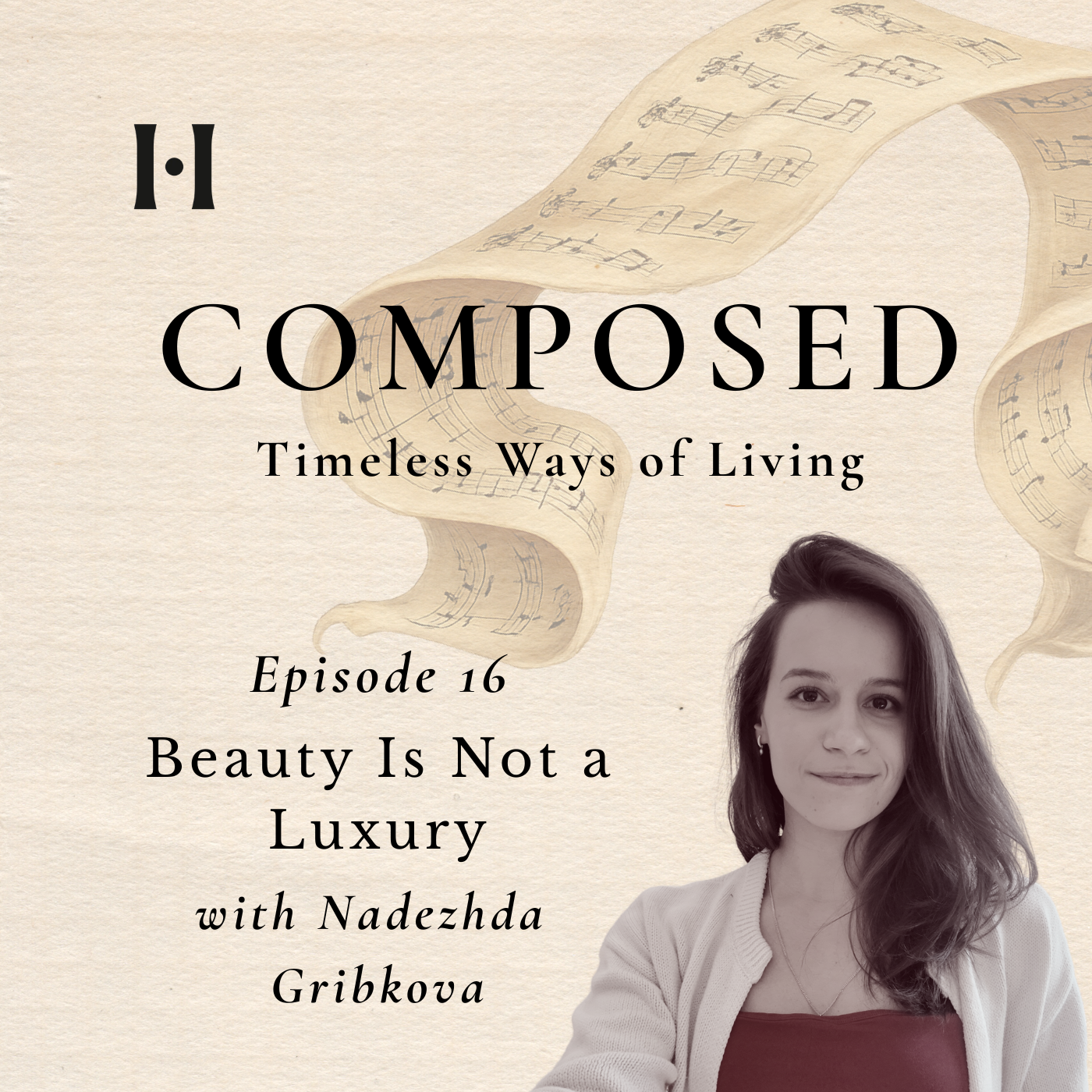
Composed: Timeless Ways of Living
Beauty Is Not a Luxury with Nadezhda Gribkova
What we attend to quietly shapes the people we become. In this episode of Composed, Christine Perrin speaks with Nadezhda Gribkova about beauty-first education, the patient work of looking, and the relationships that make genuine learning possible. Drawing on Dostoevsky, Rowan Williams, Jane Jacobs, sacred icons, and her own experiences as a student and teacher, Nadezhda explores why formation cannot be reduced to transferring information. Her own education, as a fifteen year old in a new country, significantly shaped her life. Her teachers, she explains, took her seriously by tackling difficult books in conversation and asking good questions toward the person she would be but was not yet. She offers simple practices for recovering attention, including memorizing poetry, observing art without rushing to interpret it, and returning to the patterns that remind us what is true. Their conversation invites parents and educators to consider how beauty can deepen family culture, strengthen human connection, and orient an ordinary life toward flourishing. At the heart of the conversation is a hopeful claim: beautiful things are not luxuries reserved for experts. They are gifts that can ground us, enlarge our vision, and help us remember how to live.
Contributors

Guest
Nadezhda Gribkova
Originally from Moscow, Russia, Nadezhda Gribkova is a PhD student in the Slavic Department at the University of Chicago. She holds a graduate degree in Art History from the University of Illinois at Chicago, where she studied modern and contemporary art. At UIC, she worked as a graduate lecturer before beginning her doctoral research at the University of Chicago. Her current work focuses on the interrelation of ethics and aesthetics in Soviet art and literature, tracing the formal and philosophical influences of pre-revolutionary religious traditions on the development of Soviet cultural practices. She has published on Soviet Modernism, Eastern European Conceptual art, and crypto art. She is currently working on two articles devoted respectively to Dostoevsky and Tolstoy, examining the relationship between the ethical and the aesthetic in their literary practices. She is also the creator of the Poetics Through Russian Art YouTube channel, an ongoing project dedicated to Russian literature, art history, and the role of aesthetics in contemporary life.
Host
Christine Perrin
Podcast Host and Contributing Writer
Christine Perrin is a literature professor, writer, poet, and podcast host. After teaching literature full-time at Messiah University for almost 20 years, Christine arranges her time to write, teach in Italy, and host the Composed Podcast. Christine is a graduate of Johns Hopkins University (BA in Writing Seminars) and the University of Maryland (MFA in Poetry).
Related Resources

School-Choice Tax Credit Gets Big Boost From Treasury
Married couples can donate double, making tax break worth $3,400, not $1,700

Bessent Advances Divisive $26 Billion School Tax Credit Plan
The program, dubbed the Education Freedom Tax Credit, allows individual taxpayers to direct up to $1,700 of their annual federal tax bill to nonprofits that grant scholarships to students to pay for qualified educational expenses.

Not All ‘Classical’ Schools Are Created Equal
The most consequential differences are often the least obvious.