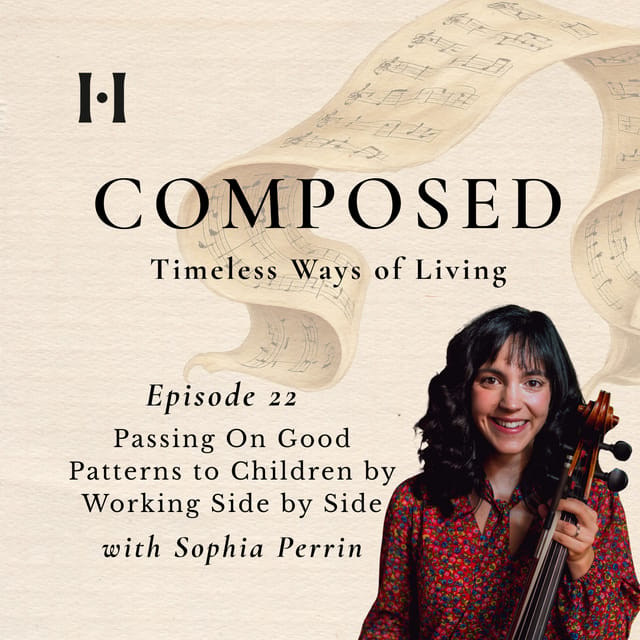
PodcastComposed: Timeless Ways of Living
Passing On Good Patterns to Children by Working Side by Side with Sophia Perrin
What do children remember most? For Sophia Maeda Perrin, it was hanging laundry on the line with her grandmother, bottle-feeding baby goats in the spring, and sitting down to every meal with her family. In this episode of Composed, Christine Perrin and Sophia talk about how a family’s living patterns pass from one generation to the next, often before anyone thinks to name them. Sophia was homeschooled with her six siblings and is now a young mother in Colorado. She talks about bringing children into ordinary work, keeping a feast even in seasons of hardship, and sharing a home with extended family. If you weren’t handed these patterns and wonder where to start, this conversation offers both encouragement and a practical first step.
Sophia also describes the habits she is building now as a mother. She reads with her daughter for an hour a day and finds fifteen minutes at the edges of the day for her own reading. She treats screens with healthy suspicion and plans to celebrate name days as family feasts. Along the way, she describes classical education as a spiral rather than a straight line, because children return to the same stories with deeper understanding. She also reminds us that children learn with their bodies, through music, movement, and work done side by side.
References Mentioned
- Emily Maeda, “Living Patterns and How We Learn Them” (Composed)
- Leila Lawler, The Summa Domestica
- Josef Pieper, on feasting
- 3 John 1:4, “I have no greater joy than to hear that my children walk in truth.”
Transcript
Sophia Maeda Perrin: You can choose to live like you never have enough, and that will be a way that you choose to live. Or you can choose to say that everything came from God, and that our response is only to say, if everything comes from God, then we can only give thanks, and it will always have enough because of that. Nothing is ours.
Christine Perrin: This is Christine Perrin, host of A Timeless Way of Living, a podcast of the Humanitas Institute that explores living patterns of virtue, craft, community, and delight, and draws the classical tradition into contemporary times. Sophia Maeda Perrin, welcome to Composed. Thanks for having me. I'm so glad you're here. Thanks for coming.
I'm gonna say a few things about you that are formal and then we wanna hear from you, some more. So Sophia grew up being homeschooled k through 12. She went to Hillsdale College where she was an English major and a classics minor. She has since taught Latin at the Paideia School. She has six siblings and two children, one in utero.
And she is the daughter of Emily Maeda whose podcast we listened to earlier, and that one is called Living Patterns and How We Learn Them. I thought that it would be of great interest to people to hear about how these living patterns that that Emily talked about have taken on a life in your life. And so thank you for indulging me and being willing to come and talk about that. I would love to hear just perhaps a beginning about hearing you talk a little bit about your grandmother because your mom spoke so much about her and her intuitions.
Sophia Maeda Perrin: Yeah. It's so interesting because my younger siblings... There's a span of twenty one years between all of us. And my younger siblings, the second half, have such a different experience than my grandma than I do. Because when we were growing up, we would spend at least one day a week with her, and she had a huge farm.
And I just remember whenever we whenever we went over there, she always... We just fit into her life. She would always take time to do things with us, like she loved cards, so we always played cards with her when we went over. But we would do the chores with her, we would do... Make whatever she was making, you know.
I remember we'd always look forward to her pancakes because she always made all of those from scratch. But she just... I... The thing that I remember and love, she's still alive, but growing up with her is that she just folded us into her life and made us a part of her life. Didn't feel like we were a burden, but she also just...
Whatever she was doing, whether that was doing chores around the farm or even taking care of her garden or picking raspberries, we just did it with her. And I just love that so much. It's such a special memory because my younger siblings don't have the same. She moved into a house in the city when they were little, and that really changed her life.
Christine Perrin: So you're the second Yeah. Of seven Yeah. And the oldest daughter.
Sophia Maeda Perrin: Yeah.
Christine Perrin: And some of the patterns that you were folded into, your mom has also spoken about. But this, I've heard you say, includes taking care of goats and making cheese and making... Can you go into... You you mentioned picking raspberries and gardening and taking care of animals, but maybe a few more specifics of that. And also, I love your pointing out that we live in an age of child centered everything.
Learning, parents are always... You know, I remember this magazine, Family Fun, you know, where you were supposed to plan these really special things that would stick with people. But it sounds like a chief part of your experience was a kind of Wendell Berry experience of, you know, don't go away and do your work. Do your work in a place where children can see it, and be with you, and learn it too, and be in fellowship as they learn.
Sophia Maeda Perrin: Yeah.
Christine Perrin: I hear you describing that. Yeah. Well, because we
Sophia Maeda Perrin: would look forward to spending the night because it meant that we would get up, we'd get to go milk the goats, and if there were baby goats, we'd often get to bottle feed the baby goats. So we always look forward to the spring because bottle feeding the baby goats was so fun. Like, there'd always be a couple that wouldn't connect with their mom, so we'd have to bottle feed them. And you have to do it like multiple times a day, and it's so fun watching the little baby goats.
Christine Perrin: My goodness.
Sophia Maeda Perrin: We also had to take care of the chickens, which was not a favorite thing of mine, but we had to do to feed the baby goats. But even just things like she believed that laundry should be on the line in the summer, so we had to hang up the laundry. But somehow that turned into something fun when you do it with your grandma. Yes. It doesn't feel like the same chore when you have to do it at home By yourself.
By yourself. But when you do it with your grandma and your cousins, because you'd always have all... I had three girl cousins who were all my age, like, were all within a year. And so we'd all come over and spend the night together. And so that would be something really special, where we're doing all these, like, really mundane things with my grandma, but we'd be doing them together.
You know? And then we'd get to go play because she had 10 acres, so we'd go play out in the field. Like, she'd pack us snacks, and we'd go play dress up in the field. And then we'd come back in and help her with something else.
Christine Perrin: That's remarkable. Yeah. People pay hundreds of dollars so kids can can go to camp and do this. But this was your childhood I know. And with your cousins.
Yeah. Did... When you would go over every week, was that with your siblings and your cousins, or just you and your siblings?
Sophia Maeda Perrin: The weekly things was often my siblings. Okay. When we would go... Because she took us to, like, a weekday bible study
Christine Perrin: Okay.
Sophia Maeda Perrin: With her. And so we'd go do that with her, and then my mom would pick us up.
Christine Perrin: It sounds like, from what you've described and from what Emily has described, that this was very much a part of Emily's thinking as well. Your mom's thinking that children can be folded in. They don't have to be in a separate part of your life. Yeah. They can come...
And your family had a business... Has a business, landscape architecture, and you all help... Were a big part of that as well. Can you
Sophia Maeda Perrin: talk about that? We all worked. In the summers, once we were old enough, When I was 15, I asked... Was asked if there were child labor laws around me because I looked so young. And I said, I can almost drive.
But it felt like we were all needed... The business needed all of us to run, which was a unique thing.
Christine Perrin: To feel necessary.
Sophia Maeda Perrin: To feel necessary once we were of age, to be part of building something. It wasn't just that it was something that my parents did, that it kind of took all of us to help make it work, and that we contributed something valuable in the work that we could do. That it wasn't just my dad offering us a job, it was that we were part of it and that we had skills that were assets. I mean, took time for those skills to build, but but it started with us weeding with my mom in the summers when we were really little, and we would grumble about it. But then that led to, oh, we can actually...
Like, we have stamina to now do it in high school, and we know what's real and what's a weed.
Christine Perrin: That's a real skill.
Sophia Maeda Perrin: It's a real skill.
Christine Perrin: I'm wondering if that happened with your grandmother too. I love the language of her folding you in, but I wonder, was there some point at which that transitioned and you were actually a help to her, and you understood that you were a
Sophia Maeda Perrin: help to
Christine Perrin: her? Or did that just get paid forward in your own family's work?
Sophia Maeda Perrin: I'm trying to remember. There's a point in time where I stopped spending as much time with her probably when I would have been a help. Like, I just had less time. Yes. But I remember it when my brother was sick.
My my grandma took us for the initial week when my brother my brother was diagnosed with cancer when he was 13, and in that initial week, my grandma took us. But I remember being able to help with the little people that like, she didn't know the things that they needed
Christine Perrin: Yeah.
Sophia Maeda Perrin: Because it was just... We were all in crisis
Christine Perrin: Yes.
Sophia Maeda Perrin: And I was 11. But I remember being like, oh, I know what to do with these guys. You know? Oh, no. No.
Like, grandma, they need this, Which was like something very small, you know what I mean? Like, oh, we sing this song before we go to bed, and this helps them. You know? And I remember feeling that of, oh, I can start contributing, and it's not just her doing everything for us.
Christine Perrin: It's interesting because in all of these situations, it requires the the adults to pull back and to think about what you will be and what you will do. Mhmm. Similar to I had... I've had another guest say that she felt her teachers teaching to the adults she would be. And it sounds similar
Sophia Maeda Perrin: Yeah.
Christine Perrin: That everyone involved were thinking about the kind of family member you would be.
Sophia Maeda Perrin: Yeah.
Christine Perrin: And how to raise that family member.
Sophia Maeda Perrin: I've never thought about it that way. It...
Christine Perrin: It's just so interesting that maybe it was more intuitive at that time, and maybe it was more necessary. Mhmm. But I think if people are to return to this
Sophia Maeda Perrin: Yeah.
Christine Perrin: It would have to be conscious because it's so different from the mindset that we've all been taught to be parents in. Yeah. I remember that both my grandma and my mom, in like... We had chores, but they would take the extra time to make sure
Sophia Maeda Perrin: we did them properly and wouldn't just do them for us. You know, there's that point when you're learning how to sweep the floor, where you have to do it a couple of times in the same go around to figure it out. Know I mean? But they wouldn't short circuit the process and just do it because it was quicker. They were willing, which is a tendency that I have, to just say, okay, I can just do it.
It's quicker. But they... I realized they were both so patient in that and just saying, no, it's worth you learning how to do this even if it takes more time, because it will pay off in the end. Because then you'll know how to do all these things. And if I just short circuit the process, you're never gonna figure this out.
Mhmm. If I just say, okay, I'll clean the counters because it's faster, you'll never figure this out. And to me, it felt so tedious and so much like, oh my gosh. Are you kidding me? Do we have to
Christine Perrin: do this again? And probably, you know, I'm wondering... Well, first of all, I love that language of short circuit the process because that rings, echoes from your mom, Emily's discussion as well. Yeah. That part of what you're doing is using your broad sense of what is worthwhile, and you're having backbone and sticking it out with people who don't know that yet Yeah.
So that they can acquire the deep experience of it being worthwhile, and not just have someone tell them that, but be able to draw on their experience. But I'm wondering if even as the second oldest child, if that was something that you had to do with your siblings too. In terms of this is how you do it, No. Do it again. Yeah.
Sophia Maeda Perrin: I feel like my mom gave us a helpful balance where she didn't want there to be a pecking order in the siblings, where there was, like... The siblings were always constantly correcting. So I feel like she did a really good job of taking the time to do that with each kid so that there wasn't having to be a bad power dynamic between the older siblings and the younger siblings, where I was constantly like, you need to do this again. You need to do this again. But I think there is something just watching someone doing it.
That's that intuitive handing down too, you know?
Christine Perrin: Yes. Because... And even watching someone being corrected.
Sophia Maeda Perrin: Even watching someone being corrected.
Christine Perrin: In the in the chore.
Sophia Maeda Perrin: Yeah. But like, because I remember, I have an older brother, and then there's two younger sisters, and the youngest sister always wanted to do the dishes with us from the time that she was like two or three, you know, and we all grumbled about the dishes, and she would be so excited. Both of them, actually, both of my younger sisters always wanted to do the dishes, like they were excited to do the dishes. Because it was what we were doing. You know?
And so in some ways, we had to forge that older Yeah. Of watching my parents and then wanting to do it. But then the younger siblings kinda just came along. It was something that everybody did.
Christine Perrin: That's interesting. I think that's one of the blessings of large families.
Sophia Maeda Perrin: I do too.
Christine Perrin: We're talking about work right now, but I know that one of the major focuses of your family is also feasting. And we think about feasting as that thing that the work is for. And I'm wondering if you could talk about some of the patterns that helped you to know that, or helped you to know that now.
Sophia Maeda Perrin: Yeah. Yeah. Well, we've seen it. As I've gotten older, I... We've now been through two weddings.
And my family has thrown two weddings, my own and my brother's. And for my brother's, it took so much work to get our two acre property ready, and it took so much work to get all the different things ready. And then a year later, I was married, and it didn't feel... After we had seen kind of all the work that it took, and then the feast that we had, it was so much more worth it to do it again for almost everybody. Some of my younger siblings didn't feel quite the same way.
But I think life gives so many natural fasts between my brother's illness and my dad's illness. I remember when my brother was sick, when he hit this... Like, one of his sickest points, my parents threw a dance to celebrate all the people that had loved us. It was like halfway through. And my mom read simple gifts to everybody because she said, without all your simple gifts, we wouldn't be here.
And I remember we were still in the fast of his sickness, and yet there was still this beautiful feast where everyone danced and spent... It was on Midsummer night, and everybody spent the day the day so happy together, celebrating his life, and all the communal life that we wouldn't have been here in our life if it weren't for everyone, giving us mini feasts in our really long fast.
Christine Perrin: That's such a beautiful picture of life, even though it's intensified in your experience.
Sophia Maeda Perrin: Yeah.
Christine Perrin: The idea, and even Josef Pieper says, you stop in the middle in media re. You don't wait until everything gets right. And in the middle of the riddles and the sadness and everything that's unfinished, you work to have a feast that says, this is worth it. Because
Sophia Maeda Perrin: how is the work worth it Yeah.
Christine Perrin: If if it's just more work? Yeah. And that's such an incredible illustration of it. Yeah. And I know that at your brother's wedding, there was dancing of the same sort that was almost this echo.
Sophia Maeda Perrin: Almost to the day, ten years later. It was a day off being to the day, ten years later.
Christine Perrin: Or a couple days ten years later, which really felt like a beautiful echo. And you never would have heard it as an echo if you hadn't stopped and feasted in the middle of that excruciating time. And it was a thank you, but it was also
Sophia Maeda Perrin: reverence for life. Absolutely. And celebrating the life not with, like, a... I remember later, he went to a dance with a bunch of other cancer survivors, and they were all dancing to, like, party like tonight, like, we're gonna die young. And something suddenly felt really wrong about that, you know?
Like, no no no. You all were gonna die young. Like, you guys have all faced death way too young. But there was this feeling that life is worth celebrating even at its hardest point. There's still something good to celebrate even in its darkest moments.
Christine Perrin: Can you say more about food, which obviously was a part of the feast, but it's not the same thing as the feast. And that has played a big role in the life of your family, in your grandmother's life, in in your life now as an adult and a mother.
Sophia Maeda Perrin: Yeah. I didn't realize this till I went to college and got really sick because food was just part of the life of the family. Like, everybody sat down to eat breakfast together because we were homeschooled, and then we took a break, and everybody ate lunch together. And even my dad, for a long time, had his business at our house. So he would come eat lunch with us.
You know, it's like everybody was just together for meals, and then it wasn't till we were all in high school that we started missing dinner because it was like kind of a nonnegotiable to miss dinner. And so it just made eating and being together such... Like, they were just combined. There was nothing utilitarian about it in some ways, even though it is a really utilitarian thing to have to eat and have to make meals and all of those. But it felt like it was a mini feast in the day.
And that was always cherished even if we didn't realize that. You'd... Like, and I didn't realize that till I was in college and I was a long distance runner and food became a very utilitarian thing where I had to eat to do the thing that I needed to do. But I was eating alone a lot of the time, and it just changes the relationship to food. Where I had grown up with this very food is a good thing that is just part of our life, you know.
That that's how you end the day together. You end the day with a meal, and then you are able to all participate in everyone's life around the table. And it wasn't till college that I realized kind of what a gift that had been that I had no idea. It was just an intuitive thing that we just did. It's just something that my mom gave us and my dad gave us.
And it wasn't until college that I realized, wow. Without community in a meal, it really changes food.
Christine Perrin: How did you address that in college? Did you try to create community, or did you just wait until you were back together with your family?
Sophia Maeda Perrin: It was a little bit of both. I really tried to find people to eat with because it makes it so sad. Yeah. I feel... You feel the absence of people when you eat alone.
Yes. And it's such a gift now to not eat alone with my baby, and... But now, my husband and I live with my brother and sister, and so often we all eat dinner together every single night, and it's like two families joining together every single night. But I think when I came home from college and lived with my family in the year between graduating and getting married, I relearned kind of the gift of eating in community and was so grateful for it again. And it kind of re instilled the importance of it that there's a natural loneliness that I think is good, but that we're not meant to always be alone like that.
Like, we're meant to... However we can foster it, we're meant to eat together.
Christine Perrin: It's this... I remember hearing it discussed as bread in the hungry soul, and that there's something about the fact that we need to eat, but that it isn't purely utilitarian. That is one of the deep mysteries of our lives. And I think you're putting your finger on it. It just gathers into itself so many other things, fellowship, even this decision that you've made to have a table that's shared with your brother and his wife.
And I wonder if you... I I know I'm asking you to do something that's conscious and it's probably so much more intuitive, but can you talk about that decision? I've had other people that I've interviewed who have also chosen to live as a couple with another couple. But, can you talk about that decision and how this thing we're talking about, this fellowship, this table, this shared life, maybe prepared you for desiring that?
Sophia Maeda Perrin: Yeah. When my husband and I were thinking about... We were on the East Coast, we're thinking about moving back to be near my family when we had our first baby, And we were trying to decide the cost of living is so high in Colorado. And we were trying to decide what we were gonna do. And then we thought, wow, my brother and sister-in-law are renting an apartment, and we're gonna rent an apartment.
And what if we just pooled our money and we could have a house for the same cost as renting two apartments? And so it kind of started from like a utilitarian standpoint of like, man, we could just have more space together. And then it really grew into something of like, wow, we could maybe potentially see a life of always living together, and if this could work out, we could share space, but also share our lives together. And we kind of held it lightly because you never know how two families You never know. Are gonna come together, and if it's gonna meld or if it's gonna be too difficult.
You know, there's four personalities. Yes. Especially, it's my brother, so it's I'm bringing my husband into it and his wife. And so there's two Yes. It's much easier for...
Other cultures. Two other cultures coming in.
Christine Perrin: Three cultures.
Sophia Maeda Perrin: Yeah. So now it's like, there's three cultures and then two unique cultures Mhmm. In these two new families. And we weren't sure how it was gonna go. And it's been...
We've been so struck by how good it is to live altogether. That it's been a... There's always little things that come up. Like, the dishes are always an issue because there's five people in the house. The dishes are always an issue.
But as we so enjoy being together that we would rather be together than be apart at this point, that we have we have our own lives, but then we've so enjoyed getting to share the communal life of eating together, but also every winter we get really into board games. And the four of us will play board games at night together, which is so... Like, my husband and I, we before this, we never played board games together, and now we play board games all the time. But there's something really beautiful about living in community. It's in such a close proximity that I never envisioned my life.
I didn't think I'd live with a sibling once I got married. Because it's always the thing of, like, you just have your own nuclear family, and we kind of can't imagine our life right now without them. Not that we could. We could absolutely live separately, but it's been such a gift to our daughter to have four adults that she can love, and that love her so much. I don't know what she's gonna do if we ever move away from her funkle and fancy.
Christine Perrin: I'm thinking about several things. One is your keen observations about culture, given that now you see three cultures in one place. That's a... An exponential learning curve compared to just having two cultures. And also living with your brother who shares your culture, that's another learning exponential situation.
And then I'm also thinking about the fact that your mom's was part of a big family, and each of those children had big families. And now you're living with part of your family again. It seems that once one gets a taste of it in its healthy form, it's... There's no going back. There's something about fellowship that you're talking about that it seems like you maybe can't taste with two children and two adults in one lonely home.
You know, one nuclear family that's cut off from neighbors and cut off from the extended family. Do you have any thoughts about that? It might still be too fresh.
Sophia Maeda Perrin: Yeah. I think we... Our first year of marriage, we were living in an apartment building with all of our friends on a school campus. And even moving in with my brother into a suburban neighborhood, into a house, we felt like the shrinking so keenly. And it took us a while to get used to that just because we had been around so many people all the time.
And there's nice aspects where you wake up and you don't hear little kids' voices right outside your window when you when you wake up every single morning. There's nice things about, like, feeling a little bit removed from the rest of society. But I think there is a feeling that that we'll never wanna live far away from our people. That I think, especially in the West, the... Everything's built around the car, and everything's far apart.
And it's kind of hard. We just had friends come from England, and they're like, even just to get to the next house is so far. Like, even just to get to your neighbor's house is so far. And I think that the communal life that we have now, I don't think we're ever gonna be able to go back to just living far away from everybody. Like, think even if we don't live, we thought about, like, what if we buy a house down the street?
If we can't... If we don't live together, if we grow out of our house because there's too many kids, what what if we buy the house next door or we buy the house down... Like, there's a house two doors down that is up, and we're like, what if we just bought that so that we could just be close by? Because it... In some ways, all the three different family cultures have influenced us all so much that it helps us build something altogether.
You know, that we always have unique perspectives inside of our little family culture that we've now built as a group of four. You know, that my sister in law's family has influenced so much, and that my husband's family has influenced so much. So that it feels like we're able to build something new together, influenced by these three different people. You know?
Christine Perrin: A new civilization.
Sophia Maeda Perrin: Yeah. That we wouldn't have if it was just me and Noah even. That we would have, but that Sophie's family adds so much to us and our culture. You know?
Christine Perrin: That makes me think about what Lewis says about friendship that when one of his friends died, he thought that he would get closer to the third friend that was still alive. But he said, no. That friend pulled something out of the third friend that is lost with the friend. Yeah. And I I hear you saying the same thing about culture, that everyone contributes to the culture, and it's rich for that.
It's almost like a Mediterranean crossroad or a treating, you know, Dubrovnik or Venice or something. Well, and
Sophia Maeda Perrin: it feels like we're reaching back to something that most that most people have lived in throughout time.
Christine Perrin: You're tapping into an ancient past.
Sophia Maeda Perrin: That, like, I talked to friends that are... Like, I have friends that come from a Hispanic family, and it's just normal for families to live together. Like, at one point this year, she had her brother-in-law, her in laws, and her sister-in-law with her three kids all living at their house with her own family there. And everybody just lived together. Like, that's just what you do.
And then they separated, and they bought a house down the street. But it feels like we're tapping into kind of a way that people have lived for a long time that for some reason our culture has decided to isolate away.
Christine Perrin: A wisdom. Yeah. And an old wisdom.
Sophia Maeda Perrin: A really old wisdom.
Christine Perrin: I know that the... This is not my inclination to ask you this question, but I... I'm thinking about the culture that might be listening and wondering, well, how do you have boundaries or, you know, something that ensures... Is that just part of a healthy upbringing? Or is that something that you have to reinvent once you decide to take on these old wise ways?
Or did the old wise ways themselves instruct you?
Sophia Maeda Perrin: When we moved in, we made... Like, before we moved in, we had lots of conversation about kind of expectations of how it would look living together. And, of course, those shifted, but we we wrote those all down so that we have them and we can always reference them of, like, these are kind of our house rules.
Christine Perrin: Mine laws.
Sophia Maeda Perrin: But it was... We had to establish things like, okay, if one couple has friends over, the other couple's always invited and can turn it down. And it's just like basic things like before you ask someone over for dinner, you have to ask the other couple and get approval, or before someone comes in for... To town. You know?
So it's all those basic things that I think we'd have... We sit down for dinner once a month together and just discuss kind of what's going on. Is everything going well? Are there things that people would really like to change? Are there big things coming up that are gonna cause us all to need a shift?
Like, we're having another baby, and that's just gonna cause a shift in how the relationship happens. And for my brother and sister-in-law, they work a lot, and so they have to cut... Like, we all kind of have to we've learned that we really have to communicate. As soon as we stop communicating, that's when we've hit friction points because it is still two families living separately, you know, and together. But I think we've learned that being couples really helps because when we need our own space, we can just kind of go away.
And our house is even built to allow that. Like, we have an intuitive sense when kind of people need space, and that's been helpful. But also it doesn't... I think because we're both couples, it doesn't feel like we're leaving someone out to take time apart, you know, because the other person has a person. And I think it would feel differently if it...
If we were a couple and there was a single person. You know, I think that would be a harder dynamic than... It's easier because nobody feels angled or nobody feels we both have equal voices at the table because there's two of us and there's two of them. There's a symmetry. And that really helps.
But communication has been the biggest thing for us of we just have to constantly make sure everyone's on the same page or else it wouldn't work.
Christine Perrin: What you've been describing has... Is your education at the feet of your grandmother and the feet of your parents and and the the table with your siblings and now, again, a a new table. But I wanna think a little bit more about your formal education with you and hear what the patterns were for that, what the ones are that you want to replicate. And you yourself have found it, it appears to me, be very natural to be a teacher. That seems like I think you probably have that...
Those skills and temperament, but it seems like it was also just a part of what you all did. But I've seen you in the classroom, and I I see that you're a very good teacher and that you have a deep sense of education being relational as opposed to first oriented towards content. And so I'm just wondering if you could talk a little bit about what gave you that. Am I right that you think of education as relational? And what gave you that sense?
And how do you think about what a child is being prepared for when they're being educated? What do you want to pass on from the way that you were educated?
Sophia Maeda Perrin: It was interesting because we all were homeschooled together, which is a unique thing for a while. And then we moved to kind of the hybrid model, where we the university model where we moved to being in class a couple times a week, and then being at home the rest of the time. And that really helped in the older years. But in the younger years, I just... I've been thinking about that a lot more just because my baby.
That's the closer time to... That we're we're to that closer time right now, the younger years of... And I just remember we had instructional time, but we also had so much free time. Like, remember that, like, everything that my mom did allowed us to still be kids. And I was thinking about this a lot when I worked in a kindergarten because you see five year olds in class all day long, and it's not it's not what their bodies wanna do.
Like, you can see it in their little bodies. Like, they just wanna go run around. And I was so grateful looking back, remembering all the time we had to wonder in the early years, that everything was oriented around wonder, whether it was our nature studies that we did, or even just doing math and reading. We had very small amounts of really concentrated instructional time, and then we're able to kind of go out and explore that ourselves on our own with my siblings, you know? But we always...
We had so much time to also be kids. Our education was really important, but it was equally as important to just be kids and to explore kind of the world with the wonder that you lose. And by the time...
Christine Perrin: In an institution.
Sophia Maeda Perrin: In the institution. But by the time kind of the wonder needed to grow into cultivating wisdom, our education moved that direction. You know? It became more rigorous. It became more throughout the whole entire day.
You know, all of those things.
Christine Perrin: But
Sophia Maeda Perrin: I am so grateful for the unique education that I had because I feel like I was given different skills than kids in school. And some of those different skills were... I knew how to manage my own time from an... Far before a lot of my peers in college. Like, remember that.
I was like, mom, we are in class so much. Like, I don't even know... And like, she was always like, in college, they won't tell you when your assignments are due. And I was like, they hold my hands way more than you held my hand in high school. I was like, I don't even know what to do with myself because it was like, have so much time, and I feel like I'm kind of bored sitting in class so much.
Like, I wasn't bored because Hillsdale gave me so much rigor, but, like, I was like, I don't have the same kind of... I'm not used to being in the classroom so much. Like, this is strange. And kind of like the amount of time that we spent going over, like, box checking stuff, I was kind of appalled by. Only for my first year.
And then Hillsdale really gave me... Really built on kind of all of the education that I had been given. But I was so grateful that the church was also so integrated into the life that we had time to be able to go to all the weekly services, and we had time for it to be... Like, every morning we read the lives of the saints before we started the day, you know? And so it was...
All of our life was just folded into one, and it gave me a very cohesive view of what life could be. That it wasn't... We didn't have to go to school and then come home. Like, we just got to be with my mom all day long, which was sometimes kinda... Or sometimes I wished we had other teachers.
But I now, as a mother, I'm like, oh, I I understand why my mom wanted to be with us all day long.
Christine Perrin: That's lovely. I... I'm thinking also of that period of time after college when you were thinking very strongly about wanting to give some of the things that you had experienced to students who wouldn't naturally have that experience. You were thinking sociologically about education and wanting those... You know, wanting this not to just be for a certain set of people, but really wanting to expand that.
And I know you looked into ways of giving that, and you still have thought about that. How would you respond to someone saying... Maybe critiquing your experience and saying that's just so elitist. That's so privileged, and most of the world can't get that. And therefore, in a way, it's wrong for you to have it since not everybody can get it.
How how do you... Because I know you're sensitive to that concern. What would your response be?
Sophia Maeda Perrin: I think that's... It feels... In some ways, it feels so funny because you knew this, your own family. We grew up like the working poor.
Christine Perrin: Yes.
Sophia Maeda Perrin: You know? So like, on some ways, it felt so not elitist.
Christine Perrin: Reef like beans and carrots.
Sophia Maeda Perrin: Peanut butter and jelly. Yes. Like, we lived on beans and rice in the winter because my dad owned his own business, and in the winter, there's not really work for landscapers in Colorado. So I never... I think I never grew up thinking that just because it was like, no, this is just the way to make our life work.
Like, there was no private school to send us to. There was no private school Christian school to send us to. So my my parents said, well, we want them to have a Christian education, and so that means we homeschool them at home. Like, we want their education to be centered around understanding who God is. And my mom always had a verse in her house that said, I have no greater joy than to hear my children walk in truth.
And that's what oriented their life. And so as I was thinking about it, I just felt as I was ending college and just seeing in Hillsdale, 40% of the community lives behind... Below the poverty line. And I worked in the school system as just like a mentor to kids that were in really bad homes. And so it just made me think like, how can we equalize this gap that feels so strong, where these kids are in school and just feels like they're trained...
Being trained to be institutionalized, and that's the only thing. And one of my favorite things was seeing the group, NINSA, that brought classical education in an after school program. And I just think we have to think about it creatively in terms of... And it's hard for me because now we live in Colorado, which is a very wealthy state, where it is... I think it's just an elite state, and it feels like there's there's not really a need for it in Colorado.
Because of charter schools. Because of charters... Like, the charter schools are really good, but even just... There's not that many poor people in Colorado, you know? And so as I I saw it much more clearly when we lived in Richmond, like, oh, wow.
There's a real need. There are schools like Imago Dei that are working where parents only pay what they can absolutely pay, and then the rest is funded privately to make it possible. But it feels like we think about education to... We only think about education one way as inside a school building. And I've loved watching kind of the movement expand into ways of, no, there's lots of other ways to give this, whether it's an after school programme or it's even one on one tutoring.
You know, like, there... It doesn't have to be this elite thing, and it hasn't been this elite thing until very recently with the way that the public schools have evolved. And I think the charter movement is a great example of trying to make it less of an elite.
Christine Perrin: That's really helpful. The... All the examples that you gave. Even homeschooling, if if a parent has been educated or has access to becoming educated. And I say that in all the senses of the word, not just a credential or a degree.
But then that's something they can give. And as you were describing, your family sacrificed in order to give it. Gladly so. But it wasn't easy to make it happen financially. And there was a kind of economy and almost skill set, almost a cleverness that needed to happen in order to figure out how to pull that off.
And I'm thinking even about having a large family, that's similar. It's a skill set of how do you stretch Yeah. What you have
Sophia Maeda Perrin: Yeah.
Christine Perrin: To meet everybody's needs emotionally, financially. How does it become an abundance mindset and not a scarcity mindset? I'm wondering if you have any thoughts even on that because I sense that your experience was frugal but abundant.
Sophia Maeda Perrin: My husband and I both talk about that, that we grew up never having a sense that we were poor. Both of us grew up never having a sense because our lives were so rich. And I remember my parents explicitly talking about this when, like, we we got to the age of budgeting because my dad is an accountant. So my dad... That's helpful.
My dad has a sense of this. But the... He said, you can choose to live like you never have enough. And that will be a way that you choose to live. Or you can choose to say that everything came from God, and that our response is only to say, if everything comes from God, then we only give thanks, and it will always have enough because of that.
And it's such a... That... It's almost a fairy tale. I know. But it's such a formative way of thinking about the world.
Christine Perrin: The gift mentality. The gift
Sophia Maeda Perrin: mentality that nothing is ours, you know. That it's all a gift from God and that we're asked to steward it. I think about that with my toddler who says everything is hers. Mine. Mine.
You know, and that's such a... It feels like it's such a human thing to say mine and in this economy. But I think in our family, we all had a keen sense that it took everyone to make it work. My youngest brother came when I was 19. My oldest brother was 21, and the youngest was eight.
And we all feel... In some ways, my parents were in a different stage of life, and it was a real shock to have another baby. But we all feel, what would our life be without him now? You know? And that was, I felt like, emblematic of our whole life that it took everyone to make the life work.
You know? Everybody was a keen and important piece of the life. And I think that's... Comes out of that abundance mindset.
Christine Perrin: I think so too.
Sophia Maeda Perrin: Everything is a gift, and it means that every gift is important, you know, in its own unique way. And I think about that, like, in thinking about the church that Christ talks about, like, every member is important, whether you're the hands or the feet, all the different limbs, you know, every... Like, Christ gave that to us as a way of thinking about life, that every member is important, no matter even if you have... And then it helps think about all the different personalities and how they melt together, you know, where some personalities feel like they're more important than others. And it's like, no, every every voice...
And even now, like when one sibling is not present in the communal life, their absence is really missed. You know? Like, we we miss them. Yes. Because most of us live at home, but two don't.
Like, most of us live in Colorado and two don't, and we feel that so strongly. There's an absence when you're not... When we're not all there. And that's a good thing too. You know, we learn how to...
My mom... We all talk about it as an ecosystem. You learn how to refill the ecosystem, you know? But the ecosystem has to change.
Christine Perrin: What if you had to... Let's say there's someone listening who thinks, I wish I could live that way. I wish I could have that mentality. I wish I had been brought up with that mentality, but I haven't. So where do I start in thinking about life as a gift and with a gift economy, thinking about abundance and the way necessity can be in abundance and fellowship and relational education.
Where would you say people should start? What is one habit or pattern that they could make a part of their life that would begin to open them to this as they make it a habit.
Sophia Maeda Perrin: Yeah. Okay. I had a really funny one come to mind, and I'll say it, and then I'll give you a different one. It's funny. My parents...
And my husband and I were just talking about this, of tithing 10% to the church. Because, like, when you have... So it's a very fun... That's a very funny pattern, but we were talking about it because we we're like, we don't have very much right now, but it feels so important to offer what we do have as a... Like a constant reminder, even if it feels like a really big stretch to us right now, as a constant reminder that, no.
No. Our first priority is to the church and to life there. So that's one thing that I've been thinking about a lot. And that's... My my parents always stressed that with us all growing up, that you always...
It doesn't matter how much you have, you always give 10% of what you have to the church.
Christine Perrin: It strikes me... Just to interrupt you for a minute, it strikes me that that is more than just about the church. That's about putting some of the language that I've heard is the big rocks in the stream, and then letting the stream flow as opposed to just thinking about what you can do on the basis of what it seems you have. But, no, these are the things that matter to me the most. And I remember even as a young mother getting...
Waking up and realizing, I love to read, and I love to be walking in nature. Why am I not doing those things? Because I have this list of things to do, but not... The list doesn't include the things that I love the most. Yeah.
So, no, let's make the list after we put the things I love the most in the day.
Sophia Maeda Perrin: I I think about that so often. Like, it's so easy to get caught up in all of the chores as a young mother of the day. And I... My husband and I have been talking about this a Like, what are the things that we wanna prioritize? And some of those things...
Like, the big things, the big rocks are, like, we wanna have people in our life, which means that we have to have dinner with people. You know? Like, we have to welcome people into our home. And even just, like, I don't have very much time right now to read tons of long books, but my daughter and I spend an hour a day reading books together.
Christine Perrin: You know? And it's... And she's not two yet.
Sophia Maeda Perrin: And she's not two. And, like, that's what she... That's what we love to do together, you know, is to read books and to go outside. It's two of those things that... And so I have to remember to prioritize those and not feel like they're a chore
Christine Perrin: Mhmm.
Sophia Maeda Perrin: And put those big things. And so, like, from my perspective as a young mother, it feels like do the things that you love Yes. With your babies, you know? Yes. And don't let the other things take.
I remember my mom said, and I was so critical of this as a young kid, because I like things clean and neat. And she said, I either do what I love or I keep a clean house. And she said, well, find a middle ground. And I have never felt that so keenly as a young mother. It's either I do the things that I love, which means welcoming people into our home, reading with my daughter, take...
Doing things that I love with her, playing music with her, or we keep a really tidy house. And for me, it's been, what are the things that are important? And those things are... Let's prioritize those first, and the other things come around them.
Christine Perrin: That's really helpful. And and I like the way it began with tithing, but it has a ripple effect. It has a It's
Sophia Maeda Perrin: ripple a way of living. And even one of the best advice my professors gave me in college, My senior year, we had like a capstone course where all the seniors in the English department got to sit down with a bunch of the professors, and they sat down. And they each gave us like a short story or something to read, and then they gave a lecture on it. And the last day, they all sat on a panel and we got to ask them any question we wanted. Somebody asked, like, how do you prioritize reading?
Because one professor had 11 kids. And somebody asked, like, how do you prioritize reading for your own sake? Not for your kids, not for work. How do you prioritize? And he said, it's in the edges of life, and it's in the fifteen minutes when you wake up, or it's in the thirty minutes before you go to bed.
And that's such a helpful way of thinking about how do you keep doing the things you love when there are so many demands.
Christine Perrin: Because the edges add up. Because the edges... Fifteen minutes a day.
Sophia Maeda Perrin: I mean, I haven't done the math ahead of time, but it's a lot in over a year. Yeah. Even... And but, like, fifteen minutes of intense reading gets you into a different kind of brain space even. If if you can do fifteen minutes of intense reading, it's so much more than having an hour of distracted reading, you know?
Yes. And I was so grateful for that of, like, okay, how can I put the things that I love on the edges of my life? And it sounds like... When I heard it in college, it kind of sounded like fringes. But it was so helpful to think, no.
No. No. There's so much time taken up by other things. How can you carve out the small spaces for what you love in your time... In your day?
Christine Perrin: Which makes me think that time taken up for other things makes me think about technology and and distraction. And not just... Well, I mean, the smartphone, I think, is the chief technology still. Is that something that you would comment on in terms of a big family, an education, your own motherhood? How are you thinking about technology?
Sophia Maeda Perrin: My grandma always was so suspect about any kind of technology. And I feel like that's really had a trickle down effect. I was just thinking about this the other day where we didn't have a TV, which meant something almost twenty years ago. You know mean? Like, it really...
It meant something that we didn't have a TV in our house. Like, there was no streaming at the time. And I remember any kind of entertainment we did together, it was a... We always... Like, anybody...
If anybody was watching a movie, we always watched it together. Like, every movie had to be a group decision. And that's been so helpful in just thinking about technology as if it doesn't help the whole, is it worth doing? It's even things like my husband and I, we were like, we don't really wanna wear headphones in the house together because it means that someone is either being entertained solo. And it's like, if we're gonna do an entertainment, we should just do it together.
Like, it should be a distraction to both of us if we're gonna do it, or else we we shouldn't do it at all. You know? And so I feel like having a baby has really given us both a sense that, man, technology takes a lot of time away from her. Our phones take a lot of time away from her. And it's kind of a clarifying thing to think, okay, we don't want her addicted to the phone.
So that means we have to break our own addictions to the phone. Those neural pathways. Yeah. But... Or it's just the thing of, like, we watch how quickly she organs to the screen, and we've both been trying to say, well, like, she has this amazing attention to read all these books.
And we're like, as soon as we give her the screen, it's all gonna go away. So my husband's goal is 10 years old before she watches a movie. Mine's a little bit more realistic. But I think being suspect of technology has been the way that we've been moving, the more we've seen. Especially as my husband teaches in the schools, and he sees the effects of attention inside the classroom.
Even though his school is completely no phone policy, they don't have iPads, they don't have computers, the time at home really affects
Christine Perrin: their attention. Which is interesting. It it sort of connects with something you said earlier, which is that as you were raised at home, there weren't two different ways of being. There was one way of being, and it all happened
Sophia Maeda Perrin: Mhmm.
Christine Perrin: Under that umbrella Mhmm.
Sophia Maeda Perrin: Of home. Yeah. And I... I'm really grateful because my husband was not raised the same way. He went to a Christian school, and he still has that feeling of...
It doesn't... Like, dad was at school with him all the time, and his mom was at school with him at different points. And he still... You can still have that experience, I think, going back to that culture thing, that you can still have that experience. And I'm grateful for his perspective because he feels so strongly that you can still have that experience.
You know, I only have the experience from being in the home with my mom all the time. He's like, no. No. You can still have that experience where they don't have to be a sharp dichotomy.
Christine Perrin: That is very helpful because for people listening who... It's not of an idealism that you have to change everything and do this one thing. Yeah. But rather there's a principle, which is be with your children. Find ways to be with them.
Sophia Maeda Perrin: Yeah.
Christine Perrin: I know that my priest brings his children with him many places. They come and bless houses or are there for naming name naming ceremonies or... And it's a blessing to the people that whose houses they go to, as well as to them, as well as to the relationship. So it's just that principle being repeated.
Sophia Maeda Perrin: Yeah. Because he never felt like he didn't have enough time with either of his parents, because they built their life together around one thing. And I'm grateful for that because it helps me to remember there's not just one way to do it. You know? There's lots of ways to build these patterns of being together even if it means...
Even... Because he's been like, well, why can't our kids go to high school? Like, I had a great experience in high school. I had lots of friends, you know, but there there's lots of ways to do it.
Christine Perrin: That's so helpful. I am wondering as you think about your life right now, what is a pattern that you still hope to acquire that you don't have yet? And how do you go about doing that? The reason I ask you it this way is because so many of the good patterns that you're describing to us, you were given from childhood on. But a lot of the people that are listening maybe weren't given those patterns.
And so for you as a patterned person, we're all patterned. But Yeah. Given the patterns that you learned, how how do you set about it? What... How do you set out on that journey when you are facing all the resistance of getting started?
Sophia Maeda Perrin: The one thing that we never... We celebrated saints days, but we didn't have saints days connected to our names particularly. We didn't celebrate those saints days. So our our daughter's name is Penelope, and her feast day is September 1. And one of the patterns that I wanna start building, and my feast day and Noah's feast day, is building in celebrating and making those days special as, like, our name days.
Christine Perrin: Mhmm.
Sophia Maeda Perrin: And I think it's just... We haven't started that yet because she's only one. It's gonna take some time. But I was thinking about the thing that I wanted to do was celebrate each of our name days as a special day and making it however that is gonna look, think. Maybe celebrating it like a birthday with special meals or...
And celebrating the saint themselves. But that's one of the patterns that I... We have not built yet that I would really like to build.
Christine Perrin: And so it sounds like what you're saying is the first step is to think, to contemplate. Mhmm. What matters? Why? And maybe you could tell us why that matters to you.
Sophia Maeda Perrin: Well, think it's thinking about building the many feasts into the life, into the... You know, because I'm so grateful for the church. They give us so many Feasts throughout the year. But in our particular family, we have these special Feasts, you know, and getting to build that and actually celebrating them because feel like our names are so important, and the people that they're... It connects our daughter Penelope to this person that she's never known.
I mean, I think she's a fourth century saint, you know, and being able to place ourself in time, but also have these many feasts that pull us outside of time.
Christine Perrin: Oh, that's lovely. Thank you. That really helps me to understand how you're thinking and how you're going about it, which is to say this is a pattern that's been important, but how is it gonna be instantiated in my own Mhmm. Culture. Mhmm.
And then you can watch other people and how they do it. You can repeat the good things that you received, but all located in this way. And I think you know that one of my... The most significant things that happened to me was when I was 30 going to someone's names day celebration. And it was so extravagant, and their life was so not extravagant.
And then a week later or so, he died. And I just... I love... I didn't know this. I'm asking you this.
I didn't know this, but I I love that that's something that you're seeking. And I myself have had that sensation of being with people that hold high this idea of feasting. And when you have the church, you have so much in relationship to feasting, but you still have a sense of what are the mini or the personal feasts. The personal feasts. And what should they be, and how will I make that personal to me?
Sometimes for us, one of the things I love is to have a celebration meal when people come into town and invite people from... That are local with the people that have come in and and choose a table wide question and, you know, get going on it.
Sophia Maeda Perrin: Yeah.
Christine Perrin: But I I love that you're thinking about that. And I wonder as well, what are the kinds of questions or activities that you feel you're standing on the shoulders of giants, your grandmother, your mother.
Sophia Maeda Perrin: Yeah.
Christine Perrin: They've done all these things that get you started at a different place than they started at. Yeah. Talk to me about that. What does that mean? What what have you been able to do that because of your starting point?
What is it like even to think about starting point in your twenties for the first time maybe because it was always given.
Sophia Maeda Perrin: Yeah. It's one of those funny things where it's so intuitive. Sometimes you... I feel like I forget. Like, I've I've been given all of these things, and one of the ways that I've been given to re remember is actually reading somebody else, which has been so helpful as a young mother.
Like, there's all these things that I watch my mother do all the time that I forgot. You know what I mean? Like, all the dealing with a newborn, dealing with how do you run a household, all of these things. And I love Leila Lawler because she has put this all into, like, a succinct sheet, the Summa domestica, which is hilarious. She's Catholic.
Three parts on like, how to run a family, how to run a household. And it's been so helpful being able to read her because it re reminds me of how tall the giant is that I'm standing on. Because I read it, I'm like, oh, yeah. Mom taught me this a long time ago. You know what mean?
But sometimes you can only remember it when it's explicitly given back to you again. You can only remember the intuitive things. Yes. Both my husband and I laugh about that even when we talk about classical education. Because I was like, can you explicitly flush this out for me?
Because I know I know these things, but it... So it feels like in rebuild... In starting building a life, a new life, it's helpful to re remember these things explicitly and to flush them out because sometimes the intuitive is almost too hard to remember.
Christine Perrin: It's buried in you.
Sophia Maeda Perrin: It's buried, and it comes back. But sometimes I really need the jog of like, oh, no. No. It's right there. You just have to remember that it's there or somebody else telling you those things.
Christine Perrin: That's so helpful because we are naming creatures. Mhmm. And the name of a thing and the act of naming a thing is part of your encounter with it.
Sophia Maeda Perrin: It's so hopeful. I think about that with, like, we have Adam naming the animals
Christine Perrin: Yes.
Sophia Maeda Perrin: On our wall. You know? That, like... And even teaching some... A little person to name now.
Yes. Like, she's learning... Our little toddler's learning how to name everything, and it's so fun watching her find the words to name the thing that she wants.
Christine Perrin: Nothing like that.
Sophia Maeda Perrin: You know? But I think I take for granted a lot kind of the the patterns that I've been given because I just assume that everybody has them. And it's hard to remember that not everybody has these things.
Christine Perrin: Do you have anything to say to people out of that conversation about what classical education is? And and I'm asking in the broadest sense, not for an elevator pitch or a definition, but just given the fact that the two of
Sophia Maeda Perrin: you have talked about it, the two of
Christine Perrin: you have received it in very different ways, The two of you are planning to give it yourselves, both to a wider group of people as well as to your own children. How would you say it in your own words to someone just coming into it?
Sophia Maeda Perrin: This is my least favorite kind of question. Sorry. When you say that I'm an intuitive teacher, I always feel like these things are not intuitive to me. Like, I never feel like these are intuitive to me. I think it's such...
You're so full of
Christine Perrin: it though. I mean, we met in Orvieto
Sophia Maeda Perrin: Yeah. We did.
Christine Perrin: In the summer program when you were a senior. Yeah. And I remember you wrote that essay, choosing a metaphor for the relationship between the ancient world and the Christian world and classical education. And I just remember thinking, where did this person get educated? This is so wonderful.
This is so remarkable. And that was, you know, before I knew you. But you were 18 or even 17, and and you did... You had an answer that was very good.
Sophia Maeda Perrin: Did have an answer. Well, I feel like particular... Classical edification feels so tied to the liturgical life. And they padded off of each other so well. And I remember thinking, as a little kid, we learned the timeline, which was a CC thing with hand motions.
And it always felt so like it was just like a linear sense of time, like we would go through it all. And then I remember in high school coming back and being like, oh, those were how all those pieces fit together. And I think, like, the combination between wonder and having all the building blocks and then the synthesis that comes through edgy... Classical education, where it's not a linear experience of the world and it's not linear experience of history. You know, it all keeps coming back Mhmm.
Is, like, one of the most beautiful things about classical education.
Christine Perrin: That's so helpful. Almost a spiral.
Sophia Maeda Perrin: Yeah. And it it feels like it participates in, like, the time of the church too. Like, we're constantly moving forward while also participating backwards. You know? That, like, we're constantly participating in things that are in the past that are present now while moving forward in our lives.
And I feel like classical education really helped give me a sense of that because I remember we were learning about the Monewans when I was, like, five, and then I learned about the Monewans when I was a senior. You know? And it's like feels like that full circle thing. It's like, oh, no. The things that were way back there that I didn't understand are now coming into focus now.
You know? And it's... It almost feels like how I feel with my mom and the intuitions that, like, classical education gives you the intuitions as a small person and then helps you synthesize it at the end.
Christine Perrin: That is incredibly helpful. I hear you using language of participation, as well as recursiveness, this return and enlargement that happens. And that is also a beautiful answer to the question of standing on the shoulders of giants that it's both a return and an enlargement or a reification, a reenactment and an enlargement.
Sophia Maeda Perrin: And there's something so embodied about it, you know, that, like, you can only participate it in our bodies. You know? Do you wanna say any more about that?
Christine Perrin: That's... I'd love to end on that note of what... Why the body is so important because that goes hand in hand with this idea that we learn relationally.
Sophia Maeda Perrin: Mhmm.
Christine Perrin: It's not about content that we're pouring in.
Sophia Maeda Perrin: No. I feel like I learned... Because we were homeschooled, music was a huge part of our education, and it wasn't... So many of my friends who did music had to do it at the end of the day. But like, I had my music lesson midday, you know?
And it... Like, it was just folded into our education. And in playing an instrument, I played the cello, and you feel it in your body. Like, feel the rhythms, you feel the vibrations in your body as you play. Mhmm.
You know? And it's a... And you've... Like, you have to learn with your fingers tapping on the... You know?
And like, there's a vibration in your fingers. And it's like one of the most embodied things I feel like you can do. But I think it plays into the larger... I think my husband would love nothing more than to be able to teach lie and embodied, and he can't do that. It kinda kills him.
But that...
Christine Perrin: Going to places, speaking the language
Sophia Maeda Perrin: Speaking the language, doing all those things. Having
Christine Perrin: the feasts, having the music.
Sophia Maeda Perrin: Yeah. And that our bodies are so integral. I was just remembering that I memorized poetry best walking. Mhmm. And I was so grateful to not have to memorize poetry in a seat, you know, that I had.
It was in college that I did this, but we learned poetry as kids too, and we always had to stand and, like, we had to use hand motion, you know. But that our bodies are part... It's not just our minds that it has to be integrated into us in order for it to really settle in, you know? And I think about that with all the patterns that I was given, like, was participating them in an ablotti matter... Manner, you
Christine Perrin: know? Yes.
Sophia Maeda Perrin: We we did these things together, and that's how I learned them. And I learned by watching my mother do them and mirroring that, you know.
Christine Perrin: And accompanying your grandmother.
Sophia Maeda Perrin: Accompanying my grandmother.
Christine Perrin: Waiting the garden, and hanging the laundry, and making the feast, and making the wedding feast and all the things that you've mentioned have involved the body.
Sophia Maeda Perrin: The the body has to be such a piece of it.
Christine Perrin: Sophia, thank you so much for this time and for everything that you looked into, peered into in order to name for us. Thank you for having me. My pleasure. You've been listening to Composed with Christine Perrin, podcast of the Humanitas Institute about composing well lived lives of virtue, craft, community, and delight.
Contributors

Sophia Perrin
Guest
Read bio: Sophia Perrin
Sophia Perrin is a lover and cultivator of beauty in all its forms. She was classically educated at home with her six siblings. She studied cello throughout her childhood, and now enjoys making music with her entire family. In college, she pursued an English major and Latin minor while competing on the cross country and track team. She now enjoys reading Moo, Baa, La La La, to her babies, Penelope & Sebastian, taking long walks with her family, baking gluten-free delights, and exploring the mountains of Colorado. When she’s not reading board books, she enjoys reading novels, particularly Kristin Lavransdatter. She teaches at St. Helena Academy.
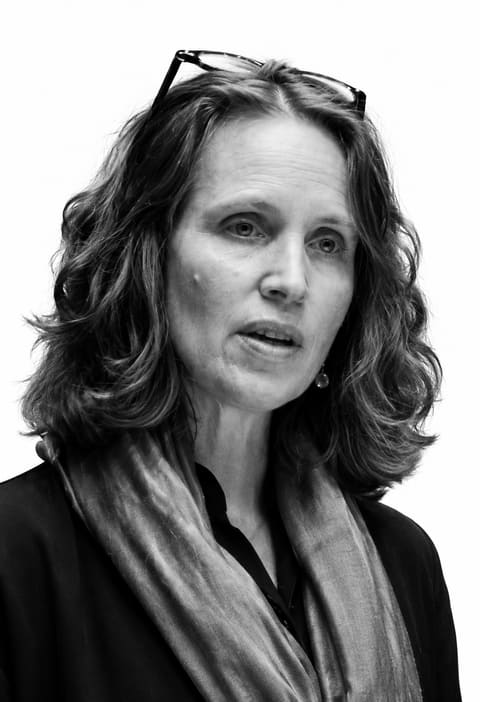
Christine Perrin
Host
Podcast Host and Contributing Writer
Read bio: Christine Perrin
Christine Perrin is a literature professor, writer, poet, and podcast host.
After teaching literature full-time at Messiah University for almost 20 years, Christine arranges her time to write, teach in Italy, and host the Composed Podcast. Christine is a graduate of Johns Hopkins University (BA in Writing Seminars) and the University of Maryland (MFA in Poetry).