Miroslav Volf: So why aren't you worth something when you have failed? The answer must be because it's success that creates your worth. The lack of success devalues you and you no longer feel like you have worth. And we do that in the absence of something more significant to define us.
Brian Williams: Hey, folks. This is Brian Williams, host of Forged, a podcast of the Humanitas Institute about forging well lived ordinary lives of discipline, delight, craft, calling that draws wisdom from the classical tradition into contemporary times. Today, I'm really delighted. My guest is Miroslav Wolf. Miroslav is the Henry b Wright professor of theology at Yale Divinity School and the founding director of the Yale Center for Faith and Culture.
Today, I'm interested in speaking with Miroslav about a life worth living and how that can be undermined by the restless pursuit of superiority. Those themes form the heart of two of his recent books, Life Worth Living, A Guide to What Matters Most, and The Cost of Ambition, How Striving to Be Better Than Others Makes Us Worse. So welcome to Forged, Miroslav.
Miroslav Volf: Thank you very much for having me.
Brian Williams: It's wonderful to have you here. So listeners, I have a sharp bunch of listeners, and, you know, they'll pick up pretty quickly that you probably didn't grow up in Connecticut where you live now or in Philly where I live. So if I'm right, you grew up in what's now modern Serbia under a communist regime, but did so as the son of a Pentecostal minister. Is that right?
Miroslav Volf: Yeah. That's that's correct. I I was born in Croatia. And then when I was five, my father moved to Novi Sad where he became a pastor of a Pentecostal, small Pentecostal church, and that's where I grew up. That's where I rebelled against faith, and that's where I matured in faith.
And from there, it is that I was called to be a theologian.
Brian Williams: There you go. That's a long that's a long journey. So but but growing up, I mean, there must have been some pretty fierce friction between, you know, being the son of a Pentecostal minister and growing up under a fairly secularist atheist regime. So what kind of messages were you receiving as a kid, you know, about what what makes life worth living, both from the home and then from the culture?
Miroslav Volf: Well, I mean, from the home, it's it's it's pretty much straightforward Christian stress on loving God and loving one's neighbors that was drummed into us. There was also a message of humility, and we'll talk about this theme, which is very important in the book, the cost of ambition. But that was part and parcel of growing up. That's from my parents' side, the home side in the school and everywhere else, I think the best way to describe is I was a kind of feeling that I was nobody. That there is no worse thing to be than the son of a Pentecostal minister, which is what I had to repeat at the beginning of every academic year when the records were written down in the big fat books of records in the school.
And then I was asked my name, my father's name, my mother's name, my father's profession. And I said he was a minister, and they didn't know what that is. They knew what the priest was, but it was a little bit suspicious. Where does your father work? That was the critical question.
He works in Christ's Pentecostal Church of Yugoslavia. Christ f what? And it it went from there on.
Brian Williams: How did you navigate that as a kid? I mean, how how did you manage that? Because I mean, childhood's hard enough, let alone to being having having that kind of, you know, what just comp cultural incomprehensibility about what your dad does.
Miroslav Volf: I mean, I I must say I was praying for the earth to open up and swallow me in cruel mercy when this was, happening. I was all red in in face. I felt, totally humiliated. On the other hand, I was pretty much liked by most of my friends and colleagues. It doesn't seem to have rubbed on them and was doing relatively well in school.
And so I couldn't it was a little bit of a tough of a of a life, but I don't think it made me worse for wear. Yeah. That's probably how I would put it.
Brian Williams: Okay. Were were there were there pivotal moments in your life where you were really confronted with this question about what makes life worth living?
Miroslav Volf: Well, I I think I think very early early on. As soon as I came back to faith, I was kinda it took for a while a rebellious son of a Pentecostal minister. I came back to faith, and then people always asked the question, why? What happened to you? And and so forth.
And central to this question were two things. One was, is it reasonable? And the second question was, is it desirable? And is it desirable because, of course, the critiques of religion were predicated on both critique of the reasonableness of faith, but also on the on the kind of ill effects that the faith has on lives of people. And so that question, what do you, especially as a young person, want to do with something as backward as is the Christian faith?
And so I would have to say from the very beginning when I was 16, that was the most important question of of my life. And I pretty soon started reading also not just literature, but existentialist philosophers who highlighted this question as a central question, defining question of human existence. And so I wrestled with it from the get go in my whole Christian journey as as a Christian thinker, as one who thinks about the Christian faith. This was the central question. How can we live with that?
Brian Williams: And did you have teachers and mentors and guides along the way who took that that seriously in you, or did you find yourself, you know, somewhat the the don't know, the the kid that thinks about big questions in the context when nobody else is doing that?
Miroslav Volf: Well, I didn't have too many too many teachers, certainly not in the school where I was attending because I was in civil engineering school, which I took a kind of shift from civil engineering high school to what was yeah. What's in Europe called Gymnasium, which is a kind of humanities oriented school in order to get into university and study philosophy and theology on the side in a small bible school. In the context of philosophical discussion, that was the question. I I think certain form, I mean, certain circles, notwithstanding Marxism, kind of existentialism of the Heidegger's type. Or even at that period, even the young the works of young Marx, which has have very much at their core the question of the kind of life that is worthy of our humanity.
So that was always a really important central as I was studying, and I pursued it then from the specifically Christian standpoint.
Brian Williams: Yeah. And one thing I I'll say to our listeners, I always appreciate about Miroslav is that though he describes himself as a theologian, he he he's really as much like a Christian ethicist, and always moving from from theology to to how do we live. So let me ask this question though, because I I think this book comes out of your experience of teaching at Yale. So was your experience with contemporary students that they weren't asking the kinds of questions that you were asking when you were 16, 17, 18 about what makes life meaningful or significant?
Miroslav Volf: Yeah. I I think that's exactly what what my experience was. And my sense was nobody opened up a a vista for them to ask that question. It's not that they are closed in principle to it. It's just that going through the high school, I I can't make judgments about a wide variety of high schools that are there in United States.
But certainly students that that come to Yale and what I hear otherwise, the the emphasis in high schools as it is in the universities as well is is is to kind of explain the world and to kind of understand the the functioning of the world, including functioning of of societies to insert oneself then and be able to be a kind of contributing successful member of the of the society. What is it that success constitutes in? That's what's left open. Success is what counts as success, or success is what pays, or success is what other people consider to be worthy of being and how one is worthy of being. So so that was left very much an individual in the sea of forces, social forces and cultural forces in which they found themselves, which I just thought it was unconscionable.
The most important question of our lives is not being asked.
Brian Williams: So you've been teaching for several decades, which in the history of the world is not very long, but have you seen a shift in kind of questions that students are asking over your decades of teaching? I mean, was it that at the beginning of your teaching career, you know, thirty years ago, forty years ago, students were aware of this question and grappling with these questions and then increasingly these have become less significant? Or do you think this is just pervasive of our kind of late modern moment that the questions of real meaning and significance and what should I be pursuing in my life have been diminished in the face of, you know, material prosperity or something.
Miroslav Volf: I I've seen the shift, but I think that that the shift is as you suggest. The shift has been going on for for for a while. I've been persuaded and partly the reason why I'm teaching the class and started the class life worth living, and and it's now in many countries and but some 80 universities it's being taught. The the reason for that is the book by a colleague of mine here from a law school who is a kind of philosopher and teaches in jurisprudence. His name is Tony Cronman.
And he wrote a book called Education's End. And he analyzed how certainly in American education at the very beginning, Harvard was founded with questions of meaning, questions of what kind of life is worthy of us that was kind of presumed what one has been trained also in it at the very center of of education. And it has his argument is that it has remained so even through secularization all the way through something like seventies, early seventies in in this country. I don't need to go into details of why why how he's arguing for this, but one important element is something that you've mentioned as well. And that concerns that increasingly we have had in the intellectual culture broadly, but in universities in particular, a dominance of natural sciences and of the methodologies of natural sciences that are after an explanation or that are then those explanations then employed in something like technical reason, instrumental reason.
And that humanities, in order to justify themselves, needed to adopt as close as possible to the methodologies of natural sciences to be respectable members of intellectual community that is a given university, which meant that the large conversation across centuries about what is what constitutes a a good life has kind of dropped into the background, and humanity has started being about explaining what's happening and why in various domains of of human activities. So I think that's that's as I as far as I can tell, that's probably kind of how the shift has occurred in the Western tradition. I I I think it's great that we are emphasizing natural sciences. I think it's dismal that we are have forgotten kind of the original intuition behind humanities and behind I think great religious traditions.
Brian Williams: Well, yeah. Because it's in the humanities, I guess your the point would be, it's in the humanities where these questions naturally arise when we're reading the philosophers, reading the theologians, reading reading the great works of literature that just invariably and inevitably raise these kinds of questions. I mean, I've often thought when I've thought about the ends of education, certainly in our contemporary university education, it seems to be that we're preparing students in universities to get a job so they can take their place in the storefront. Sometimes to be researchers so they can find a place in the research university, or maybe a certain kind of citizen so they can find their place in the ballot box. I've often thought, well, it's either the storefront, the research university, or the ballot box, but they're all still functional and none of them really raise the question of what what does it mean to live well as a human, and how how can education prepare me to to do that?
You've seen this in your students. How do you see this crisis of meaning as you described it? How do you see it manifest in your students? Because I I I think some listeners might be asking themselves, oh, am I stuck in a crisis of meaning? Is that what I'm feeling?
And so I'm wondering what what that what that feels like for students or what it might feel like for listeners who, you know, might might be resonating with this idea of a of a crisis of meaning.
Miroslav Volf: I mean, it it seems like we are, as human beings, are goal oriented. And invariably, we will set goals for ourselves. We'll strive to achieve those goals. And I think also we are meaning making and meaning seeking creatures. And when those goals themselves prove to be too light to bear the weight of meaning, it has profoundly negative effects on us.
There's a certain kind of. There's a certain kind of sense of purposelessness. There is also a kind of sense of needing always to find some one or the other high in order to foreshorestole ways of thinking and but not knowing how to answer the question, why am I actually here? What's what's the point of me? Yeah.
What am I for in a deeper sense of that word? Not just to feed myself or to lick in a certain way, but and if I can answer it for myself in regard to some some other people, then I ask, well, what are we together for? Which is simply a variant extension of that same question. And I think those kinds of questions are being asked, and I've seen also this is the last thing I will say. I've seen also that students not being able to answer the question of meaning if they are failing at what's immediately at hand or if they perceive themselves as as failing.
It's very easy for them to be very disoriented, not to know, not to have bearings and the kind of certain sense of futility and maybe despair also, and certain forms of depression settle in. So I think it has consequences in ordinary lives and day to day lives of folks.
Brian Williams: Well and certainly maybe this feeds into your book on ambition because I run an honors college, and I work with some high achieving students, and often find that there are students every semester, we're getting ready to start a new semester, and I'm waiting for it to happen this semester too, students who for their whole lives have predicated their well-being on their success, and usually in an academic context, that means their superiority over their peers, and the kind of affirmation they've received from that, and then they get into university, they get into challenging courses, and all of a sudden they fail. And it represents this real crisis of their identity because they think, oh, who am I now? Because my well-being and my person, my values, predicated on my success, and all of a sudden I just failed at something, and the self has to then be rebuilt almost. I think for some of them, they realize how how unstable it was and how fragile it was. But there's always this this, you know, period of like the the deconstruction of the self, and then how do we reconstruct the self?
And I'm guessing you see the exact same thing probably in spades at Yale where you are.
Miroslav Volf: Yeah. Yeah. I I think that's a that's a general phenomenon from what what I could tell. And I think it's connected with the idea that we have to kind of create our worth. And this
Brian Williams: What do you mean by that?
Miroslav Volf: Well, so so if I fail, I I'm I'm not worth something. So why aren't you worth something when you have failed? The the answer must be because it's success that creates your worth. The lack of success devalues you, and you no longer feel like you have a worth. You put yourself on the scales next to whoever you do, and suddenly you're a lighter.
Brian Williams: Yeah. That's right.
Miroslav Volf: And then you have lost worth. Right? And so it seems to me that that's it's a consequences of defining the self through achievement. And we do that in the absence of something more significant to to define us.
Brian Williams: Yeah. So so let me ask with respect to your book, The Cost of Ambition, How Striving to Be Better Than Others Makes Us Worse. And and I and I was saying to Miroslav before we jumped on here that I'm really finding the book compelling and and and convicting, and and I'm really grateful it, and I'm still working my way through it. So how does the pursuit of striving to be better than others, how does it undermine this life worth living? I mean, is it is it that it it creates a fragile self that that can't endure opposition or or failure, or what is it about this striving to be superior to others that that, yeah, that undermines our pursuit to live well?
Miroslav Volf: It it seems to me that it places an emphasis on what is not stable enough to give us true satisfaction or or maybe better even a sense of our our worth. If there are no objective standards, how we measure excellence, which is what happens when we whether we are in economic field, whether we are in field of politics, whether we are field of sports, whether we are in the field of education, the the standards are really not kind of objective so that one can pursue excellence within them and know that there is some standard that I can achieve and that I can think of myself as Mhmm. As excellent. That has its own problems, but but it's it's a lesser problem than the one that we've created for ourselves in absence of that. And that is that I'm constantly whatever I have achieved is constantly threatened and constantly undermined.
And that there's kind of which means that I'm insecure even when I possess it because it it it cannot be lasting. My worth is then at sea all of the times, and it's kind of the boat is rocking.
Brian Williams: Because my value or my worth is not predicated on, like, what I'm actually doing, but it's predicated on somehow doing it better than other people and having that that that that betterment, if you will, acknowledged by somebody.
Miroslav Volf: Yes. Yes. You put it put it quite quite well. The the the only criterion that I have is how I stack against Mhmm. Against others.
And as you also added, this is not simply a private affair between me and that and that person because my worth is not simply what somehow I alone in my quiet hour know about my performance, but the worth is also how I am seen by by others. It it is a kind of a social social category. Yeah. What I find that it it also does, it devalues any kind of forms of goods with which I shore up my achievement. For instance, I get myself a certain I I dress in a certain way.
Now I haven't decided to dress this because this is of aesthetically pleasing to me. And so that I would dress this way no matter how It compares with what others do. Great. I mean, there are such people among us, and they're they're fantastic exemplars. Mhmm.
Bill Cunningham used to make a make a living in part from taking photos of New Yorkers who who dress in a in a in a kind of funky, their own Yeah. Style of a style of a way. But but but in any case, the the in this case, the dress or whatever it is that we have has lost value that it has as itself. It has no intrinsic value. Its value is indexed to what this does for my standing.
So so I empty of value everything else by by wanting it to redound to my own
Brian Williams: Mhmm.
Miroslav Volf: Value, which is to say somebody might might love a piece of clothing, go to a party, and somebody's wearing exactly the same piece of clothing. And and that piece of clothing that I liked so much suddenly is devalued because somebody else also is wearing even though aesthetically in any other ways, it's lost none of its qualities. And and to me, that means that the whole world that surround us is kind of employed in this means of competing to be somebody in the eyes of somebody else.
Brian Williams: Now listen. We're both educators, and so some of my listeners will have heard me giving a talk that I've given in schools around the country on the history of grades and grading. And I call it teaching students to feel pleasure and pain at the wrong things, which is riffing on Aristotle because grades and grading were actually invented to rank students against one another for scarce prizes. They served no pedagogical value. They were not driven by any educational philosophy.
They purely existed to rank students. Even at your own Yale, maybe you know this, Yale invented the four point o scale, which emerged from the private journals of Ezra Stiles, the president of Yale. But get this, he ranked his Latin and Greek students in four large categories and gave them names, and then those were translated into ordinal numbers, one, two, three, four. And so Yale started keeping a record of student scores, and they put them in these four ranks. But here's what I love.
They called it the book of averages, and not only did they keep it secret from students because they knew it would create toxic competitiveness, they wrote it in hieroglyphic code. So even if even if a student came across it, they wouldn't know how to interpret it because they feared at the very beginning what knowing your grade would do when you realized how you rank against some somebody else at that fine level of like, I have a I have a, you know, a 3.9 and you have a 3.91. And so it's like we're nurturing children all through their grading their their schooling system, the and we're using this this techne of grades that is just teaching them to to rank themselves against one another.
Miroslav Volf: And instrument in the process instrumentalizing the knowledge.
Brian Williams: Education. That's exactly right.
Miroslav Volf: Itself rather than learning because it it it is intrinsically valuable thing.
Brian Williams: That's exactly right. Because I I find that my own students I I don't I I practice the old version of Yale. I don't let them know their grades, and they have to ask me for them. And usually, they're not interested in their grade. They're interested in their grade, what, in, like, you know, contrast to somebody else's grade because they they wanna know, and so it it's this kind of toxic competitiveness just built into built into our systems.
But let me ask you this question, because I know you you you reflect on this. How do we avoid pursuing superiority while also nurturing the drive to pursue excellence? Right? Because I I think with some people, we might say, well, don't They're like, if if I'm not caught up in that, then maybe I'm content with being mediocre. Maybe I'm content with the mediocrity of my life.
So do you think the pursuit of excellence is in a in a field is good, and how do we distinguish that from the pursuit of superiority?
Miroslav Volf: Yeah. I think a student who says what what what you have just said, how do I know that I am kind of then then excelling is already given given in to the idea that excelling is always the the something that happens in competitive relationship to to somebody somebody else. It would seem to me that we can excel. For one, we can excel when we compare our today self with our tomorrow self. We are we can see the the the improvement whether that's in playing an instrument, whether that's in learning another language, or whatever that that is that that matters to us.
And and so pursuit of of of improvement in that sense seems to me the intrinsic to the nature of doing something that I love to do and therefore I want to do and be able to do with greater excellence and and better. For myself, I think that the strongest motivation and healthiest motivation is developing love for the thing for its own sake.
Brian Williams: That's what I was gonna ask. It seem it seems like it's the it's the pursuit of something that that I love, that I recognize as good, and that that delights me regardless of what how however anybody else is is pursuing it. Right? This is the Yeah. This is the wonderful thing about the word amateur.
Right? Being an amateur saxophone player is wonderful because it just means you're a lover of it. You're not being paid money for it. You're just pursuing it because because you enjoy it or soccer player or whatever it happens to be.
Miroslav Volf: Yeah. I mean, we we do live in a society that is, from a to z, almost all domains are governed by striving for superiority. And it's very difficult, whether that's in academia or or in other other domains, it's very difficult to be part of that. It's difficult to be hired as a as a professor. It's difficult to graduate.
It's difficult to hire to to teach. And so it is in other domains as well, competitions among musicians and artists. Everything is based on competition and the kind of gaining of reputational capital in this way.
Brian Williams: Hey. You in The Cost of Ambition, you spend a long chapter with a thinker that has been significant for me since I read him back in my undergrad days, and that's Soren Kierkegaard.
Miroslav Volf: Mhmm.
Brian Williams: And I find myself circling back to him probably once a decade, and I used to teach sections of his book, Works of Love, in a high school class when I used to used to teach that. But one of the most important books for me was the book you spent some time with called Sickness Unto Death, and it's a small book. It's actually on my shelf right next to me, and it's a difficult book, But I wonder if you can just say how how Kierkegaard in that book helped you frame some of your thinking around the toxic nature of striving for superiority and the relation, how that maybe manifests or or emerges from a a misrelation of the self to the self. Can you just unpack how how Kierkegaard, like, helped you, you know, frame some of these questions?
Miroslav Volf: I I think this the the the self, if I understand Kierkegaard correctly, the the the self that he is interested in is the self that doesn't establish itself or or himself or herself, but is established through that which establishes the In in other words, it is a self that that is a creature. It it it and which means that it it is a self that is a gift to itself. And in that sense, that which by striving for superiority we strive to achieve, that's always already given by the sheer fact of our humanity if I recognize it properly. And that's why he has this marvelous meditation on worry. And when Jesus says that we shouldn't worry what we should wear, if we look at lilies, but then if you look at Solomon, Solomon in all his glory, the the lilies are more beautiful.
The Solomon is in all his glory. And so glorious king and and a humble lily are being compared. Humble lily is is is more beautiful. But humble lily is less beautiful than a human being and valuable than a human being, which from that it follows that Solomon, qua human being, is more glorious than Solomon as a royal potentate.
Brian Williams: Mhmm. And I think that's what I found so compelling in his reflections in that book that to feel the kind of integration or harmony of the self, that we have to receive the self that's been given to us and not pursue a self that wasn't given to us or demand to be another self than the one that we are, but to recognize that we are gifts to ourself. In doing in receiving that gift and not comparing ourselves to others, we find ourselves experiencing and I can't remember if he uses this language, and maybe you know, the language of a of a kind of contentment or a language of of of an internal harmony or I mean, I I don't know. I I there's another author. I like Hartmut Rosa who uses the the phrase, like, resonance or something like that.
Right. There's a sense of, like, contentment or wholeness in myself Yeah. When I'm no longer striving to, you know, compare myself or to be a a self other than the one I am.
Miroslav Volf: Yeah. That that kind of theme is also again in the in that meditation on on the lilies in the field. When he tells the story of that little lily whose whose self image gets spoiled by the naughty bird that compares the lily to other lilies. But prior to that, that that lily lived contented in the environment where where it was as as it it was. And I think that this idea of contentment is it is so fundamental.
And a kind of retrieval of that idea, especially in the context of striving for superiority seems to me very important. Nicest expression of of the kind of contentment that I know of is comes in Paradiso, early on in Paradiso when Dante comes to the souls who are at the bottom rank of of heaven. And then basically, he's trying to figure out how it is that they can be contented when they're on the lowest rung of the large hierarchical scale, and they know it. And then the response is of the of those souls is actually amazing. Mhmm.
And they say, we long for what we have.
Brian Williams: Isn't that beautiful? It's the character I think the character is Picarda Donati that he's asking this question to. And she says, in his will, my peace. We long for I mean, it's it's beautiful. And that sense of, like, this is where I wanna be.
Miroslav Volf: Yeah. Yeah. I I mean, it's fantastic. And I think that the sense of of of self as it is, the the the goodness of it and resting in that goodness, whatever the self is, and self is a dynamic dynamic thing. Movement might be there, but it's not reference to something we need to catch up with.
Brian Williams: So let me ask this question. When we're thinking about the contentment of the self, the contented self, and the self that receives its own self, the person we I receive myself as a gift. So if I'm not to focus my accomplishments in contrast to other people's accomplishments, what is it that I am attending to or pursuing given the nature that I have? Right? Our different natures flourish in different ways.
My dog, Luna, I went with a run with her this morning, and then I got her food and water, and she's sleeping on her bed. That's a flourishing dog.
Miroslav Volf: Yeah, yeah, there
Brian Williams: we The plants and trees outside my window right here, they need water, nutrients, sunlight to help them flourish. Because we each have different natures. So so Yeah. What is it that we as humans pursue given the nature that we have so that we can, you know, find ourselves flourishing and and contented? How how do you describe that?
Miroslav Volf: So so I think of it think of it this way, and and basically goes back to to Martin Luther. I think of two occasions that human beings have. One is a vocation as a human being to become a member of God's reign, God's kingdom. And it's the vocation to recognize that we are beloved by God before we have thought a single thought that we were loved into existence. And it is also a vocation to love the source of our being and love that which that source of our being loves, to love our neighbors, to love more broadly god's creatures as we love ourselves.
Now that's an that's the same calling every human being
Brian Williams: has. Now
Miroslav Volf: each of us satisfies or fulfills that calling in our own way. And we often fulfill it through a calling of a different stripe which comes in plural. In many callings that we have, varieties of things that we can be doing with our lives, how we can employ our talents. But they're all regulated with this basic orientation and and the basic kind of foundation of the human foundation of God's love and orientation toward loving as God as God loves. So then I want to ask, well, what is it that in my own life, what do I discern that has, that gives best expression given my talents Mhmm.
To this general calling that that I have. And I think in in this discernment, we are often helped by others. We might not quite know and understand until I give a gift and see it received. I don't know whether I have a capacity to give right this type of gift in the right kind of kind of way.
Brian Williams: Okay. Who did that for you? So so so who helped you discern your own vocation? What what did you find yourself being affirmed by a community when you gave and and the way you've described it, like, gave a gift, and were there people that said, oh, Miroslav, when you do that, people seem to respond well, or you you do that well or seem to love it. Did you have those kind of moments?
Miroslav Volf: Yeah. I did. I I did. I had moments also. When you do that, you're not doing as well as you you could or you do in some other domains.
So so the so the no.
Brian Williams: So that's the way that's the other way it goes.
Miroslav Volf: So the no was it was it was not a mean no. It was kind of a gentle, but kind of honest no, and maybe it was a no that I saw less than it was directed directly at me.
Brian Williams: A bit of a Miroslav. Miroslav. Let me invite you to consider that. That might not be your gift to the world.
Miroslav Volf: Yeah. Right. Right. Or when I was preaching in village churches, which at one point I thought my my calling was to be a minister in the Former Yugoslavia, And I I realized the kind of blank faces of of these of these folks, and I realized how how incompetent, how how mute in a sense, notwithstanding all my speech I was with regard to them. But on the other hand, you know, some of my teachers, professors, when I wrote a piece, they thought, oh, this is really cool.
I you should do more of this. And so roughly that's how that's how it how it went. I think for me also, and maybe that's that's unique, but but I think there is something also about the place that has nurtured us. And a certain form of gratitude that one ought to have and reflect on what might be the best way to express that gratitude. What what do I owe to that which has brought me to be where I am?
That was really a very important question for me. Say more about that.
Brian Williams: Can I get can I stop you just can you say more about that? Do you mean like the the actual I mean, because that could be for for many people different kinds of communities for which they have gratitude that gave them something. I mean, that could be one's family, that could be one's local community, one's nation, one's church. Could you just say a little bit more about that for you? What was it that you felt?
I mean, you felt a certain gratitude, and therefore, a certain desire to give back to whatever it was. But just just unpack that for us.
Miroslav Volf: Sure. Sure. So so I was as we talked, I was raised in Former Yugoslavia. That's where I was also also trained. When I studied, I studied it with a sense I am going to return, and I'm gonna serve in whatever capacity it is in those those communities.
After I served for a while, I I was I was encountering some obstacles. And I wasn't sure whether those obstacles were temptations to give up and that I should kind of plow through, or should I take them seriously? And some of it was a question of what do I owe to particular community that has made it possible for me to be who I am. I do think that we owe something I owe something to my parents. I owe something to my brother-in-law, for instance, who played a very significant role in my intellectual development.
So so maybe the only thing I owe is gratitude. But but I think I felt I owed a bit more than that. And so basically what I did at one point, I was involved in Roman Catholic Pentecostal dialogue with the Vatican. And there was a at that time, a former professor of patristic theology who was a monk. And he ended up being then a preacher to the papal household.
He left his post. And for thirty, almost forty years, he preached every every lent to the papal household. Vraenario Cantalemesa, he's still alive. So he's amazing. And I thought, oh, you know what?
He's the person who I should ask to to help me discern. He has a sense of what monks call, that there's a location Mhmm. To which I need to be faithful. But he also has a sense of a global universal church. So I told it.
My dilemma because, you know, abroad, I was publishing articles. People wanted me to come and teach there, and I wasn't sure that I should do that with her. And then so after about an hour and a half of walking with him through through the garden in Venice, Basically, he told me he gave me permission. Yeah. Miroslav, you clearly have been calling.
I recognize that in you you should you should feel free to go in that direction.
Brian Williams: Which would be leaving your home country. Which would be leaving Leaving that country for which you felt a debt of of gratitude and a kind of obligation to care for and love. Right?
Miroslav Volf: Yeah. Exactly. Exactly. And so that's that's exactly what that's then what what happened. I went to teach.
At that time, I had a call from Fuller Theological Seminary to teach there. So that's how I ended up in United States.
Brian Williams: Well, and I was at Regent College for a long time up in Vancouver, and I think for a for a short moment, we were hoping that we might have Miroslav come up to us for a little bit, but it didn't didn't pan out. But so so what are you saying that that part of our vocational discernment as humans should include considering those communities or cultures to which I might have a debt of gratitude. Because I was asking what kinds of things should we pursue or attend to so that we do not become consumed with, you know, comparing ourselves to others? Yeah. And you said, yes, becoming part of the people of God, but then also these kind of unique vocations.
And am I right? What you're saying is part of that discerning my own unique vocation is discerning what communities to which communities might I have a kind of a debt of some sort.
Miroslav Volf: Yeah. Or I would put it this way. I may have a unique vocation. In my case, it was being a theologian. But but there is also discernment where.
Brian Williams: Right.
Miroslav Volf: I mean, we we are we take it for granted because it's a very mobile societies in in which we live that a place is kind of irrelevant.
Brian Williams: Yeah.
Miroslav Volf: And and maybe it's becoming that, but in many parts of the world and for many people, it's not irrelevant. There are kind of roots that I have in the place. And even now, I I think so if I had a call to go somewhere else, if I wanted to pursue and go somewhere and not be anymore at Yale, what would what would happen to the community around me here? Yeah. Folks who work with me at this at the center, I feel like I have a responsibility.
Mhmm. I would have to say, receive yes from them.
Brian Williams: Yeah. That's right.
Miroslav Volf: So that so that it doesn't end up being destabilizing
Brian Williams: Well, for and so that it's not just so that it's not good for you and bad for them. Yes, Right? And that that's what it is. We grapple with this with my students every semester. So a little bit similar to your course, I teach an incoming freshman course called The Good Life, and a last semester senior course called The Ordinary Life.
And the last thing we do in The Ordinary Life class is we read Wendell Berry's Hannah Coulter. And so much of this book is bound up with the question of education and place and community, and whether you're going to get an education to go find a better place that probably doesn't exist, or to come back to your home place and make it a better place.
Miroslav Volf: I should read that book.
Brian Williams: It's really good. It's one of my favorites by him to be sure, but it raises this question. We always have this conversation because I'm not somebody I've moved around. My kids were born in three different countries, and I've lived different places, and I don't know the good, like my in laws who live in rural Kansas, of living in the same place with the same people for decades and generations. There's a good I just will never know Yep.
So it's this larger question, not only what do I wanna do, but where should I do it? And can I pursue, like you perhaps, can I pursue the vocation to which I'm called in the place in which I happen to be living at the moment? And for some of us, it's yes, and for some us, it's no. But it seems like that's that's a question that we need to grapple with when we're thinking about what makes life worth living.
Miroslav Volf: Yeah. Yeah. I I think so. I I I think decisions have to be made kind of in a global way. But, also, it's very, very specific what kind of this my life is one thing to, in general, think think about it, but I think we have to think in specific terms as well.
Brian Williams: So let me let me ask you a question about practices because I know in in the book Life Worth Living, you you you and your coauthors in in the book with a with a section on on practices and rhythms and routines because you and I can sit here and think about this, and we might have listeners who are saying, Oh, yes. I want to pursue a life worth living. I want to give that up. But it's very hard to just will ourselves in a new direction. To wake up on a Tuesday morning could be the kind of person I've never practiced being.
So when you're trying to help students think about this or people who are in a career with a family, what kinds of things do you recommend to them? How do we end up how do we embody some of these things we've been considering or how do we start practicing them or are there practices that you've built into your own life? Because I'm sure like me, you've experienced your own, you know, your own share of, you know, striving for superiority. I know that feeling. But what are some habits and practices that people could think about that might help reorient them or begin to reorient them?
Miroslav Volf: So sometimes when people ask me questions like this, basically say, you know, I'm a systematic theologian, which is to say that I'm impractical.
Brian Williams: But I say you're not. I think I disagree with you because I think you're coming out with book after book after book about how we live well. So so so I think you're not. But are you leading up to say you don't know or just just to
Miroslav Volf: be I'm basically careful with it. No. No. I'm basically saying I I I I I don't know. I know how I how I do how I do things, and I I have certain disciplines of of of getting up and how how I how I start.
But then I can also be very undisciplined person depending on what season I am. I mean, how tired or not I am. So so I don't have a a a kind of clear clear sense of what what I would advise. What what for myself was really very important is I have kind of allowed myself to follow my nose, so to speak, or to follow the love that I felt for something. And trust that that and and and it had a grip kind of on me.
And and maybe it's a feature of my of my character. If if I don't start writing, I I procrastinate. I don't know what to do. But once I start writing, it pulls me.
Brian Williams: Okay. Okay.
Miroslav Volf: And I I think that's how I am in many other domains. So
Brian Williams: Fine. So let me ask this question. So Forged on the on the podcast, we we attend, as I said at the beginning, to disciplines, delights, crafts crafts and calling that constitute a well lived ordinary life. So let me let me take you through each one. So discipline, the first one.
What's a discipline you have pursued that has sustained you over the course of your life?
Miroslav Volf: Getting up regularly and doing what's under my nose, what needs to be done.
Brian Williams: Okay. Fine. How about delight? What do you especially delight in?
Miroslav Volf: I delight in in in music. I delight in I delight in physical exercise.
Brian Williams: Do you play an instrument?
Miroslav Volf: I used to play. Not not so much not so much now. I used to play in a band, actually. I was playing guitar. And I was I was trained as a violinist for about seven years.
I I did I did violin, which which I'm I'm hoping to return to.
Brian Williams: Are you? Are you gonna pick up the violin again?
Miroslav Volf: I need to. So my my violin, I I haven't played it for a while, and it was first in the wet conditions and then dry, completely crumbled. Each part is okay.
Brian Williams: Okay.
Miroslav Volf: But they've all unglued.
Brian Williams: Okay. Fine. And and physical activity, what would you did you grow up playing soccer like I did, or what what was your sport growing up over the years?
Miroslav Volf: Mainly soccer, some of some basketball Yeah. As well, volleyball Okay. As well. I've gotten then into cycling. Right now Mhmm.
I kind of shift a little bit. Right now, maybe, like, two months ago, I started regularly swimming. So so that I and I I'm having a blast. Okay. Yeah.
Brian Williams: That's great. Alright. So discipline, delight, craft. Is is there a craft you've pursued over the course of your life or one that you would love to pick up?
Miroslav Volf: I haven't pursued a craft. But if I would if I would love to do anything is working with wood. Wood seemed to me such a beautiful Mhmm. Material
Brian Williams: Yeah.
Miroslav Volf: To to craft things. I wish I was more artistically minded. I love art. I have artists as friends. I collect art.
But I can't write a poem. I can't craft any any piece of art, but immensely delight in that.
Brian Williams: Yeah. Great. What about calling? What's your calling, Miroslav Wolf?
Miroslav Volf: I think my calling is to be a theologian is probably too too abstract and too academic. I think my call is to to think what it means to be a Christian in the here and now. And that's why my books are sometimes very theoretical, but that they're always tied to concrete questions of life. And they're kind of systematic in in a sense, and there is a system in in how I construe the life as a whole. But what matters to me, kind of the the pulse of lived life.
And to think that through and motivate myself and others to live a life that's worthy of our humanity.
Brian Williams: Okay. I I like to end by asking guests if they've had a a poem or a passage that has become meaningful to them or significant to them over the years. And did you did you choose a passage or a paragraph?
Miroslav Volf: One of my favorite passages recently comes from a kind of circular letter that my own teacher, Jorgen Altman, sent after he had celebrated, I believe it was 90 birthday. And all of his life, he was is this he loved life, and it there's something really beautiful, I always thought. And then comes this this letter with this passage. I think it's a year and a half or so before he died. Every morning, I'm amazed that I'm still here.
To die means to let go. I'm preparing myself for this. To die means to give one's life over to god. I'm preparing myself for that too. The rising to eternal life is my hope in life and death.
The eternal life will be also lived. This is the life of God's new creation. Death is like a birthday to new life in God's kingdom. Every morning of every new day, that hope gives me new courage to live. But I did not invite you here to ponder things with me, but to rejoice with me.
Let us toast to life here and there. I loved this ending. Right? It's I mean, he's writing as a as a person at the end of his life. And then this toast to life that still isn't that he has lived and that other his friends live with him in communion with him.
And then the toast to life in heaven. I I've never heard anybody give a toast
Brian Williams: to life
Miroslav Volf: from there. And I I love it.
Brian Williams: Well, that's beautiful. Beautiful. And we'll leave it there with the last word for Miroslav and his own his own teacher, Jurgen Voltmann. So so thank you. And thank you, Miroslav, for your time.
I'm deeply grateful for this conversation.
Miroslav Volf: Great to have conversation with you. I I really enjoyed it.
Brian Williams: That was wonderful. So I've been talking with Miroslav Wolf about what makes a life worth living, the corrosion of competitive ambition, and reclaiming a more contented and joyful way of being human in the world both here and in the future. So with that, we'll wrap it up. You've been listening to Forged with Brian Williams, a podcast of the Humanitas Institute about forging well lived ordinary lives through discipline, delight, craft, calling. Thanks again, folks.
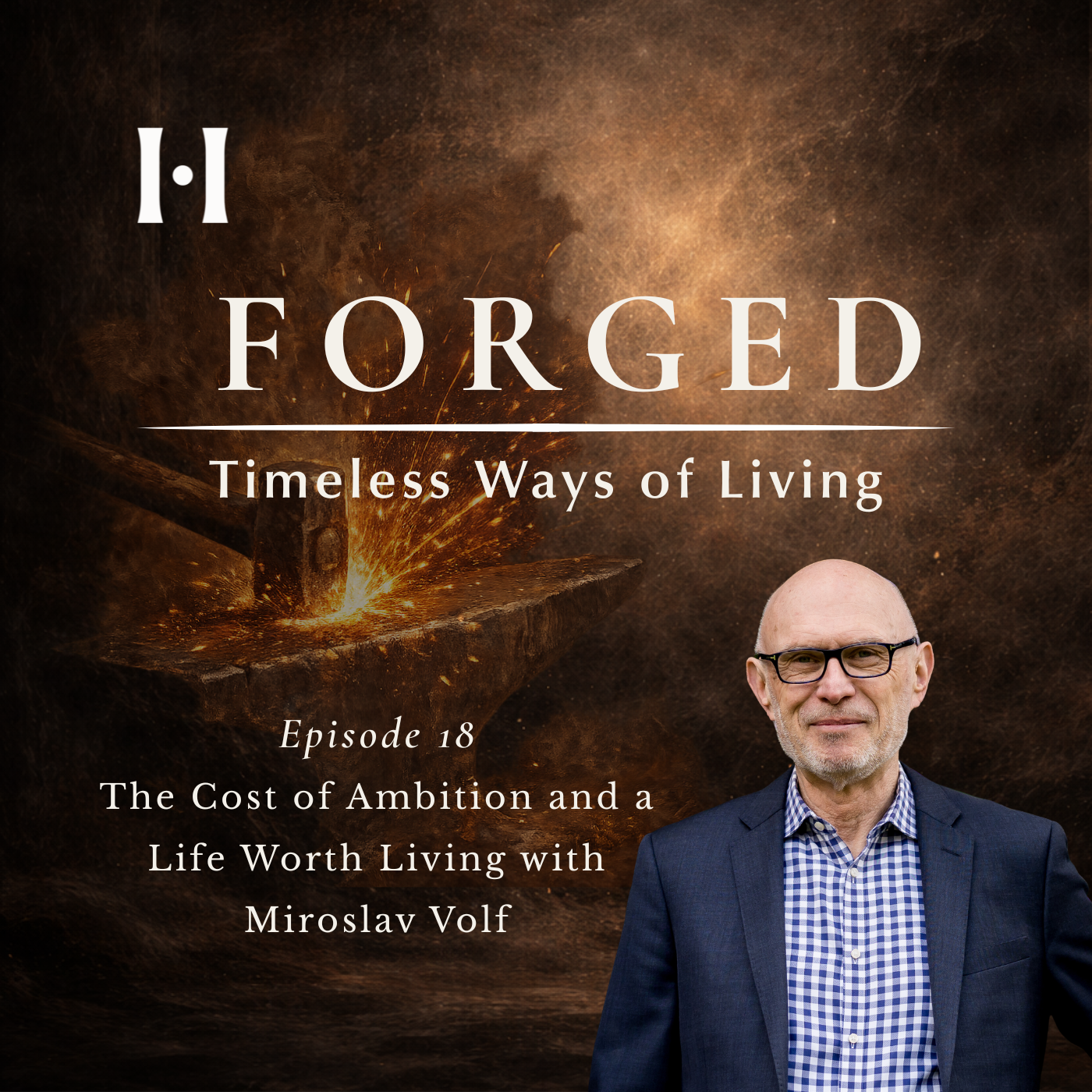
Forged: Timeless Ways of Living
The Cost of Ambition and a Life Worth Living with Miroslav Volf

What happens when your sense of worth depends on being better than the people around you? And what changes when you stop asking how you rank and start asking what kind of life is actually worth living? Brian Williams talks with theologian Miroslav Volf about the difference between excellence and superiority, the fragility of a self built on achievement, and the possibility of receiving our lives as gifts rather than projects of endless comparison. Drawing on Life Worth Living and The Cost of Ambition, they consider education, vocation, place, gratitude, contentment, and the communities that help us discern what we are for. Listen for a hopeful account of how we can pursue meaningful work and genuine excellence without making success the measure of our worth. Along the way, Volf reflects on growing up in Yugoslavia as the son of a Pentecostal minister, discerning his calling as a theologian, the disciplines and delights that sustain his ordinary life, and the writers who have helped him think about contentment, vocation, and hope.
Contributors

Guest
Miroslav Volf
Miroslav Volf is the Henry B. Wright Professor of Theology at Yale Divinity School and the Founder and Director of the Yale Center for Faith and Culture. His many books include Life Worth Living: A Guide to What Matters Most, The Cost of Ambition: How Striving to Be Better than Others Makes Us Worse, and Glimmerings: Letters on Faith between a Poet and a Theologian.
Featured Links

Host
Dr. Brian Williams
Podcast Host and Contributing Writer
Brian A. Williams (DPhil, Oxon) is Dean of the Templeton Honors College, Professor of Ethics and Liberal Studies, and Co-Director of the MA in Classical Teaching at Eastern University in Philadelphia. He is the founding editor of Principia: A Journal of Classical Education, speaks internationally on classical education, and serves on several academic and educational boards, including the Classic Learning Test (CLT). Previously, he taught at Cair Paravel Latin School and the University of Oxford. Dr. Williams earned degrees in theology and Christian ethics from Regent College and the University of Oxford, and his research focuses on education and formation in the Christian Intellectual Tradition. Brian is a runner, art collector, and traveler, having visited over 40 countries, often in search of sites and cities of the ancient world. He is married to Kim, a visual artist and teacher, and has three children: Ilia, Brecon, and Maeve.
Related Resources
_1x80oX.png)
Teaching Children the Fruit of Longsuffering
A new generation of parents has arrived, people who love their children more visibly, more anxiously, and more attentively than perhaps any generation before them. They read the books, they watch for the warning signs, and they would lay down almost anything for the good of the child in front of them. Yet many of these same parents struggle to tell the difference between play and scholé , or between protecting a child from cruelty and protecting a child from difficulty. These are not the same acts of love. One forms a soul while the other, however tenderly intended, can quietly deform it.

Why Nolan's “Odyssey” Is Inspiring Adults To Learn Again
America's fascination with Homer suggests adults are hungry for a kind of formation classical education has been offering all along.

Will Sports Prepare Me for Life?
Character developed in sports may not impact life outside of sports.