Grant Holbrook: The structure of the high school education I got, the teachers just wouldn't have had the capacity to know us. I was thinking about this because I've... 43 seniors this year, some of them I've known for eight years and I've been... I've known the kids since they were much smaller than they are now. That is not like the world of going to school that I grew up in.
The most important things in our lives are gifts and they're given in light of our not even knowing what we need to ask for it to be given. Mhmm. It's like the best gifts are handed to you to you not knowing the question to even proceed it with.
Christine Perrin: This is Christine Perrin, host of A Timeless Way of Living, a podcast of the Humanitas Institute that explores living patterns of virtue, craft, community, and delight, and draws the classical tradition into contemporary times. Grant Holbrook, welcome to Composed. Grant is a... An upper school teacher at the Veritas School in Richmond. He's taught there for eight years.
He teaches the humanities, and included in that is theology, rhetoric, and Hebrew. He learned Hebrew at seminary, I think, across the street.
Grant Holbrook: That's right.
Christine Perrin: And and, you know, in fact, I hope we get to talk about that across the streetness today, because you've chosen to be and stay in Richmond, and and fruit has been born of that decision. But I I wanna start with you telling us a little bit more. You're also a husband and father. I wanted to add that to your bio. You telling us a little bit more about how you came to be where you are, thinking through your history and your growing up, and what drew you to be a person who loves Augustine and wanted to learn Hebrew and and loves students and teaching.
Grant Holbrook: I mean, I I was born in Southern Missouri, raised by Southerners, which I always feel like is an an important thing to mention. Southern Missouri is not technically the South, but the family was from there. And I was I was enjoying conversations with people where they've come from a particular place.
Christine Perrin: Absolutely. Yes.
Grant Holbrook: So I'll lay that on the table now. But I moved to Virginia when I was 12 to Richmond. My father got a job in Richmond. We went out there. I was a public school kid.
Always did fine in school. Went to went to BCU in Richmond. Was interested in religious studies because I kinda had this inkling that I'd like to know more about this. So I did that, and then took a Hebrew class, really enjoyed that. And eventually ended up deciding I'd like to be a professor.
I think that's that's the route that I take. I I wanna I wanna be like the teachers that I had, the New Testament and Old Testament professors I had, like Rabbi Spiro from doctor... Or from from VCU. And so I ended up at the corner of Brooklyn Westwood in seminary. Had a a very international, very...
An Old Testament department that punched above its weight in terms of the size of the school. We had a a great Old Testament department. Old Testament departments are full of kind of it's a happy word, oddballs, mavericks. It's it's it's your strangest group of scholars, I think, in any in any given seminary of the Old Testament people, so I knew they were my people. So I was...
We we did that for years. My wife and I got married in the midst of that, and I was gearing up in the middle of dissertation work. We had our daughter, and it wasn't looking particularly good in terms of job prospects, and we were trying to figure out... You know, we're kinda one foot in, one foot out when we got married. Always ready to go to the graduate program or maybe when I finished up that first professor job that would lead from one place to another, you kinda bounce all over the country chasing whatever, visiting fellow this or visiting fellow that.
Yes. So we were always ready to leave from the time we got married. After about three years, the job market was kinda closing and the economy wasn't doing really well, and we said... Mean, collectively, this happened in our little apartment up on up on the 3rd Floor. I said, we should we should just live like we're staying put.
Aaron grew up in Richmond. I'd been here at at this point, you know, I'd I'd been there in Richmond for a long time, even by that point. So I said, alright. We'll just we'll just commit to being here. You know, we have family here.
We know the city. We love it. So we did. And then one day we opened the window, and we heard the sound of children playing outside. What is that?
And the school had moved in across the street. So...
Christine Perrin: What a fairy tale that is.
Grant Holbrook: I was recommended as a way to get a job. She always says a job should
Christine Perrin: Open the window.
Grant Holbrook: Open the window, and hopefully it's across For
Christine Perrin: children's voices.
Grant Holbrook: You hear that sound? That's the playground. So a classical school moved in across the street. I'd never heard of classical education. I was gearing up to be a professor because I wanted to be a professor of Bible and theology like the great professors I had had.
And, well, we needed a place to live. They had apartments on campus, so we moved across the street. We lived next to a family, the teacher and family. I went to some of his lectures. Job came open.
I interviewed for it, and I got it. And my daughter started kindergarten there when I started teaching, and so I suddenly became a teacher of of teenagers, which I had no notion of doing at all. I hated high school, so it was an interesting choice.
Christine Perrin: That's fascinating. I think I do wanna hear more about that, about hitting high school and then teaching high school. But I think also what I'm hearing in your narrative so many wonderful things. One is that beauty begets beauty. Mhmm.
That this love of your wonderful, beautiful professors that gave you these, you know, honey filled, you know, thoughts and tongues that created in you a desire. It beget in you a desire to do likewise and to pursue.
Grant Holbrook: It did. The best teacher I ever saw was my baby Hebrew teacher. Yeah. They said that... Which was what they called it in in seminary.
I always tell the students, can't call that, you all are too young for me to call it baby Hebrew because that would be demeaning. Oh, good. It's baby Hebrew if you're in graduate school. But he would he would be in the back of the class. He'd be teaching these four hour a day, six week long summer classes in Hebrew.
You know, people who've come back to school and wanna be pastors, and he'd watch the room. And when people's eyes would start to roll back in their head because of all the Hebrew grammar at 02:00 in the afternoon, he would suddenly step into a story about the Judean wilderness and the year he spent with his wife there, or ministry in the mountains of North Carolina, and it would it would come back around to the lesson too. It was this this he had he he had his ear to the room in a way I've never seen another teacher do, and it was it was so good. You you were... I talked to people for years afterward, and they would just say it offhand, you know, doctor Brisson's baby Hebrew class was the best theology class I ever took.
You know doctor doctor Brisson's Hebrew class was the best pastoral theology class I ever took. It was the best theology class. It was the best every kind of class.
Christine Perrin: Even though it was a Hebrew class.
Grant Holbrook: Even though it was introductory Hebrew, the kind of thing you might wanna teach with toys, which which I do. I have a lot of toys in my podium. So it was it was in the most kind of elementary class that you could take that he was that he was just... And he would say things and the kind of things I I pulled them out for my students too. He would say things like, I'll stand beside you and look for God's future when the past collapses.
Christine Perrin: And then just move on?
Grant Holbrook: Wouldn't elaborate. So he would just leave it. I'd write it in the margins. And so it... Things would just stew.
I think about them for years, what does he mean by that? You know, three things are needed for good interpretation, context, language, and a broken heart. And it took me years to... I'm not sure I totally understand, but I have a notion as to what he meant by it. But this is Yeah.
It's what he was doing all the time.
Christine Perrin: Seating your future self Yes. With these thoughts.
Grant Holbrook: And so I always hope that I can... You know, I I I keep some of those sayings actually in my podium, and every once in a while, you just you just pull one out, you know, and just say something like, he would say something like, when when people talk too long about God without stuttering, I begin to wonder just how familiar are you with the almighty? And and those kind of First
Christine Perrin: of all, it strikes me that you were the kind of student that wrote these things down. Then it strikes me that you were the kind of person that took them in and thought about them for years. And that you're the person that wants to give students something that they can chew on, that they can grow with. I I talked to a a student who came at age 15 from Russia and didn't have much English, and and came to study here. Mhmm.
And she said what she realizes now, as a 30 year old, is that those teachers were teaching to her adult self.
Grant Holbrook: Mhmm.
Christine Perrin: And not just to the person in front of them. They read hard books. They took them seriously with them. They stood next to them. They expected a broken heart.
All these kinds of things. Those seem like patterns that you were given, that you that sound traction in you, and that now you're giving back to others.
Grant Holbrook: Oh, I'd try. I mean, because then your whole life kind of becomes this thing that you draw forth and try to set in front of a text on any given day. As you're reading the book and thinking, you know, I think there's something from my grandfather's life that would work here. Right? You know, I I could get into that discussion, but we should get in in a particular way.
And so I was kind of looking for that.
Christine Perrin: Well, love that phrase that you just used. Your whole life becomes something that you draw forth and set in front of a text. Could you give an example of that? I mean, you just mentioned your grandfather, but you didn't mention a text.
Grant Holbrook: So in... So I've been... The last six years, I've been reading Augustine's City of God with seniors. So I've I've read the book a lot now. And not every not every page because it's 1,100 pages long in each, but a lot of it all year in in theology.
And and there's... I always I always get the kids geared up and say, I can't wait till we get to the demon mediators in book nine because it's one of my favorite parts of the whole book because that phrase demon mediator just has such a nice kind of ringing quality that.
Christine Perrin: Sounds like an anime, you know, film or something.
Grant Holbrook: I mean, Gustin does all these strange things in the book, like, where he'll end up at very orthodox doctrines, like the incarnation, but he'll he'll... In that first half of the book, he'll get there in these kind of back alley, long way around versions of it. He'll go through neo platonic philosophy and contemporary problems to him, and then you end up at this very kind of orthodox place, but you've got there in this way that puts new eyes on the whole thing. He does it over and over again in that first half of the book. But in this demon mediator's part, there's a section where he's talking about...
He says, so demon comes from the Greek word daemon, which means knowledge and knowing. So he ties the idea that demons have have knowledge but but lack charity. And it becomes this way that he describes demons being incapable of interior change and repentance because they they're capable of knowing a great deal, but incapable of love. And love is this force that changes, and that and that oddly enough is so tied up in human fallibility and your capacity to to be moved. And then he goes back to Mark one in the demon accounts where demons meet Jesus and recognize him more quickly.
It takes eight chapters in Mark for for Peter to say who Jesus is, and it takes an instant for for one of the demons to say to him in the first public moment in the ministry. Right? He says, what have you to do with us, Jesus of Nazareth, son of the most high? Are you here to destroy us? So Augustine points out that this is the first moment where the demons recognize who he is, and his first concern...
The demon's first concern is the destruction that might be wrought upon him. He has no sense of internal change. No sense of being moved to anything but self protection. So I do ask the kids, well, can you imagine that that encountering Jesus himself and your response being only that? So that's coming in the class.
But to lead into that, I lead in with... I do a little story version of this where I'm trying to talk about love and knowledge, knowledge and love. So I say, it's just after church. It's it's time for a picnic. It could be Easter Sunday or maybe it's just it's just a warm day.
And, you know, they're out, the ladies are setting up the 13 by nine glass trays, and the and the guys who like to help but don't like to talk a great deal are all setting up the tables and chairs. And you're in your little half circle with your guys, and you look across the way to the little half circle with the with the girls, and and you notice there is somebody in that half circle you don't know across the way, and she is magnificent. And they all snicker at that, and they say, and so so the question then is, what next? And that one's fun because some... Know, oh, I go up and talk to her.
And then people are, are crazy? You can't just go up and talk to her. So so what do you do? So you draw forth from them kind of how do you respond to someone magnificent in the in the other half circle across the way while the while the casseroles are being set out. And ultimately getting toward this idea that what you need is is you need information and you need it fast.
You need knowledge. Does your auntie know somebody who knows this? Do you? What kind of connection? And why do you need information?
And they can kinda get at it. But then then I kinda melodramatically turn to them and I say, love. It could be love. It may not be romantic love. It may be friendship.
Who knows what kind of love? But you can feel the electricity of that possibility, and so you need knowledge. And then we go into love and knowledge and love and knowledge. You know something better and you know something better and so you can you can love you can love her better. And you love someone more and so you can you can...
You want to know more about him. So love and knowledge work together in this way. And then we get to the demons because the demon... So after all that kind of buildup and discussion to start, I always hope they don't remember the anecdote more than they remember the teaching because that's always the texture. But the hope would be we get to the demons and we see what happens.
Like, to to emulate the demons is to is to be all head and no heart in that sense or to be knowledge but uninformed by love. So in that sense, I'm not so concerned about you being possessed by demons, which isn't something we talk a great deal about. It's a possibility, it's a thing from church history, but really it's being imitators of the demons that becomes the greater problem. And to to demonically imitate somebody is to is to run after knowledge in the absence of charity. This is...
And this is the kind of thing Augustine is doing. So so that's threaded through that discussion of demon mediators in book nine, and it culminates with Christ as the perfect mediator, and he has all these wonderful discussions about that. But that's the idea. I wanna I wanna set set a kind of story and and talk through book nine and,
Christine Perrin: you know... So you put the story in front of the text.
Grant Holbrook: In that case, the story would come first. That won't be... A lot of days just start with the text. But in that way
Christine Perrin: lines between them Yeah. Way of opening the path.
Grant Holbrook: Simple and deep, I was taught years ago by a friend saying, if you're gonna teach theology, look for simple and deep. So a thing a thing that can be compact and carried around, but that just runs way down. And that idea of that idea of love and knowledge, knowledge and love. You read scripture for the sake of knowing more about God. Why do we wanna know more about God?
For the sake of loving him better. Right? That that those two things are playing together, which is also just pure Dominican kind of love and knowledge. So it's all it's all there.
Christine Perrin: It strikes me... Several things strike me. One is the difference in response of those on the road to Emmaus, you know, where their heart burned within them when they met Christ. There was a Yeah. A response.
Yeah. It also strikes me that you're... Even though you're not talking about it, and I don't wanna go there quite yet in the conversation, but AI is a very relevant foil, or this is a foil for that conversation because there's no love. There's no... There's this idea of content, and it's so mediated.
There's no way to actually respond in this relational way that you're describing. Mhmm. But before we go to that, because I think that's very relevant to this, I'm wondering just about the effect of teaching and reading the same thing year after after year? How does that find its way into the grooves of your life and your imagination? And how do you do you begin to think of your teaching almost as a book that the two of you, the student, and you, the teacher, are feasting on together, or are are trying to bring into your relationship?
Or how does the the pattern of that, the living pattern of this presence of this book in your life Mhmm. Impact you? And and what would you say to someone who's maybe never read a book more than once? Mhmm. Why...
How do you find the book that's worth reading more than once? And then how do you get inspired enough to to reread it?
Grant Holbrook: The first thing to say would be the obligation to read it has been really important. So would you... Maybe that's that's kind of a dry answer. Having a teacher? Particularly loving.
But just being as a teacher with... Like, I'm responsible to a room full of people who have to read it every year. And so in that sense
Christine Perrin: Oh, your obligation?
Grant Holbrook: My obligation to read it. Okay. I mean, I enjoy the book enough now, though I would probably read it on my own, but I wouldn't be reading it every year several times a year. Mhmm. And so I find the obligation to read makes room for all the fruit of reading.
So it's not it's not just my pure kind of desire and whim to do it. So having that kind of day to day need to answer to them helps helps a great deal.
Christine Perrin: Which is one reason to be a teacher.
Grant Holbrook: Oh, absolutely.
Christine Perrin: To have that obligation
Grant Holbrook: Yeah.
Christine Perrin: Which you would want in your life, but maybe couldn't artificially create.
Grant Holbrook: Yeah. Occasionally, will just say to the students, say, you know, I'm paid here for the sake of my training because I have family to support, but the teaching the teaching is free. I make no charge for this. That way, don't owe each other things for the sake of praise and whatnot.
Christine Perrin: Oh, that's lovely.
Grant Holbrook: And I I, you know, I I I try to introduce him as this is this is my... You know, this is this is the oldest the oldest friend I've never met. Right? I've I've I've spent a lot of years with him, and I I don't always understand what's going on here, and I don't always agree with him. But, you know, there's there's so much to enjoy here.
And
Christine Perrin: Speaking of Augustine.
Grant Holbrook: Speaking of Augustine. Oldest warranty
Christine Perrin: you've ever met. Yes. Yes.
Grant Holbrook: He has this... And they're not... They're old enough to have stepped into this, but he has this kind of austere and difficult reputation in a lot of places, like a lot of figures do from church history. You just pick one. Right?
Jerome or Calvin or whoever.
Christine Perrin: Sure.
Grant Holbrook: But then you start reading it, and you and you see just how human it is. And, yeah, I'll point out the jokes, which are, you know, muted, and may not be there. But I think they're funny. So I say, alright. These are the jokes, people.
We gotta laugh when they happen. I don't compel the laughing, but I tell them, you know, we just... We'll we'll take it where we can get it. So... Yeah.
I mean, that that... To me, that idea that he's a friend in the room. He's this authoritative, maybe scary friend. I don't know. But I I mean, I'm not scared of him, but I wanna introduce people to him.
Christine Perrin: And and Share your friendship.
Grant Holbrook: And if at the end of the day, if if it's fourth period, if it's right after lunch and everybody's at a serious low point, I may just be enjoying it in front of you and you may be giving me nothing in return. But then again, I remember back to those classes like I had with the best teachers I ever had and I I seldom spoke in class.
Christine Perrin: I love that phrase that you want to enjoy the book or even your intellectual friend in front of the students. And in so doing, give them a taste of that fellowship that you have.
Grant Holbrook: Yeah. I think that's right. I like I like that fellowship with them. Never thought of it that way. But, yeah, that's that's right.
So, I mean, I I have it... So in thesis is often collaborative. I mean, I have I have a couple of dear friends who've taught... I've taught thesis with in the last seven years. And sometimes...
A couple of times, students have written notes at the end of the year, you know, in nice notes, and sometimes they'll mention the friendship that was a part of the class. And it's... That's a that's a human Different
Christine Perrin: friendship between you and
Grant Holbrook: the other myself and the other teacher.
Christine Perrin: Yes.
Grant Holbrook: Which is to say... I mean, there's a kind of version of that with reading an old book
Christine Perrin: There is
Grant Holbrook: a like, version City of God. But it still means that the friendship at the front of the class is an important part of the class.
Christine Perrin: I could not agree with you more. Chris and I, my husband teach a class together, and I am 100% convinced that part of the success of the class is the fact that there are two of us loving something, and we love it between us together, regardless of the others. But we want them to join us.
Grant Holbrook: Absolutely.
Christine Perrin: But when it's just me, it it's still visible, me and Marilyn Robinson, me and Homer, you and Augustine. But it's so tangible and visible to them when he and I love this thing together and invite them in to love it with us and believe that they could, you know, and communicate to them, you can love this with us too. We were once in your shoes, and someone invite us... Invited us in. And I'm I'm wondering if you think that, you know, schools are basically that idea of faculty of friends who love the truth.
Is that an apt definition?
Grant Holbrook: It's it's my favorite definition of school. I don't... I I think it's great. I I feel like I... I'm trying to remember if I said this to students.
I think I have. But just that you you put that definition in front of them. You know, schools, faculty, friends who love the truth. And we do a lot of definition work in rhetoric class, so you you talk a lot about the common topics and the four causes and say, what do you think about this definition? I'm always I'm always hoping that they'll say, we're the students.
Right? And then they say, well, I think they're nested inside the love in that in that phrase. The faculty of friends who love the truth. And so love wants to communicate itself, and so it it spreads out and it it draws people in and and there it is.
Christine Perrin: Yes. It it's generative. It's abundant. It it overflows the boundaries, the barriers. It's kind of spilling out at the same time that it's inviting in.
I know that James Taylor talks about the IHS program. Am I saying that right? At Kansas Mhmm. Where there were many times when the faculty would get up and have a conversation with each other in front of the students, And the students were not allowed to take notes, and that was a worthy use of their time. Yeah.
Just observing a well made conversation between friends who loved something. That seems so far afield of what anyone ever actually told me school was.
Grant Holbrook: Yeah. As a
Christine Perrin: Teaching was.
Grant Holbrook: I was gonna say, do you mean more as a teacher or as a student or both?
Christine Perrin: Both. Not that you get much education as a teacher, particularly if you're teaching college, you sort of just get thrown in there and rely on your models, you know, and your instincts. But I I do wonder, therefore, if if learning is so relational, because that's what we're talking about here. There's your relationship to Augustine. There's your relationship to your fellow rhetoric teacher.
There's the students coming into that relationship, with you, possibly.
Grant Holbrook: Right.
Christine Perrin: I wonder, how we should think about the mediator of of AI in education. The lack of relationality that it seems has... I mean, AI is just one little piece of it. Because long before AI, there was this notion that what you were really doing was creating a template with objectives and assessments. And it isn't that that isn't a part of education, but in some ways, it seems that it's become the greater part in so many places.
Grant Holbrook: Yeah. Yeah. That it is mostly structure and content.
Christine Perrin: Yes. Yeah. And that you you gotta get them... Gotta pour it in, and they have to spit it back up before they leave.
Grant Holbrook: Yeah. Yeah. I mean, that's where the best classroom teachers that I had or that I saw, like doctor Brisson, like Josh Gibbs teaching in the high school classroom, I think AI would always get in the way because AI can't... It can't confess its shortcomings and mean it. It it can't tell you a sad old story and mean it.
It could it could could scrounge one up. You could probably say, find some austere thing from Flannery O'Connor and summarize it or something. But it could mean And
Christine Perrin: mean it.
Grant Holbrook: And mean it. The and mean it thing would always be the problem. Right? And mean it. Can
Christine Perrin: you say more about what you mean confess?
Grant Holbrook: This is... I don't think I'm just stealing this from Josh too. But that idea that that idea that your your own dumbness and shortcomings become part of teaching the class, not as a kind of deep, weird confessional, but just if you have... I mean, if I'm teaching juniors and seniors, the idea of of where you went wrong in high school and and the way you tend to be lazy about it, and you being you the teacher. Like, how you fail to understand a text well.
I I gave a speech at the beginning of the year, this year or last year to the seniors on their retreat. And, you know, I'd made... I think I'd made a joke or two in front of a couple of teachers. It might have happened twice in the in the first couple of weeks of school. And and so at at the...
Near the beginning of that speech as a way to set it up, I described, you know, I described what I had said, and I and I told them how I regretted it. And it was it was the point of departure for the speech because I hadn't been sleeping well. I'd been having sleep trouble, and so, you know, I had all kinds of justifications for why I had sort of slide it. It was funny. I say slide it.
I I I I asked forgiveness to those teachers later, and and they were... They accepted it, and they also weren't particularly bothered by it. So it wasn't one of those things where I'd done some horrible thing. But it... You know, I was just...
Like, I'm gonna start this speech in front of the... For this senior retreat. We're gonna set the tone. I'm gonna talk about Ecclesiastes, which I like to do a lot, and I'm gonna talk about how my supposed virtues just kind of failed me in a moment right at the beginning of school in the midst of, you know... So I wasn't trying to draw too many moral lessons out of it for them, I was just showing them the thing.
Cute. Here it is.
Christine Perrin: So An idea of standing before them and standing before a text and being accountable. It's another form of that accountability you mentioned.
Grant Holbrook: Yeah. And again, think never in any kind of inappropriate ways. Right? But there are all kinds of things that you can... There are all kinds of ways you can wrong people that aren't kind of lurid or off off base, but they also they also kind of
Christine Perrin: Omissive or
Grant Holbrook: Yeah. They can... They can also kind of... They make you seem less awesome though. So speaking of other teachers to just cornerstones at Veritas for a lot of years, to teachers who retired in the last five years, I always...
I would've... I always loved about them, to be very specific, because it's always good to be specific. I teach at a southern school, the protestant school, a class... Classical Christian school, a school in Richmond, Virginia. These were two very hearty, modest, intellectual Presbyterians, and they were just always they were always the kind of students, the kind of people who were just a little bit unimpressed with themselves and with their institutions as a whole.
Like, they just didn't think they were hot stuff. So it's always good to... And it feels like it's it feels like it's those traditions at their at their unseminal best. It's just, you know what? Not that...
Not hot stuff. So...
Christine Perrin: It makes me think of Timothy Patrice's definition of... Well, I think he's quoting Ellen Bloom of eros, chaste eros is a mad self forgetting. You know, this capacity to not always be thinking of yourself. It goes back a little bit to what you're saying about the demons that their first response is themselves and self protection, but in the other direction of
Grant Holbrook: Yeah.
Christine Perrin: Self forgetful longing going going out towards something else. Yeah. A beloved object or Mhmm. Person. It it strikes me that that's one of the things you're admiring in them.
Yeah. They might not have called it that, but you're calling it
Grant Holbrook: that. They would have had some unassuming way of describing it Can moving
Christine Perrin: you say more about your education growing up and how, you know, even the things that you didn't receive, or that weren't standard, that you weren't given, that, you are giving. Or or just, you know, I'm just interested in your in your own education. Yeah.
Grant Holbrook: I talked to I talked to my wife about this a lot, because sometimes it feels like the students end up... They end up learning the kind of things that... Even talking to other teachers about this, like, I think I was in my thirties before I ever ended anything like this. But the kind of things we that we weren't doing in high school that we that we are doing now. I didn't have the sense that teachers knew my household, and and and I...
That's one of those things that I value. I mean, you mentioned being in one place earlier. Mhmm. I think that... That's a stark contrast between...
I mean, it would have kind of been the case in elementary school because it was a smaller public elementary school. But by the time he got to high school, there really was just the student stripped of his obligations in front of you in an English class with 25 or 30 kids in it. And even content aside, the the the structure and expectations would be so different if you... I always have the sense that kind of a household is present to my classroom, if only in the obligation to it. Like, I don't, you know, actively don't wanna undermine somebody's church, so I don't wanna I don't wanna use Augustine to flail the Baptists or something.
I don't wanna I don't wanna find some divisive point about communion that I think is going to split Presbyterians and and Catholics or... Yeah. So it feels like in that sense, the structure of the high school education I got would not have had. The teachers just wouldn't have had the the capacity to know us. Even if not, it it kind of deep rooted.
To to know our households, I should say that that's that's... I think that's a distinction. God, I know I know kids... I know a lot of my kids' parents. I was thinking about this because I've I've 43 seniors this year, and 23 of them I've taught more than one kid in the house.
And eight of them I've taught three. So it feels like I've known... Some of them I've known for eight years, and I've been... I've known the kids since they were much smaller than they are now. And that...
So I mean, even content aside, that that is not like the world of going to school that I grew up in.
Christine Perrin: Deep context for knowing. And they also know that they're known, which as you... I like the fact that you continue to use the word obligation. You have an obligation to them, but it creates obligations in them as well. Yeah.
And it sounds that this is a positive word. You're using this positively. That you have obligations and Yeah. We have to acknowledge them, and acknowledge them between us as well.
Grant Holbrook: I always tell them that college is so much... I I I didn't rag on college. I said, college is so much less realistic than high school. I said, what do you mean? I said, well, in high school, you're...
You you answer to people older than you and younger than you who live in your house, and you have all these jobs, and you have all these people that you've known for years, and then next year potentially you go away to some school out of state, and you're just untethered from all of it. And in that sense, it's just you're just living much less of an adult life at 19 than you are at 16.
Christine Perrin: Unless of a full life, of a flourishing life.
Grant Holbrook: Yeah. Because there aren't little ones around. I mean, if they're seniors, I'm always concerned about how did how are the fourth graders perceiving you. Right? And that's that's a very adult question.
Christine Perrin: Do you raise that with them? Do they think about that?
Grant Holbrook: Yes. Absolutely.
Christine Perrin: And when you ask them, how do they answer it? Or do you not do you not directly ask them to answer it? You just raise it as a...
Grant Holbrook: I mean, it comes up at the beginning of the year and we're always trying to... I'm always trying to foster it in them that idea of being concerned for the smaller ones. So this is not one of those lectures where I try to I try to this is kind of the... This is of once more into the breach lectures where you just... It really just turns into kind of revival...
Tent revival preaching where you're just kind of yelling and extolling and sweating and, you know, you need to take a break after the class. Because I I... There's this... So if I'm just gonna baldly recommend a podcast one, there is an episode of New Polities podcast called the the politics of tyranny, and it's the one on equality. And it's the best hour, hour and a half of podcasting I've ever heard.
Christine Perrin: It's so DC Schindler?
Grant Holbrook: This one's not Schindler. This one's Mark Barnes and... Oh, I've forgotten his name. But in that podcast, they lay out Aquinas' thing that all reality is structured on diversity and inequality, which is great because I laid out there and say, political what political party would be concerned about this and what's wrong about that? And say, well, one one would love diversity and one would...
The... So you have this idea of diversity and and inequality because the the universe is hierarchically hierarchically arranged. And I ask them about, you know, five year olds. If you ever watched a five year old, what do they want? Well, they want they wanna stay up late, they want ice cream, and they want all these things.
And do you give it to them? No. And why? Because they they don't know what they need. So the whole...
That whole podcast discussion is built around the idea that the most important things in our lives are gift, and they're given in light of our not even knowing what we need to ask for to be given. Mhmm. It's like the best gifts are handed to you to you not knowing the question to even proceed it with. And so that the the more developed and the further along is always reaching down to the less developed and pulling it upward, and it's finally upward toward God. And that's the image that Aquinas has of creation that he's getting from Dionysus the Iropagite and and a couple of other sources that he's...
That that creation is this hierarchy of of difference and inequality because because the further along have this active obligation to reach down and hand the things that the that the young don't know they need. And it... It's even in the structure of pre fall of just reality. And reality is always the more complete reaching down to the less complete and and helping it expand upward. And it's an incredible discussion.
Christine Perrin: That's beautiful.
Grant Holbrook: But then I... You know, I say... Because because ultimately, it's the image of the incarnation, right, of of the cross, of of God giving what people wouldn't even know how to ask for, what they most needed. And the gift comes and then and then the pulling upward. So it's it's incredible, incredible discussion.
But I use it. I just... I mean, as as a high school teacher, I think there's a lot of just pilfering. Right? So you you hear that and
Christine Perrin: Absolutely.
Grant Holbrook: Grab that.
Christine Perrin: Not just a high school.
Grant Holbrook: Take that take that and just, you know, say it to them. Like, every year you get older, you you you accrue more and more obligations. And there's suddenly more people who are answerable to you, and there are suddenly more reasons for you to be an expert unworthy of cleaning the toilets. And so it will always be a danger to find yourself above, you know, this... I'm I'm above that kind of thing.
And every year you get older, you'll get more accomplished and more... And the sin will get easier to commit. And you have it now because the school is full of kids younger than you. There are no kids around here who you're not obligated to in that way. So...
Christine Perrin: You're calling to mind so many things. One is I I had a student who was at Kenyan, and she was in The US. And she was doing college, and we were working together closely. And she decided to go back and not finish college in The US. And she said to me, I don't like the person I'm being...
Becoming without responsibility. Mhmm. She said, I I didn't like my responsibilities very much. I had to help with a lot of things, and it was onerous, you know, and Yeah. Burdensome.
But I really don't like who I'm becoming without them. And it included tasks to serve the family, but as well taking care of younger, in this case cousins.
Grant Holbrook: That's so astute.
Christine Perrin: So astute. I couldn't believe that this is a 19 year old woman who picked up on this in herself.
Grant Holbrook: Wow. It took me into my... I always I always tell them, I call them the kids, right, I always tell students. I I didn't really make sense as as a as a teenager. Maybe as maybe into my twenties and thirties, things started to make more sense.
But I... Recognizing the importance of what she saw at 19.
Christine Perrin: And making a very consequential decision on the basis of that recognition Yeah. Struck me Perfect. Forcefully. I've never... I mean, that must have been ten years ago.
I'm wondering, you're describing so many so much beauty, this beautiful podcast and idea of, you know, and I love your gestures of pulling up. The the ones that are higher pulling up. And I I'm wondering both how this beauty shapes your decisions and your patterns of life. But also, do you have an early memory of beauty in your own life that maybe at the time you wouldn't have said, oh, that's beautiful, but you still remember it, and it did feel like a kind of recognition that was important.
Grant Holbrook: I had a moment... I don't if middle school's early enough. I had a moment in a classroom, it would have been seventh or eighth grade. It was a a reading teacher, and she said... I'd never I'd never heard a teacher talk like this before.
She said... She says, is it is it more important to be loved or needed? When I was younger, I would have said loved, but now that I'm older, I'm not so sure.
Christine Perrin: Interesting. I think I was
Grant Holbrook: in eighth grade, and I had just never heard anyone talk like that. And I think it's not... I mean, it's not it's not representational beauty. It's it's kind of inside that it was conversational beauty, but it was... It stuck.
I don't remember a lot of what happened in eighth grade, but I remember that, is is it more important to be loved or needed? See, that one... There's some... I guess there's some other moments that would be... Well, there's a sports moment, which is maybe a little far afield.
No? My dad my dad was a tennis pro, so I grew up I grew up hitting with him a lot. And we went to see the Davis Cup one year, which is sort of the the international competition where each countries have teams, and they play against one another. And the Australian team was in DC to play to play against the Americans. And Patrick Rafter was an Australian player, and he was warming up hitting volleys.
So he just... One of the coaches was feeding him, and he was hitting volleys. And I remember thinking, I've just never seen anything physically like this before. Rapture was a great... I mean, he was a he was a servant volley player, so he was always attacking the net.
He was maybe one of the last guys who was really doing that aggressively, and I loved that. But the volleying the volleying was so effortless and elegant as a warm up, and seeing it in person as opposed to on TV. So to to stand near the, you know, near the court and watch and watch the the smoothness of what he was able to do was remarkable. It's just it's just kinda seared in my memory. So a tennis memory.
Christine Perrin: Yeah. No. That's wonderful. I I think that's part of... I love the difference in your examples of beauty.
One is almost one of imagination towards others, and towards the subject of of relationality, and the other being just sheer fit of physical image
Grant Holbrook: Mhmm.
Christine Perrin: Of something that you could say that was beautiful. Mhmm. Can you say a little more about how beauty has initiated patterns or actions or, you know, things that you wanted to do or live as a result of recognizing, not necessarily in those two examples, but just in your life.
Grant Holbrook: You know, I feel like it's come up in in reading in the last couple of years. We've done reading groups with friends who are... You know, faculty friends who are... I mean, it seems like every time we get together, we have to talk a little bit about Eric Varden. So how do how do you have that in my back pocket?
So the the the the bishop of Trondheim. Right?
Christine Perrin: Yes.
Grant Holbrook: And between his writing and Abigail Valvalle's writing, there were there were there were a handful of... It started a couple of years ago, and it continues. It feels like if there's a if there's a pattern of a beautiful reading that that isn't directly in class, which there's plenty of because of things like Augustine and the Psalms. I got him into the Psalms too on this question of consistent beauty. It's reading...
We read... I read The Power and the Glory this year in the fall with some friends who were teachers because I found out the teacher who teaches next door to me, it's... It was his... What's a book besides scripture that's worth reading more than once? And his answer was The Power and the Glory.
And so I read it, and I'm not... I probably haven't gone a week without thinking of The Whiskey Priest ever since Mhmm. Because the book just rocked my world. I loved it. So, you know, was reading reading that and reading Barden, and his writing moves me, like, maybe, like, nobody's up writing it.
I mean, except short of scripture itself, which which does move me in in a way that I can't describe and then I try to live inside of. I find Varden's work... Like, I'm just... He's one of those people I'm just glad he's alive now because it feels it feels like a gift that that that he's... I mean, I feel like in terms of in terms of his...
And I think I've already said this in your presence and so I apologize. But Yeah. Just in terms of what he can do as a as a writer of English, especially with English being his maybe, what, fourth language
Christine Perrin: Probably.
Grant Holbrook: I I think only Lewis is maybe his equal in the last hundred years as a as a great writer of of lay accessible English spiritual writing. Just gorgeous.
Christine Perrin: It is. I I think of it as being bigger on the inside than it is on the outside, you know. You you... It's almost like a magician's hat, you know, when you start taking things out and you realize how much was packed into that sentence. Yeah.
And also, he trusts... He deeply trusts music, visual art, literature, theater
Grant Holbrook: Mhmm.
Christine Perrin: To to help us to understand.
Grant Holbrook: Mhmm.
Christine Perrin: That he relies on them in the most, I think, complete way I've ever read a prose.
Grant Holbrook: Yeah. And my my doctoral adviser... I always wanna call him Doctor. Facher because I love the German word. Right?
My doctoral adviser was... He's... He he loved reception history and and Job. So I I had had some exposure to that reading Job and then reading Job in light of McCleese... McCleese's JB and all of the all of the kind...
All of the art that flows out the Frost wrote poems that are related to it. And I mean, all of it, just the kind of the the outpouring of of of the Western canon in response to Job. But but but doctor Ballantyne was was very much attuned to that kind of thing, and Varden is able to do that too. Mean, doctor Ballantyne passed away. I think it's it's been about a year, a year and a half now.
But he... He's able to do that in a way that I've just never encountered. I've seen people do it to very... In varying degrees of success, and I I saw doctor Ballantyne live it in in terms of his as a teacher, but I think Vartan is kind of unequaled when it comes to that capacity to receive art and then to write. Also, his his writing is so unified.
Even though it spreads over so many things, he has I keep feeling these themes he comes back to, like, broadness and carrying. Have ever noticed the carrying force of things and the broadness of heart and these kind of things? He has these these kind of grounded ideas that seem to just swell over and over again in his writing. So even that feels like a kind of... It feels like a reward of having read and reread him for a few years.
Like, you just you start noticing the patterns.
Christine Perrin: I wonder if that comes in him from having guided other souls as a spiritual father.
Grant Holbrook: Mhmm.
Christine Perrin: You know, because I'm sure things themes come up in other people's lives, and they probably build deep grooves into your own imagination. Yeah. So people might not know what reception history is, but you did explain explain it, it. But but I I just just wanna wanna put a highlight on it because I I love the tacit understanding that you have, that buried understanding that when a great piece of work, comes into the world, it's generative, you know, almost like a a garden, or seeds, you know. It it...
Things come from it.
Grant Holbrook: Yes.
Christine Perrin: And you can kind of follow this stream almost
Grant Holbrook: Mhmm.
Christine Perrin: Of what comes from the thing.
Grant Holbrook: Right.
Christine Perrin: And it will it'll just take you... Way will lead unto way. Because a beautiful thing, whether it's a book, or a violin, or a piece of art, or even a place in nature, the Grand Canyon, whatever it is, it it's generative. Mhmm. And beauty comes from it.
It begets more. Yeah. And I'm just wondering if you would read us some of what you've found in this text that you brought with you.
Grant Holbrook: Oh, let's see.
Christine Perrin: And... Or or any anything that has been that sort of... You've been the reception history, so to speak, for it.
Grant Holbrook: Oh, so I'll do two things totally unrelated to one another. One one from one from Augustine and one from Wendell Berry. Wendell Berry and I, I should say. I should preface this by saying he and I have a somewhat... I won't say a hot and cold relationship, but, you know, it's it's a relationship of friendship, but it's not all roses.
Because I always feel like a few years ago, I read Jabber Crow and To Kill a Mockingbird at the same time. And it's one of those... It's it's so much fun to read things near one another.
Christine Perrin: Oh, say more about that.
Grant Holbrook: And and I felt like this was my sense, and I really I really love and respect Barry's work. But that said, reading those two in concert, it felt like Barry's... So they have a lot in common, and they're both writing out of twentieth century American Southern kind of stoic sensibilities. You can you can feel whether it's the kind of farming stoicism of of what Berry's doing in Kentucky or or Atticus Finch
Christine Perrin: Mhmm.
Grant Holbrook: Who's just magnificent as a character. Magnificent. Magnificent. I I mean, I was... But I read them both, and I think by the end of it, it feels like the instincts that come out of Harper Lee in To Kill a Mockingbird or the intuition...
The moral intuition of To Kill a Mockingbird is such that that she has a a kind of a Christian love for her enemies that I think... I mean, and I have had... We had some book club discussions about whether Acas Finch is maybe in the end a little bit more stoic than Christian in some of his sensibilities, and I think that may be true. But as a whole, the work the work as a whole I think has a kind of a kind of great love for the place and even even a kind of hard won love for its enemies. There's a largeness of spirit in To Kill a Lockingbird.
And while I love Barry's work, I mean, especially... I especially like his essays, I think he has a little bit more kind of... I'd say Greco Roman pagan, and I mean that in a good way. He has he has a little bit more kind of righteous contempt for his enemies Mhmm. That I think just characterizes the work a little bit.
And maybe that's not fair.
Christine Perrin: No. I'm I'm thinking now.
Grant Holbrook: I I do think it's do think it's a righteous contempt.
Christine Perrin: And But Coulter, who are the enemies?
Grant Holbrook: I mean, it's it's... What's what's the young farmer's name? Troy.
Christine Perrin: Oh, right. Yes.
Grant Holbrook: I mean, there there... Maybe there's some kind of redemptive quality in what happens to him at the end, but at the same time, it feels like I'm I'm not just reading it for the end, I'm reading it for the the fullness of what of what Barry's laying out. It feels like in conjunction with his essays and his fiction, there is a kind of just contempt for the enemies that I don't think characterizes Lee. I think Lee Lee has a kind fascinating. Of a kind of expansiveness, a kind of broadness of spirit.
Christine Perrin: And of course, you're reading one text of Lee Yeah. And many of of Barry.
Grant Holbrook: Well, to be fair, this is where this is where my Barry people can come flying at me with pickaxes because I I've I've read
Christine Perrin: They will.
Grant Holbrook: I've read some... You know, a a few of the essay collections, some of the poetry, and I've... Have I read more than one of his fiction books? And maybe just one of the fiction... Maybe just J.
R. Crowe, which I really enjoyed. But it feels like put against one another, I feel like this is this is the sense I get of the southern stoic twentieth century small town life.
Christine Perrin: Well, I love the pattern that you're sketching out for us, which is, first of all, to read next... Things next to each other. Mhmm. To let them tell you about each other. Because you could say, well, that's very random.
I mean, what do they have to do with each other? But you're telling us what they have to do with each other, and also what they give you when they're put next to each other. Yeah. And I think too, what I hear you saying as a reader is that sometimes the external markers of a work, even maybe where it would get put in a bookstore, is is not the truest thing that's happening there. You know, that these...
That that you're talking about this compassion for the enemy that is more Greco Roman or Christian or Stoic. Yeah. And, you know, we don't necessarily think of Harper Lee as a Christian writer. We do think of Barry that way.
Grant Holbrook: Right.
Christine Perrin: And so I I like the the films that you're laying upon it, and the questions that you're asking of it. And they must have helped you ask that. Yeah. That was Two together.
Grant Holbrook: That emerged out of book club conversations that that weren't aimed at at Barry. They were aimed at Harper Lee. But it it was it was paying attention to the two that I thought... And thinking about my own life and the kind of... Again, I've come from Mississippi farmers.
So that so that that southern stoic idea, that that that thing that's underneath Atticus Finch is... It's under... It's underneath when I see people completely violate the norms of what what I what I don't even know are norms. Those norms, I think, are drawn... They're they're coming from the same wells as as as Hal Harper Lee's writing Attica's Finch.
Those kind of... The the kind of southern gentleman tradition Mhmm. That that he embodies that that I'm not even completely just endorsing. I don't know. Just it's just it's just where I come from, I think.
Christine Perrin: Yeah. Because I feel You understand deeply.
Grant Holbrook: I recognize it. And I think a lot of people read Finch probably from all over the world and recognize something from themselves and their own cultures, but his feels very specific to me.
Christine Perrin: I'm curious also about how Flannery O'Connor enters in Because she had contempt for everyone. You know?
Grant Holbrook: You know who didn't like... You know who doesn't like Flannery O'Connor? Marilyn Robinson.
Christine Perrin: I know that. I know that. And and she she... I've read or heard her in interviews say... I mean, she hasn't...
She doesn't come around and say she doesn't like her. No. No. No. But she says that she, in some ways, has a lack of generosity towards her her characters.
Grant Holbrook: Yeah. She's like, they kind of... What I think I heard her say one time, you know, she she she... Like, I get what she's doing. She's creating these kind of awful characters and then killing them and then, you know, in various ways, and then pointing to Grace, but I...
Yeah. I think she just doesn't... You're right. The generosity question.
Christine Perrin: Showing how everyone is worthy of contempt, and therefore, in need of grace. Yeah. And therefore, what is it that prepares us for grace when it appears?
Grant Holbrook: Yeah. I have this relationship with Leonard Connor that where I sort of... I'll read one, and then I'll and then I'll kinda be horrified and put it down and pick it up two or three years later. I'm slowly making my way. I love Revelation.
So I have a foot
Christine Perrin: Oh, I love Revelation.
Grant Holbrook: Yeah. Maybe that's the that's the toehold for everybody. It's toehold. Just they're just trying to
Christine Perrin: Okay.
Grant Holbrook: Hold on to it. Because I know my love... My my my reading friends love it love it so much. I know it's good, and I know... But I also just can't bear it.
Christine Perrin: No. I I agree with you. It doesn't it strips things bare. I I will say that after I read Faulkner, I find comfort in O'Connor.
Grant Holbrook: Yeah. Faulkner is someone I've had trouble with. I haven't been able to actually commit to it. And his... I should commit to it because his people...
He... The county he lived in was next door to the county that that my family lived in, you know, before I... You know, the sort of generation before they left Mississippi for Arkansas.
Christine Perrin: Think you have to commit.
Grant Holbrook: It it feels like that make... That gives them a kind of geographical proximity that that I suddenly... I I I have to at least...
Christine Perrin: But you could recognize something in, you know, To Kill a Mockingbird that's truer to your experience even though it's not geographically as close. But Yeah. I I will just say that when I read him, the despondency and despair of that work drives me to O'Connor for relief. So, you know, I'm agreeing with you about O'Connor for the most part, but I...
Grant Holbrook: I'm not disagree... Like, don't dislike her. Just I just have to run for No.
Christine Perrin: I agree. But it's all about that juxtaposition in some sense, and so you've brought this other pattern into the attention of people listening, which is reading things next to each other. And, you know, a lot of people listening might be in the position of not being readers yet Mhmm. Wanting something better. Yeah.
And I... As a consummate reader, and, you know, someone who's so nourished by it, I wonder where you would suggest people begin. If they wanted this, you know, relationship with authors and texts to be a part of their life, but they hadn't cultivated it yet.
Grant Holbrook: This is slightly afield because I think we've been in the world of novels. But just to just to throw in, mean, would... The Psalms would be the place that I'd begin with any text because those, you know, I'd I'd walk and recite those with the dog in the morning, and then, you know, it's just with... It's one of those two. Sorry.
That's that's
Christine Perrin: Same a as as an aside. That's a I'd like you to say that more slowly Okay. And dramatically, clearly. You walk and recite the songs So... With the dog.
Grant Holbrook: This is one of those things that I let students know. You know, this is... Dog walking has become an important part of my life since we got a dog four years ago. And so I walk him twice a day, and in the morning before the sun rises and I go to work, I walk the dog and I and I run through the Psalms that I've been working on, slowly trying to memorize and build up. So it's just a thing I do, and it means that I have those texts on hand so that I can walk and I can ponder a line or two and I can think things through and I...
You know, it becomes this wonderful thing that you can then sit with. And the Psalms is one of those things like I I Psalm one and two in Hebrew every day when I leave the house with the dog first thing, always. It's three hundred sixty five days a year. It's it's always the beginning of the day.
Christine Perrin: Why do you love the Psalms so much? Why do you love Hebrew poetry? Or what do you love about Hebrew poetry?
Grant Holbrook: I love the sound of it, for one. I I love the sound of it in the air, which is why when I try to recite it without actually moving my mouth, I can't... I don't remember it very well. So...
Christine Perrin: Do you memorize it in English?
Grant Holbrook: Only if I have students memorize it and chant it. Or sometimes just sort of incidentally, I kind of have it. But generally generally, I focus on the Hebrew. I can I can kind of work it backwards from the Hebrew into the English, I'm kind of familiar with the English? But really, it's...
The Hebrew is what I'm walking around with. So I always try to mutter that quietly, so I don't frighten anybody as I'm in the in the neighborhood with the dog.
Christine Perrin: You can't be too careful when you're reciting the Psalms in Hebrew in the dark Yeah. In the suburbs. So you would recommend that people start with maybe reading the Psalms aloud?
Grant Holbrook: Yeah. Yeah. I mean, so I, you know, I like to carry a small piece of paper around and just work a verse or two at a time to add another one and add another one, you know, a size that fits in the fold of the wallet, that kind of thing. And then you just have a couple that you do. I mean, for me, it's Psalm one and two every day that start, and then and then I'll just grab three or four other ones that I've done or I'm working on that I'll just...
As I'm walking the dog, I'll just run through them. And then and then just prayer prayer that's more kind of general, but that quiet... Is the quietest moment I have every day in the dark with the dog in the, you know, in the neighborhood or in the park, or really just in the neighborhood in the dark. But
Christine Perrin: I love the way you're giving us so many patterns all at once.
Grant Holbrook: Well, here's... So this is how it connects to the students. I I tell students, and I wondered about this. This wasn't a thing the first few years I taught, but then at some point, just as you start talking more about your life, you realize, you know what? You graduate.
I walk the dog twice a day. The train's leaving the station twice a day. If you wanna come walk with me, you can, and that's great. And we can chat, and we can go for a walk, and I can show you my favorite sycamore tree on the walk, and it's fun. And so students do, which is great.
So over Christmas break or over summer break or that kind of thing, you know, suddenly suddenly we've had this very slowly growing, I won't say stream, but there's there's just there's just groups of students here and there, one or two, who who come back and... But it's it's it's because they know... I mean, this... So right now I'm reading Brothers Come Muts Off, and I'm I'm only about 200 pages into it, and I haven't gotten all the way through it before, so I'm I'm doing work. But I'm in a book group, so I have an obligation, which is what I needed.
Christine Perrin: So you put yourself under an obligation.
Grant Holbrook: But that's right. There's a moment there's a moment where Alyosha is... He's... He runs into the boy who's getting pelted with rocks. Yeah.
And as he walks up to him, Dostoevsky observes it, I think in the in the mind of Alyosha that he comments about the fact that he's carrying the sling full of rocks underneath the same bag that he's... Underneath the same arm that he's throwing with. And so it it it comments on the fact that he... Alyosha understood intuitively that with... This is not the wording at all.
Intuitively that with children, you can't just come right at them with a greeting. You have to come at them with some concrete thing unrelated. So so he comes at him with this this concrete thing about the bag being under the wrong arm. And he... And the kid just, on ceremonies, explains, oh, no.
I'm left handed, I think. Right? So you have this moment where you get Alyosha's insight of how to talk to kids. The dog walk feels a little bit like that in some ways where it's... I don't mean it.
Makes it sound too contrived. It was just a thing that was happening and I realized Sure. I realized this is just happening and it's not it's not... Like, you can have lunch with me and we can talk Right. The serious depths and despairs of Read
Christine Perrin: my books and then we'll
Grant Holbrook: Right. We can, like, we can continue the most intense thing imaginable. But if it's instead... People know, he's walking the dog and I know he lives close to school and there's a park nearby. You just join the thing rather than having Yeah.
Kind of schedule a summit. And so it means they just know doctor Holbrook is probably walking around muttering the Psalms every evening and every morning, and I can go I can go along.
Christine Perrin: But see, what I love about this too is that the dog has to be walked. Yeah. And you're combining that with something that is not necessary, but is a pattern that is joined to this daily rhythm. And so this living pattern of going outside Mhmm. That Timothy Petits has told me last week that he, for him, it was a paper route, and just being out in the weather, and getting the smells from other people's houses, and looking into their living rooms and such that Yeah.
Be... Was a living pattern in his life that brought him into good things. And I hear sort of underplaying it, but I hear the same thing. This living pattern of walking the dog is also now memorizing psalms Yeah. Dwelling in the psalms, dwelling in quiet, dwelling in darkness, having a real invitation to your students, you And know, it's
Grant Holbrook: so it's only 19, 20, and 21 year old, and they just come back and they go for a walk because it's because it's Thanksgiving break. And we've also been... I mean, we we we do... We've been doing some dinner and movie nights too in that same way. You know, we'll just show a movie on the side of the garage, which is great fun because then you just, you know, picking out movies.
What are the kinds of movies that that 19 year olds should see? And I have a recommendation on that by the way. Oh, good. Just gonna throw that out there.
Christine Perrin: Yes.
Grant Holbrook: I think... And I I showed this two Christmases ago or last Christmas. Every 19 year old should watch the Irish movie once from about 2005.
Christine Perrin: Oh, I saw that. Yeah. Yeah.
Grant Holbrook: There are a lot of Irish f bombs, so that's a warning. You should be 19, but you get so used to them that they sort of don't even sound like cussing after a while. But the movie is is gorgeous and Yeah. The kind of... The moral the moral weight of the movie and the joy of the movie and the music of the movie and the fact that...
I'm not exactly gonna spoil it, but it's to say, by the end of it, you you see people in their full lives who have who have obligations that they could that they could sever and then kind of run off into a... Love Springsteen, but you could you could kind of seventies Springsteen, you know, shake the dust off this town and make a run for it Mhmm. In your Trans Am or something. And instead of making a run for it, like you would expect kind of breathless, secular romantic movie, they they make a beautiful choice that isn't that. So it's not like Walk the Line where you're rooting for for June Carter and and Johnny Cash to, you know, to abandon their marriages and get together.
Christine Perrin: Mhmm. Mhmm. That's a really wonderful recommendation. I'm I'm actually going to write it down even though I've already seen it, and go back and see it again. Oh.
Thank you.
Grant Holbrook: Alright. Sorry, was...
Christine Perrin: No. And and also you're calling it you're calling it a beautiful decision. That's that's instructive. Would you close us out by reading some of this Augustine?
Grant Holbrook: So this is City of God. If you... If you're ever interested in reading City of God, it's 1,100 pages, and here's what I'd recommend you do. Book one is on suffering, and it's magnificent. And it's...
I mean, it's all their assault and consent and suicide. And I tell the kids... And I I mean, I think this is fundamentally true. I've heard lectures that are trying to make room for euthanasia and that kind of thing in theological settings. And to do that, you have to you have to knock the legs out from under two things.
You have to undermine the story related to Saul and Samuel about what the end of his life was like. So you have to kind of recast that and you have to challenge Augustine because City of God is the kind of authoritative moment in the Latin tradition where he makes the the robust case against the idea that suicide has kind of a place where you can fit it in. So suffering in book one, which I I think you have to read the 40 or 50 pages of of book one because otherwise, don't quite get to join the club of having read the book. Like, you have to be... You have to wade into the suffering.
And so book one, should read, but then flip to the end and read the last book. And the last chapter of the last book, so chapter 30, he ends on rest. Right? This is the book he wrote the last... He finished it three years before he died.
You know, he died with the vandals at the gates besieging his city. And, you know, mean, this... It's one of the last... The last giant book he finished right alongside of... He's finished on the Trinity as well.
I'm trying to find this. So he's talked about heaven and the resurrected body. Here's the moment. So there's a moment right in this last two and a half pages where he asked the question, what will come of my memory of the sins I committed in heaven? Am I dipped in the river Lefe so that I...
In forgetfulness, I move on and those sins are obliterated? Do they become not just untrue, but are they erased? So that's the that's the kind of the question on the table is what what comes of your memory of your sins in heaven? And so if I'm talking about that with a student or with a class, inevitably, I'll mention some, you know, like something I did in ninth grade that I'm not proud of. But it mostly has to do with social cowardice, that kind of thing.
So the kind of thing you can admit in front of in front of people. But it's also real. You think, I remember this happening in ninth grade and I I didn't treat Andrew Wright in this way. This was this was a wrong thing I did. Anyway, let me let me just read here.
Thus knowledge of evil is of two kinds, One in which it is accessible to apprehension by the mind, the other in which it is a matter of direct experience. Similarly, vices are known in one way through the teaching of the wise and in another way in the evil life of the fools. There are two corresponding ways of forgetting evil. The learned scholar's way of forgetting is different from that of one who has experienced suffering. The scholar forgets by neglecting his studies, the sufferer by escaping from his misery.
The saints will have no sensible recollection of past evils. Theirs will be the second kind of forgetfulness by which they will be set free from them all, and they will be completely erased from their feelings. And he'll continue in that... Essentially, he continues in that with a metaphor that says, the one free of his sin won't forget his sin. He'll remember his sin like a doctor understands a whole range of of illnesses that he'll never have himself.
So that what you end up losing... What was that that phrase? Completely erased from their feelings. So you lose the gut response of the guilt in remembering it, but you don't lose the gratitude that you do in remembering that it happened and that you become a doctor in relation to to the ills that you can't. So so you never forget your sin, but you lose that kind of gut sickness that you had before.
Because to lose completely memory of it would be to would be to shake free of the gratitude you have and being being rid of it.
Christine Perrin: Thank you so much for being on this podcast, Composed. Thank you for sharing with us your living patterns and your life as a reader and as a teacher. It was wonderful to spend this time with you.
Grant Holbrook: Oh, thank you for having me. Oh, and I don't know I don't know if this counts as a a promotion, but of course, we did have a conversation
Christine Perrin: We did. That's worth Yeah.
Grant Holbrook: It's worth mentioning.
Christine Perrin: Yes. And we will link that in the Okay. In the program notes
Grant Holbrook: Yeah.
Christine Perrin: The conversation that we had about Eric Varden's book Chastity.
Grant Holbrook: Mhmm. Thank you so much for having me. Enjoyed this immensely.
Christine Perrin: I did too. You've been listening to Composed with Christine Perrin, podcast of the Humanitas Institute about composing well lived lives of virtue, craft, community, and delight.
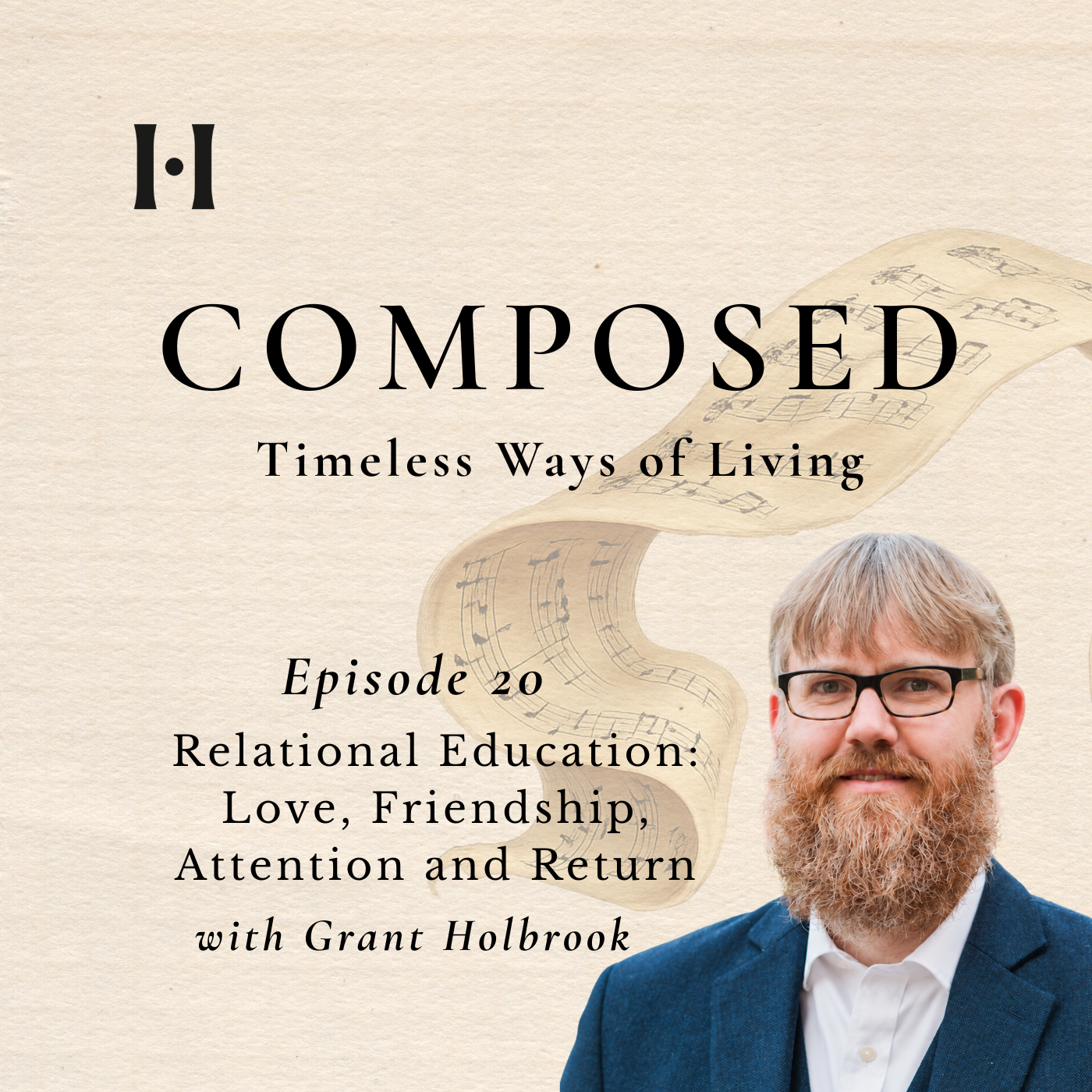
Composed: Timeless Ways of Living
Relational Education: Love, Friendship, Attention and Return with Grant Holbrook

What if some of the most formative patterns in a life begin with simple obligations, reading the same book again, walking the dog each morning, showing up for students, or staying rooted in one place? Christine Perrin talks with teacher Grant Holbrook about the relationships and repeated practices that quietly shape a person over time. Their conversation moves through Augustine, the Psalms, friendship, beauty, teaching, and the connection between knowledge and love. Along the way, Grant considers why education is deeply relational, why older students need responsibilities to younger ones, and how good books can become lifelong companions. For parents and teachers wondering what habits truly help form a human being, this conversation offers a hopeful picture of a life shaped through attention, fidelity, and love. Grant also shares practical patterns from his own life, including memorizing the Psalms while walking his dog, rereading great books under the helpful pressure of obligation, and taking time with former students who return, to walk, talk, and continue learning.
Contributors

Guest
Grant Holbrook
Grant Holbrook and his family live in Richmond, Virginia, where he is an upper school teacher at Veritas School. He spends most of his classroom time with the oldest students, teaching Rhetoric, Theology, and Biblical Hebrew to juniors and seniors. His graduate and doctoral work was in Old Testament, and his dissertation considered the poetry and ethics of the Hebrew acrostic Psalms. The works of Erik Varden, Bishop of Trondheim, and St. Augustine, Bishop of Hippo propel much of his current reading and writing. The Holbrooks are members of Church Hill Presbyterian, atop the oldest and loveliest neighborhood in the city.

Host
Christine Perrin
Podcast Host and Contributing Writer
Christine Perrin is a literature professor, writer, poet, and podcast host. After teaching literature full-time at Messiah University for almost 20 years, Christine arranges her time to write, teach in Italy, and host the Composed Podcast. Christine is a graduate of Johns Hopkins University (BA in Writing Seminars) and the University of Maryland (MFA in Poetry).
Related Resources

More Than a Résumé: Classical School Graduates on Who They’ve Become
Classical school graduates reflect on who they’ve become and how their education formed them in mind, character, and a lifelong love of learning.

Something Bigger Than Myself
In Sarah’s words, her teachers taught her “how to know what’s right and how to do what’s right.” That is what we mean when we say a classical education prepares young people for real life.

Why Nolan's “Odyssey” Is Inspiring Adults To Learn Again
America's fascination with Homer suggests adults are hungry for a kind of formation classical education has been offering all along.