Christine Perrin: This is Christine Perrin, host of Composed A Timeless Way of Living, a podcast of the Humanitas Institute that explores living patterns of virtue, craft, community, and delight and draws the classical tradition into contemporary times. Leah Labresco Sargent, welcome to Composed. So nice to have you tonight.
Leah Sargeant: Thank you for having me on.
Christine Perrin: I'm very excited to talk about your book but I wanted to just begin with some smaller things that I picked up about patterning. I I think patterning is a big part of your vocabulary. It's a big part of your life. And I noticed some things that you said in an earlier interview where you mentioned the way in which you began to pattern towards community before you lived in a family. Before we go there, can you just back up and tell us a little bit about yourself?
Leah Sargeant: Sure. I grew up as an atheist in Long Island. I went to college and joined a debating society where I fought with the smartest wrong people I could find to become a Catholic. And then my husband and I have lived up and down the Eastern Seaboard, but we're married with three kids in Maryland.
Christine Perrin: That's great. And I I understand from your website and from your book, which I have happily finished, you are a policy analyst and that this is your third book. You wrote Building the Benedict Option and Arriving at Amen before you That's wrote this right.
Leah Sargeant: Arriving at Amen is about my conversion and coming to learn how to pray after living as an atheist for so long. And Building the Benedict Option is supposed to be a practical handbook for building Christian community starting from wherever you are now, not where you imagine you'll be in the future of things you can do in the next two weeks to two months.
Christine Perrin: I appreciate that so much. And I I feel the presence of Aristotle in a lot of your thinking about what does it take to develop habits. One of the ones that you mentioned in an interview was sourdough. Can you start by talking about some of those habits and patterns?
Leah Sargeant: Well, sourdough is certainly one of the things that's been a sometimes presence in my life. I've had let's see. I think I've had two sourdough starters in all across my life, one of which I lost on a move to California, lost on purpose because the idea of trying to get it across the country on a plane was a little insane. So I would decide whether I'd pick up again or not when I moved there, and I didn't. And then sometime later, I was able to start again with my mother in law's sourdough.
And then I had three kids, and I had to make a choice about who I was going to keep alive. And I picked the baby. That's Kids been part of the seasons of my life, and I hope will be again, because it does kind of require this constant attentiveness that it needs to be fed and has to be used to be kept. And so prompts that question of who am I going to make bread for next? So right now, I'm not doing it regularly for anyone.
I can make one off yeast breads if I want. But, you know, a mom who's got older kids in the neighborhood does keep an active starter. So she's constantly facing the question of, alright. I know I'm making this many loaves this week. And the question is, to whom do these loaves belong?
And so when I had my most recent baby, the baby that killed my sourdough starter, you know, she dropped off bread for me, which was just so lovely of her. And she was just always looking for, if I'm going to make at least two loaves a week, where is at least the second loaf going?
Christine Perrin: I think what was so interesting to me is that you connected it to when you made up your mind to convert. You said when you made up your mind to convert, you decided that you wanted to put more effort into eating than was strictly necessary. It was anti Gnostic, but but connect the dots for us in that respect. So
Leah Sargeant: I'd I'd had kind of a very, you know, my body is a mech suit for my brain kind of perspective on the mind body relationship as an atheist. And one thing I knew in becoming a Christian was that that wasn't allowed. You know, what the new form of how I lived with my body was, I would have to find out. But a very core part of the Christian claim is that our embodied nature is a gift. Even when it feels like a cross, it's a gift offered to us for our salvation, that we are embodied souls.
We are not brains and intellects that happen to need bodies for now. And so I really wanted to move away from some of what I'd done as a recent college graduate with some of the flaws that implies of my, you know, lunch can be carrots and hummus directly out of the hummus container so that there are no dishes. Right? Versus, no. There have to be dishes all the time as a way of showing respect to the act of eating.
And for me, making bread and sourdough in particular, it was a little gross. Like, I don't like getting my hands all messy. And this kind of guarantees you're doing it for the sake of your embodied existence, both the eating of the bread, but the making of the bread as a very bodily existence. And I thought I should lean into that and ask God to see me through.
Christine Perrin: I love that. A couple of others that I picked up on. You said when you started learning to waltz, you spent a lot of time practicing the basic waltz step, the kind of endless repetition as the Hail Marys of the rosary. The reason I was supposed to keep practicing was so that my feet could keep the rhythm no matter what. And this strikes me as yet another trust in habits, trust in patterns, trust in rhythm that you had the sense that would lead you to something good even when in the moment there was a gap.
You you weren't completely conscious of its goodness or availability or naturalness for you.
Leah Sargeant: Yes. You know, one thing I really loved about ballroom is that I think it's easy to watch people dancing and think, I want to learn how to do the cool parts and think that it's all deliberate action. But when you take the role of a follow, as I did in ballroom, then most of the time, you don't know exactly what dance move is coming up. And the more you try to anticipate it, the further wrong you're going to go. So you really practice the basic.
And you also practice the moves, but in an actual dance with a partner, you are really thinking I'm just keeping the flow of this pattern of rhythmic steps going. And if I do that and if I have a strong connection with my partner, I will find myself in the right place. I will even be able to dance some moves that I haven't learned and practiced explicitly because I'm able to be moved, and I'm moving in the right rhythm wherever I go. And for me, that's always been an animating image of prayer because with God, we're all the follow, male or female. And I think as a new convert, there is time of that question of, well, when I meditate on the mysteries of the rosary, when I'm praying the Hail Mary, what am I trying to do?
How am I resting meaning from this prayer versus how am I present with God, holding myself lightly, ready to be moved when he gives me a tug?
Christine Perrin: That's very beautiful. And it it seems like a interesting segue to to the dignity of dependency because I sensed in this early awareness of the way that you sort of put yourself in a rhythm, you put yourself in a pattern that you trust will open up into something good or something proper or something that you'll learn to respond to properly. And I sense that you were saying something similar about this work of habituation to being dependent, not just being a helper, but being dependent on others and living you know, behaving as if the world is a place where our relying on each other is fundamental to who we are. I even had a little bit of fun. I don't know.
I should have checked this with my Latin Latinist husband, but I had a little bit of fun with this Dependeo ergo sum. Was, you know, I I depend. I am dependent. Therefore, I am. And then I also was working on homo fultut.
Leah Sargeant: I only had one year of Latin, so you have to help me out.
Christine Perrin: Okay. So I think it's the human is the one who relies on others. Homo Mhmm. So, like, or, you know, all the you know, all these ways of describing. So I was I was sort of trying to formulate it according to some of the ways that our essence as humans has come down to us.
But can you segue for us into from these this deep sense of the way in which living patterns are something that you commit to and trusting there'll be fruit from them down the road? Can you segue toward the idea of dependency and the way in which we begin?
Leah Sargeant: Sure. So to start with, I'd say that there are kind of two core ideas to my book, and one of them is that it is dependence, not autonomy, that's at the root of what it means to be a human being. And I think, to jump into Latin a little myself, I think I have a via negativa root. If you look at the other end, well, what does the other view imply, and why do we find we have to reject it? What does it force us to accept?
The ideal of autonomy that we are most ourselves, that a flourishing human life requires us to be strong enough, I would say, to manage without help and to be able to give to others only out of our excess, that our connections of love to other people never threaten that fundamental self mastery. Well, when you look at that definition of what it means to be a human being, a full human being, what you notice really quickly is you don't get to be a full human being for that much of your life. Infancy, childhood, obviously, it's right out. Old age is frequently a descent in this idea back into this kind of subhuman way of living where you need others intimately and almost all the time. And a great deal of the middle of our life is kind of dappled with these periods of dependence, whether it's by illness, injury, or in many cases, by the fact that someone else, someone very old or very young, needs you so intensely that you don't have this expansive freedom to do what you like and only give out of what's extra to you.
You are giving out of yourself in a real way, which means that you yourself become limited by the neediness of this person you love. And I think that really offers us a pretty stark choice. Either it means that it's in some real sense very good to be a human being, that being a human being is something we only get to do in its fullest expression at small periods of our life, and women get to do it less because pregnancy, nursing, etcetera, will always offer more and longer interruptions of what it means to be autonomous than men experience. But even men won't be able to fit this mold for very much of their lives. Just periods of, I guess, you know, after college to middle age, before your knees get bad, and as long as you don't get sick.
So that's one option for how to respond to just what it is to be human, how we respond to it. Or the other is to say, there is never an interruption of being a human being. When you're very small, when you're very old, when you're ill, when you're needy, this is what a human being looks like who is sick, who is a baby, who has dementia. But none of these things can touch that fundamental identity. And if that's the case, then we have to figure out how to live well amid dependence rather than figure out how to escape it or blunt its effects as much as we possibly can.
Christine Perrin: This was incredibly compelling to me. One thing in particular that that struck me, I wonder if this is in any way accurate to you, but it even though you call it a feminist manifesto, it seemed to me almost like a Christian humanist manifesto because I I found you know, I find in in first, second, and third wave feminism, there's a lot of antagonism between what men need and what women me need. And there's you're sort of always fighting for the biggest piece of the pie, that involves, you know, shafting someone else in a sense, shafting the other side. But you talk about the amity between the sexes. I've heard it called reconciliation of the sexes.
And it seems like you're starting with women, but you're arguing back to the human in such a way that you're suggesting this is what is good for the human. This is what's good for men. But I know this by being a woman. Can you say more about that? Is that was that intentional or was that something that you arrived at as you worked through it?
Leah Sargeant: You know, part of the way I put it is that women are, in a very real sense, the canary in the coal mine when it comes to this illusion of autonomy. The way I explain it is that men and women will always eventually both be exposed as people who are not autonomous and can't convincingly pretend to be autonomous for their whole life. But you can look at any individual person and ask, what gets you caught? When are you exposed to someone who can't live up to this imaginary ideal of autonomy? And for women, that sense of both internal exposure that you know this isn't possible to live out and external exposure that other people have caught you not doing it tends to come earlier.
And it tends to come through our potential to bear life in the womb. Whether or not you're seeking to become pregnant or desperately seeking not to be, that sense of exposure that you could be intimately tangled up in someone's needs and it will alter the whole course of the rest of your life comes very starkly towards women. And for men, I think that awareness that they can't, in fact, pass themselves off as autonomous indefinitely may come later through aging. But sooner or later, everyone gets caught.
Christine Perrin: So can you comment on the fact that it's a feminist manifesto when it seems to me like a Christian humanist manifesto?
Leah Sargeant: Absolutely. There's a lot of definitions of feminism, so all I'll say is I think mine is the right one. But I think it points to what I think is truest and has always been a thread within what's always been a contested fight over the word and the movement. What I define my feminism as is being concerned with what it means to be just to women as women in a world that often receives women as defective men. That if we try and take an unsexed look at the world and just treat everyone as generic humans, well, neither men nor women fit particularly well into that model of unsex, disembodied human.
But women tend to be left out more starkly because the things like fertility that make us different make us very different. And what I think is frustrating is that often an attempt to help women, even some strains within feminism, sort of treat being a woman as the problem that we are trying to help women solve. That if women don't resemble a normal human being closely enough because they can get pregnant, then there have to be as many legal and medical avenues to become unpregnant as possible because men can never be pregnant. So women's full equality depends on similarly being free to never be pregnant except by an active choice of the will. And I think we see that in Kaif Kopen case after case, that being the most controversial on pregnancy, but in other ways too.
One thing that stood out for me from Caroline Freado Perez's work on gender disparities is when she talks about female surgeons mentoring younger women in the profession, that they teach them how to hold equipment in nonstandard ways because the equipment is designed for a normal male sized hand. And so to use a scope, they have to position their hands differently than the designer intended to hold it at all. So I think you see kind of from that sort of politically neutral example of designing for a generic person, which means A man. Disempowering women, to the more politically contentious one of what it means to fully welcome pregnancies and life in the womb, this sense of if we don't talk about women distinctly, we will wind up shortchanging them inadvertently, if not maliciously.
Christine Perrin: That is a very powerful argument. I liked this quote. Rather than throwing off ties of love and care as an unfair burden on women, we should view them as the foundation for the authentic self. It is our vulnerabilities that allow extend ourselves in love and receive love in return. That seemed like a particularly beautiful statement of the case that this is the authentic self.
I like your term canary in a coal mine too because it seemed to also expose the embrace of the machine age and of the human as machine that, as you make the case so eloquently in the book, has harmed men as much as it's harmed women. It's harmed women in very particular ways, and I see how you've started from that point and worked your way out. But the sense that we are required to become more and more like machines. One story in the book particular that struck me was the woman that needed a disability prescription from her doctor to sleep nine hours.
Leah Sargeant: Eight hours. Eight hours. Even it's even more just she worked at a bank that had very punishing, unpredictable hours. She wanted to be able to sleep like a normal human being, and she thought her best chance of doing that was to get a disability accommodation. So she got a note from her doctor saying this patient has issues with depression or anxiety or something that would be exacerbated by not sleeping.
So as a matter of ADA compliance, you need to allow her a work schedule that includes time for sleep. And the bank initially said yes. And then I think they must have had their legal department think about it for a few minutes and go, hang on. What percent of our employees could plausibly get a doctor to say they needed to sleep for medical reasons?
Christine Perrin: For eight hours.
Leah Sargeant: Too many of them. They fired her and said, this job is incompatible with the accommodation you've requested, lest everyone make this unreasonable demand.
Christine Perrin: It really exposes I mean, I think everybody at this point is feeling the machine like, exigencies or the exponential explosion of machine like expectations. Have you found that as as you talk about the book and you tour for the book that that's something that particularly strikes a chord in people?
Leah Sargeant: Absolutely. Because I think part of it is that we work with enough machines that there's pressure on us to remake ourselves to interface well with the machine, which often means making ourselves more standardized, rounding off the corners, fitting some model that may not fit anyone particularly well so that the machine isn't confused about what to do with us rather than trying to make our built environment, make our machines, make our technology work well with the human person in its full range. You know? And this can be everything from kind of the less morally charged but still annoying experience of when I'm talking to a phone tree and I'm talking to somebody that's listening for my speech that's a robot, I kind of adopt a more robot like voice to remove any ambiguity where I'm like, operator. Operator.
I realized that, you know, I'd like to speak to an operator, please. I think actually voice recognition at LLMs have gotten now better at receiving full human speech and translating it. But for a long time, I was like, I've got to get past this machine to talk to a person. I'd better fit the inputs it expects or else I'm going to be on here forever. And just like that woman at work where they just fundamentally weren't interested in employing human beings, I would say, at her bank.
They were employing people in an inhuman way that couldn't possibly work for anyone for very long. So they'd reconciled themselves to the idea of employing people in a way that did violence to the matter of what they were as humans, And that eventually, they'd get new ones when the real the ones they were using broke.
Christine Perrin: I think one of the things that struck me very powerfully in the book was the chapter that you wrote on men. I think it was chapter eight, Men Into the Breach. I was particularly moved, I think, by your sense that well, many things. One was that women get to become parents, get to become mothers by virtue of their bodies. In a very visible way, they're providing for a child.
And you talked about men having the sort of opportunity to claim that role and even the naming of a family to be a kind of flag or a kind of owning of that role and responsibility and even nobility. And I was I was particularly moved by the story of the men who don't have families and who felt a sense of their own inability to provide and and kind of rise to the nobility of that opportunity. Can you comment about that?
Leah Sargeant: Yeah. You know, one thing that surprised me is one of the men who wrote in to me when I was writing on these topics, an inviting comment, is he said the analogy he reached for was a maternal example to explain how he felt. He's like, I know that women, when they're breastfeeding, if they go too long without feeding the baby, have this discomfort from the backed up milk, from the need to give, and the frustrated opportunity to and he's like, and that's what I feel like. And I really appreciated him stating it that falsely because as a man who was unmarried, who may not live with roommates, as a woman, it's actually easier for me even when I'm unmarried to be invited into other people's lives. People find it natural to ask me to babysit.
If I see a cute baby at the park and I walk over and go, oh, what's your baby's name? How old are they? People receive that very cheerfully. And I think a lot of men, they're strange men, if they don't have connections, when they show interest in people, there's a sense of, is he making a pass at me? Why is a man interested in my extremely cute baby?
Sure. It's because it's an extremely cute baby. But he felt like it was harder to put himself forward to care for others and that he had this excess, like my friend with their sourdough starter who needs to bake for others. And the excess he knew was intended to be used to be offered for other people's good, but all the channels by which he might offer it felt plugged up. And so he had this real grief, not only about the ways he wanted to be cared for, but about how narrow his life was without these avenues to give of himself to others.
Christine Perrin: That is such a profound observation that I I think you know, I'm in my I don't think that's something that was occurring to women of my generation. And I'm really happy that you put language to it. I I wanna read a little bit more that you said in that chapter. As more of life's dangers become private and personal, the paradigmatically womanly kind of risk remains present, but the public shared dangers that formed men's character and courage becomes rarer. And then you go on to say, where do men today find the special dignity and quiet pride?
It comes from growing something larger than themselves. That seems to be an element missing in the conversation about being men and women.
Leah Sargeant: Absolutely. And I think we do see this turn up in that we see a lot more men turning to what are termed deaths of despair, suicide, overdose, drinking, etcetera. And part of the reason when men who have attempted suicide are interviewed, a lot of them cite the sense of, well, I'm not necessary to anyone. Yes. I almost have permission to do this because I don't have a family or they might be better off without me, but I can remove myself without creating a hole.
And therefore, I am capable of doing this. It might be okay when I don't want to live to stop because I won't leave a gap. I think, you know, obviously, women experiencing these pulls too, but I think women are more likely to be knit into something where there is that countervailing force of someone who will miss them. And men are lonelier, have fewer friends, have more trouble making connections, especially outside the context of a marriage. And part of that is that a lot of kind of the neighborhood and communal things they might have belonged to have gone away.
You know, things like community associations, elks club, etcetera, have all gotten smaller and rarer. So you don't have that. You don't have what I was talking about, which is the sense of, well, I know what my strength is needed for. It's needed to repel bandits, or it's needed to fight this war, or it's needed to work at a very physically hard job that would be harder for my wife to do than it is for me. And so I'm contributing something only I can do.
And I think that sense of the necessity of a man has faded for both men and women, the sense of what do we have to have them here for. And for me as a Catholic, there's still a very obvious what can men do that no one else could do. I belong to a church with an all male priesthood. So there's this kind of balance for me between what's this distinctive way of bringing something more than yourself into the world. For women, it's childbearing.
For men, it's confecting the Eucharist. And both sexes, whether or not you yourself have a baby or you yourself become a priest, get to participate in this strange and glorious capacity. I am the kind of person who could be this channel of new life, of grace. That's not something that feels accessible for everyone. I think beyond that, you know, there's just a definite need for virtue.
And I think for men who are less tied physically to the needs of others, it gives them more freedom than many women enjoy to rush towards a new need because they're less tied down by their current obligations. So when my dad was in hospice, it was my brother who did more for him than I did. And this was partly because he lived closer. So we both had, I guess, one to two train rides, except mine was the whole Eastern Seaboard on the M Track, and his was the Long Island Railroad. But beyond that, I had a toddler, and I was pregnant.
Even if it had been me versus my husband, the one stepping in, I just always was caring for a baby or made a little sick by a baby or needing to go to checkups for the baby in a way that even a man in the same family would not have been. And my brother wasn't married yet, And so he was freer to give of himself in this moment of emergency than I was because I'd made these different commitments, these bodily commitments that limited how much I could say yes to my mom and my dad to help them in that time.
Christine Perrin: I'm having actually a response from your book and and from what you're saying now that there's something incredibly encouraging about this potentially being the answer to the meaning crisis that we're experiencing. There's a sense in which the thought of people wanting to be noble, wanting to be larger than themselves, wanting to be dependent on. That the lack of that is actually creating a hunger for meaning encourages me. Did you find that as a result of of writing this and I know it's your, you know, it's your third book, and in some ways, it's a it's a very, ambitious book. It's got manifesto in its title.
Did you find yourself encouraged by what you found as a result of just the kind of responses you were getting on your substack and and to some of these posts?
Leah Sargeant: Yeah. I think there is a real hunger for more and a hunger for better. And a lot of my work in writing the book and giving talks and engaging with people is not making the pitch that it's good to have ties to other people. It's making the pitch that it's possible to take this chance, that there's a reason to make what feel like risky choices, giving people permission. I think there is this desire, but there is also the sense of, well, this is so important that I should approach it very cautiously.
You know, I shouldn't get married until I'm older and I know a lot more about myself. I shouldn't have kids till we have saved up a lot more, till we have enough bedrooms. And I'm making the case that, first of all, you're going to be exposed. If you love anyone, you'll be exposed to some amount of risk or turbulence, and you don't want a life without love. And given that you're willing to sign up for a degree of turbulence, you might as well go all in, push your chimps into the table.
You'll have a richer life, and all real relationship of love will expose you to wanting to give more than you have, which I think is that fear, especially for parenthood. I want to do right by my children. I want to give them everything. I want to be good enough for them. But that's not a promise any parent can make.
A parent can do their best. A parent can attempt prudence. But loving a child of all people means signing yourself up for any range of needs, personalities, and finding I am not the best person to do this, and yet I am the one who must press on.
Christine Perrin: How do you square this with the the birth dearth and with, you know, the kind of the decline in sexual activity and the sense that, you know, we're on this cliff in terms of doing the really human things. And we we almost have to, like, become you know, we have to do research to, discover our problems and and sort of rediscover what's natural. How, how hopeful are you that this is a kind of life of virtue that is recoverable or that is in touch? We're still close enough to turn to it and embrace it.
Leah Sargeant: Well, I'm always an optimist now that I'm a Christian because I think the odds are weighted in favor of our virtues and in favor of our hopes beyond what our own strength would guarantee or give us reason to feel optimistic about. I think one thing that's important to remember is that the birthdirt is being driven substantially by the absence of marriages or by the delay of marriages. So I think people put a lot of emphasis on how do we persuade people to have children and miss that the point at which it's most important to intervene is how do we help people match earlier and feel confident to take the plunge when they're ready? I think it's a multipart problem. If I could pick one thing to do in a very dictatorial way, I would shut down all the dating apps because I think they really cultivate enmity between the sexes, that women get barraged by unpleasant or vulgar messages, which makes it harder to notice or want to respond to a good guy mixed in among, you know, the crotch pictures.
Mhmm. And men, meanwhile, are messaging again and again and again and receiving silence so it feels like they're being rejected by every woman in the world. I think that volume issue and the the kind of consumerist design of dating apps really drives men and women apart. So I'd shut that down. And then given that men and women, in fact, still want to know each other, I would hope that would leave room for some more community based and in person ways of meeting each other to flourish.
I don't think that'd be enough by itself. I think one thing that makes it harder for men and women to know if they're getting ready to get married is that there isn't really a shared cultural understanding of what marriage is anymore. And if you don't belong to a strong tradition where you've got a strong definition in your mind, it's very hard to judge. Do I have what it takes to get married? Is this a good person to be married to?
Because you're judging them against kind of a yardstick that feels like it turns to smoking your hands. Well, what does it mean to get married? Which virtues are required? And I think that does push people towards the cautious feeling approach of, well, if I don't know, maybe if I wait longer, I will know, versus I think you just need a theory of marriage to be able to decide. There's a megachurch, an evangelical megachurch that does something I really like, which is that they tell couples in their congregation who are cohabiting that they will pay for six months rent on an apartment so that one member of the couple can move out.
Christine Perrin: Interesting.
Leah Sargeant: The goal is that you spend that time kind of not enmeshed in the same way as you are where you're living together where it's hard to make a choice either way. You spend that time doing some marriage counseling offered by the church. And if at the end of those six months, you decide you do want to get married, the church will pay for your wedding. It'll be a relatively bare bones wedding, you'll and be getting married with all the other couples who made the same choice. But you won't have to pay for the dress.
You won't have to pay for the flowers. They're going to get you through. That's fantastic. If not, you've already had time in another apartment to decide, I don't want to marry this person. If I don't want to marry this person, why would I move back in with them?
Christine Perrin: How much do you think this crisis of marriage is related to a larger problem with risk that we've been kind of trending toward as an affluent, risk averse society.
Leah Sargeant: I think something that's very challenging is that exactly that we're affluent and risk averse. So it feels like in many ways, we live at a wonderful time to take risks. There's better social safety net, more material wealth. And yet, I think people feel like their hold on stability is very fragile and that, especially for kids coming up today, they've had a very risk averse childhood with more parent supervised activities, more senses of one wrong step in peril to college admissions rather than do weird stuff and just send the best stuff to the colleges. And I think just when I compare to how my husband grew up in a homeschooling co op, he just got to do things.
He ran a Shakespeare trip for his peers, and no adult would bail him out if it turns out the kids weren't listening to him and learning their lines. It would only work if they all believed in this project together, and they respected his authority because they loved him, and they thought he was making a cool project they wanted to belong to. We got married one year after he graduated from college, and he was very ready to get married because he'd taken a lot of risks. And he'd taken risks that could fail, and people would let him fail. So it wasn't a new experience.
And for my kids, you know, I don't know what I can do about the whole society for them. But at this age, with my oldest being almost six, feel I like that lesson comes up most often in her art where when something goes wrong, she puts a line in the wrong place. She went through a whole phase of, I will crumple it off. Right? Like agony.
And at this age, my job is saying, making mistakes is the only way of getting better at anything. And that everyone who has real mastery has it because they took risks with something they weren't good at yet. And if you only do the things you're good at, you make your world really small. And I guess I started teaching this when they were even younger and a little pre verbal because my kids would walk around, you know, with that little kind of half drunk sailor toddler y way, or they'd climb on things and they'd fall down. And I would sing them a little song, which went, you know, sometimes you go clunk when you're exploring.
And it was about, you know, if you if you'd never fell down, then you'd only do what you knew you could already do. And that's not the life I want for you. Now did this help the kids? That's so weird. Woah.
But but I want this to be a theme of my parenting at every age.
Christine Perrin: Yes. Do you do you think that that virtue of taking a risk and of being willing to do something that's messy or that's imperfect, is that a virtue that that we're lacking generally that you would prescribe?
Leah Sargeant: I think so. You and I think part of it just comes out of the idea that part of growing up is not being an amateur or a public amateur at anything. You find the things you do have mastery in. You focus on your strengths, etcetera. And one thing, again, I think about as a parent is I'm asking my kids to spend a lot of time learning and a lot of time not being good at stuff.
Do they see adults do that ever? Do they think learning is something that's only for children? And so my kids have seen me draw, and I'm worse at drawing than my six year old. And she was kind of shocked that I could be bad at something as an adult. I've thought about as they learn languages.
My husband has studied Greek. I haven't. Our kids will. I'd like to try learning it alongside them so that they see that there are things I'm not good at, and I can only get good at by struggling. There's a karate school near us that offers all ages classes, which seems like another good opportunity.
But I really think for anyone, kind of how are they thinking about risk intellectually? How often in your own life do you see an adult take a risk somewhere where other people can see them, where they're not very good at something, and they're willing to sit with that period of disfluency for the sake of pushing through to something better?
Christine Perrin: I love that phrase, period of disfluency. That's a really great phrase. What what do you think the threats are to feminine formation in our cultural moment?
Leah Sargeant: I think a big one is the sense of the best way of navigating the world is camouflaging the gaps between you and a normal man. But I think a lot of this is offered with the best of intentions because it is hard to find yourself in one of those gaps and then not be treated fairly so that you do want to learn to use the tool the other way or anything else. But one thing that stood out to me is that I was looking even just at the way that breast pumps are designed and marketed. Was fortunate enough to never need one for my first two kids, and then I was back at the office two days a week only at nine months, which I was really lucky about. To feed my baby, I needed to rely on one too.
So I was looking at the different kinds, and a lot market themselves on how unobtrusive they are. You know, this breast pump will fit inside your bra. This breast pump will run almost silently. And to make that kind of trade off, to make it very small, to make it very quiet, you're almost always making that trade off against its core functionality, that a very small, very quiet pump is probably not a very powerful or efficient pump. But the idea is it's your job to make this problem you have of feeding your baby not noticeable Mhmm.
And certainly not a burden on anyone but yourself. And so if you have to accept a machine that doesn't work very well for the sake of not having to step out of the meeting or not having to reveal that you're pumping, that's probably a win for you. I think that repeats in domain after domain where women run up against one of these differences and feel pressure, internal or external, to say, all right, here's a gap between me and what's more common for men. How can I make this gap invisible so that no one notices? And I think one driver of that pressure is that we live in kind of a thin world, philosophically speaking.
People don't really always feel comfortable talking about ideas from a philosophical point of view. They want it to be settled empirically because if it's empirical, no one can argue with you. I think there's a lot of folks who have, whether they're kind of consciously articulating it this way or not, said women's political equality rests on the idea men and women are basically not different. That if they're interchangeable, then they must be equal. It's the simplest proof of equality.
If I can swap one thing for another, then anyone who says to treat these two things or two people differently must be speaking from bigotry because there's no difference here that's real. Now I think that's just obviously false for men and women. And so that leaves you with a choice. You can either say, I can't let anyone notice. Like, hold on political equality depends on this illusion of interchangeability, so I've got to look interchangeable.
And anything that makes me different has to be private and secret. Or you can say, alright. I see men and women aren't actually the same. I still think they're equal in dignity and deserve political equality, so I've got to ground that equality and appeal to something other than sameness. And that's where I am.
Christine Perrin: Were there aspects of your own upbringing or enculturation that helped you to become comfortable with sort of saying that the emperor had no clothes, in this respect and say you know, saying that obviously men and women are different, and I'm gonna start being the woman that I am?
Leah Sargeant: Well, I think I received an enormous gift from being raised by a mom who was very much a second wave feminist and had a real curiosity and a real fierceness. So I guess I just always had that chip on my shoulder of, obviously, I'm equal in dignity to a man. If some of the reasons people have presented in the culture don't justify that, it doesn't make me nervous about whether I'm gonna lose my claim to equality. It makes me curious and fiercely determined to find a way of explaining who I am and what I am in relationship to a man rather than, oh, I've got to make sure no one finds out.
Christine Perrin: Do you have a sense of what virtues you think girls need to be apprenticed in, and what are the disciplines that teach them?
Leah Sargeant: I'm pretty sympathetic to Sister Prudence Allen, who says, you know, there isn't a difference in these virtues are for women, these virtues are for men. The core virtues, courage, prudence, temperance, faithfulness, these are all for men and women. But we also shouldn't be surprised that the ways I might be asked to be courageous will look different than the ways my husband is most likely to be asked to be courageous.
Christine Perrin: You spend a lot of time on in the book? Sorry.
Leah Sargeant: We're both called to courage. We're both called to tenderness. But I'm able to express tenderness through nursing, and he has to find a different way of expressing it.
Christine Perrin: Your book actually made me feel a lot of empathy for men because there's a sort of creativity and almost force of will that has to happen in order for them to find the same kind of relationality and, even nobility that women are sort of given in the setup of family life.
Leah Sargeant: Yes. I think one way that people respond to this that's kind of the flip side of what you just said is they go, women are constantly interrupted by other people's needs. You know, they're interrupted biologically through pregnancy, but people turn to them instinctively when someone needs care, when they need help, that they say, well, whether that's kind of the care of sitting by a sick bed or bringing food to someone. They go like, well, a woman will do it. And they go, well, that's not fair.
We ask too much of women. But I would say the flip side is more what you're articulating, which is there is a real gift in having a life where when people need someone, they instinctively turn to you. And men more often have to make space to say, I'm willing to be called upon. I want to answer this call. And I'm grateful for what I have, and I think men have real gifts to give, and we're too slow to invite them to give them.
Christine Perrin: One thing that I I liked, one outworking of of this argument, which was the kind of way that the trad wife creates a version of consumerism. It sort of creates her husband as a consumer. That was a really interesting outworking of the argument that you just made. Can you say more about that?
Leah Sargeant: Absolutely. You know, this was a particular woman who builds herself as a trad wife influencer who talks about the way she envisions her relationship with her husband is that when he comes home, he should just be at rest. He should never have to lift a finger to do anything. He should be she wouldn't phrase it this way, but it's the implication unnecessary. She brings things to him.
All of his labor is at work. What he brings to her is the paycheck, and then she reciprocates by endlessly being deferential and catering to him at home so that it's a pure place of repose. And I think that's really pernicious for a marriage. I think it's hard to have a strong bond between husband and wife if the man's primary gift comes through his employer versus, of course, he would never go home and think, I'm not needed here today. You know, my wife, I guess, will just put the Manhattan back in the fridge to wait for tomorrow.
Aside from my eating the food, there's nothing that I'm needed for here. My husband is desperately needed since we've got three kids, you know, almost six and under. And he's needed both for good things of, oh, I can't wait to hear him read the next chapter of this book with the voices he's doing for the characters. He's needed for bigger things like one of our kids is sick. I'm going to clean off the kid.
Will you clean up the floor where we're just utter partners there? And, you know, I think he and I both would love more leisure and repose in our life, and we do try and make it a priority to give each other some of those moments. But it's a real relief to think about how much we can give each other because each of us is so necessary to the family.
Christine Perrin: That that's a tone that I would say comes through the book, in some of its moments of exhilaration, of the kind of challenge and invitation that this, this ride is. And I am particularly interested in maybe the other end of the spectrum of the argument, which is how it applies to disability because that was very moving to me as well. The fact that you kind of traced out the implications for the disabled. If we do not have we don't see the dignity of dependence. What does that mean about people with, I guess you you could say, any deviation from what we might, you know, kind of speciously designate as normal?
Can you spell out that end of your argument?
Leah Sargeant: Absolutely. You know, I think I've really been indebted to some writers and thinkers from the disability community. I particularly love Sarah Hendren's work, What Can a Body Do? That's about how we design the world to either be hospitable or inhospitable to people in the full range of human bodies and experiences. But I think a big theme of that is that often we respond to what feels like it could be a passing moment of dependence with, well, this will be over soon.
How do we get through this? How do we mute it as much as we can and then come back out of it to being a real person again? I think it's common to treat pregnancy or those years when you have a very young kid this way of this is kind of an interruption of the way your life is supposed to be with some benefits you get in return, but still fundamentally, you'll get back to real life soon. I've even done this. Even while writing the book, I did this where I had a pregnancy and nausea and then a staph infection where I couldn't walk, you know, and this all while I'm writing the book.
And I said, I heard the words come out of my mouth like, wow. I barely existed in November. And then I thought, I'm like, I can't say that. I'm writing a whole book with the opposite premise. This is what existing looked like in November for me, and it was really rough.
But I think what becomes obvious is that way of talking only works for people who currently have a hope they're going to return to normal. And that once you're talking to someone who either is facing a lifelong difference or disability or an older person who's coming near the end of their life who isn't going to have any return to their previous capacity, then that whole way of framing Dependence Disability as kind of a temporary interruption, but it's Okay because you'll be yourself again soon, that can't hold for this person. So what do you have to say to them about what it means to be a human person in their shoes?
Christine Perrin: I loved this quote. Every human person's life begins in utter dependency. We cannot build a just society on a false anthropology of independence. We cannot have a feminism that does not begin with recognizing and rejoicing in the embodied difference between men and women and women's greater exposure to dependence. And you go on to kind of suggest that we need a counter catechesis that really begins to live out this idea at every level of our communal experience.
Can you give us some ideas of people who wanted to begin that? How ought they to begin?
Leah Sargeant: You know, the number one thing I tell people, if you want to take a step into this, find some way of asking for help in the next two weeks. And I put the emphasis on asking for help rather than offering help. I think it's natural to say, well, we want a world of people being more patient with each other, more generous, so I want to start by being generous. And if you get the chance to help someone, wonderful. But the task I'm giving you is asking for help.
And the reason is that when you are offering help, you are always putting yourself in the stronger position, the person who can give, who has excess. I'm not counseling you not to help, but I don't think it reassures people that you will be there when they have a big ask because you've shown that you can take the position of strength, but it's when you have the position of humility. My family does this a lot by asking other people to invite us to dinner. We're like, we've had a rough week. Would you have us over for dinner?
We're fine if we order pizza. And I think we've gotten more requests for help because people kind of see how shameless we are. We don't have a real excuse. We're not sick. We're not dying.
We want someone to help us navigate life with young kids. And we want to see people we love, and we don't want to do it in our house where we clean up afterwards. And that's all the excuse we've got. So if we think you're allowed to ask for that right now, what is it possible you could ask of me, someone who apparently thinks these requests are allowed?
Christine Perrin: How do you preserve the possibility of saying no when you're on empty? Because I think there is this great fear, not just I mean, you do a beautiful job of tracing out the fact that people want sort of neutral professional help so that they don't ever have to owe anyone anything. And I'm not talking about that, but I am talking about how do you live sort of authentically where sometimes you just have to say, no, I am sorry. I can't have you over for dinner tonight.
Leah Sargeant: I think that is good to do because it's part of what makes you a good person to ask. Someone who I can't trust to say no when I'm asking something that is too much for them is actually someone that's harder to ask for help. Saying, I'd love help this week. Are you able to? And they go like, Oh, I'm really not.
No. Now I know I could ask again. Like if we already have a strong friendship, I think they would say yes sometimes, but they can't say yes right now. That makes me less worried that I'm imposing because I think they do have the prudence to say no when it's not a need they can meet.
Christine Perrin: When would you say it's most important for us to ask for help?
Leah Sargeant: In some ways, it's most important to ask for help with whatever you feel most embarrassed about asking for help with. And that'll vary a lot. But just I'm not saying this way you have to in the next two weeks, but as you kind of think through, what could I ask for in the next two weeks? What do I really need help with that I could ask someone, a particular someone? And if you think about it, you're like, well, not that.
Don't do that one. Pick something easier, but sit with that a little. Why is it so hard or so dangerous feeling to ask for help with this particular thing? And what would it take to feel like this could be a need or a deficiency even in yourself that you could show to someone and expect it would strengthen your friendship?
Christine Perrin: Do you think it's important to ask people outside of your blood relations?
Leah Sargeant: Absolutely. For one thing, it's part of what knits friendships together. It's the experience of going through things, of having this network, these ties of favors asked, favors sought, favors returned, but not exactly. This sense of, oh, we've both helped each other so much that one of us definitely owes the other one something, but neither of us remembers which. That's what makes a really durable friendship.
Christine Perrin: I thought that was a very interesting discussion in the book too where you you talk about how important it is not to give exactly what you've received and the way that that operates cross culturally. But even in your own if you borrow two eggs, you can't give two eggs back because it suggests this almost a lack of generosity, a lack of willingness for the overflow and the give and take of life to happen.
Leah Sargeant: And you see that a little even in the phrase people use for that. When you pay someone back exactly, you can say, okay, now we're quits. Yeah. Because there's no further outstanding debt between us. At this point, if either of us chooses, we could part because neither of us has a debt that remains.
Right. And I think in a real friendship, you're certain one of you does, but you don't remember who.
Christine Perrin: That's beautiful. It's also been called, and you you use this language in your book, the gift economy. Could you define the gift economy for us?
Leah Sargeant: You know, there's a couple definitions, but I like Lewis Hyde a lot in writing about this way of encountering the world as a gift of the artist thinking of their discipline as one animated by this kind of gift ethos. And part of it is you can't hold on to anything very long, that you're a steward of the things you currently hold, but you're curious about where they might go next.
Christine Perrin: Could you these are a couple of rapid fire questions less related to the chain of our conversation. But could you say what two policies you wish you could be a part of? You you work on policy. You you wish you could be a part of changing to kind of bring some of these ideas into the polity.
Leah Sargeant: I think a big one is more support, both legal and cultural, for flex work, for both people doing hybrid jobs or part time jobs. Because part of what makes it hard to have this neighborhood or these friendships of gift receipt sort of recompense, you know, that continuing relationship is just there's only so much life outside of work. And this used to be easier to sustain when more households were single earner households. You have someone who's both managing the household at home but actually has more freedom to say, and of course, I'm going to go over to so and so who just had her baby and needs looking in on. Right?
And I think more people, both men and women, though I think disproportionately women take this option when it's on the table, want a little more space and a little less money in exchange for getting to be a steward of their friends and of their neighborhood. I think COVID really pushed working life in this direction a little bit. The question is how kind of amid all we lost in the pandemic, how can we hold on to this one growing new thing?
Christine Perrin: That's another optimistic take. And I love the fact that you say you're you're an optimist because you're a Christian. How are you educating your children? What is your I mean, this is, again, a kind of oddball question, and feel free to not answer it. But what are you you said your husband was homeschooled, you loved the kind of opportunity to fail that that gave him.
Leah Sargeant: Mhmm. So we moved to a neighborhood where there's a whole community centered on our parish church and our parish school. And the little kids so that's my almost four year old is in a Montessori preschool. My bigger girl is in a classical kindergarten, and my littlest is getting watched at home while I work. And I like that he's getting watched at home because it means I can look in on him during the day.
He's not somewhere else while he's little. I could breastfeed him for a long time or put him down for naps even while I was working. And we'll see how things play out. But one thing I like is that when I think about what their education information looks like, it's not, well, here's what the school does for them, and here's what we do for them in the home. And we hope there's not too much clash between them, that there's a lot of integration between our home and the school and the surrounding community, where when we invite friends over as we're going to do soon for birthday parties, you know, we know something about the parents, and we think that our kids can get part of their education on play dates, that there's a certain amount of trust and collaboration.
That certainly doesn't mean there's always agreement on everything. I think I can see it looking around that the families in my neighborhood have a fairly broad range of standards for how clean does your house have to be. Do you have to use real plates for guests? Or if you're busy, can you use paper plates? There's more divergence than I would like on vaccines, but there's enough agreement on the core things that there's almost no one I know through church who I wouldn't feel comfortable babysitting my kids if I got sick quickly.
And I wouldn't have to give them a lot of instruction. I would just say like, you know about kids. I have kids. Would you watch them for two hours? And I think that's really different than the sense of you're bringing in a babysitter who is a stranger or whose way of being in the world you don't know very well.
So you're trying to enumerate a list of rules that will make them good for your child for this time. And I don't worry about that very much.
Christine Perrin: That makes me think of your closing line in your book. I measure my humanity in how little my life and my loves can be sustained by my own strength. That's a really beautiful and surprising line. I think it's a very surprising line. I think there's something in us that wants our own strength to sustain our life and loves.
And I I love the way in which this book surprises and challenges us to be more human, to to inhabit the human that we experience in our lives. I wanna read you a Robert Frost poem, which you probably know, and see if if it accords with your book. It's she is as in a field, the silken tent. She is as in a field of a silken tent at midday when the sunny summer breeze has dried the dew and all its ropes relent so that in guise, it gently sways at ease, and its supporting central cedar pole that is its pinnacle to heavenward and signifies the sureness of the soul seems to owe not to any single cord, but strictly held by none is loosely bound by countless silken ties of love and thought to everything on earth the compass round and only by one's going slightly taut in the capriciousness of summer air is of the slightest bondage made aware. I could see this according with your book, but I could also actually see you objecting to it and saying, no.
Actually, bondage is is good. Bondage is part of what this is about.
Leah Sargeant: Yes. You know, I think I I always, in writing this book, kind of got pushback at various points of, does it have to be the word dependence? Like, can't it be the word interdependence? Which is better? You say sometimes, like, we'll burden each other, but, you know, that's not true.
Like, no one is a burden. I'm like, yes. They are sometimes. Like, the more we say that, you know, people aren't burdens or that our relationships together can't feel like bondage in exactly the way this poem points to of a tie that really can constrain that making the choice to love someone can close a door you might have wanted to be open in the abstract, the more we're not setting people up to love deeply. Every time I hear people kind of reassure someone who's sick with, of course you're not a burden, what I think is the shadow under what they say is, and if you were, it would be a disaster.
Really important you know you're not. Right? And I don't think that's what anyone means today. It's part of why I always frame this as we need a cultural counter catechesis. Everyone will have moments where they genuinely are burdensome to someone they love, even though they can be loved throughout that.
It's easier to be prepared to be both carer or recipient of care. If we're honest, there are periods where we burden each other, and that's part of being human, rather than to be so frightened of it that we're offering these reassurances of, of course, you're not a burden. Of course, my love for you could never cause me to not get to choose something I want. Well, that day is going to come. And are either of you going to be prepared for it if you've reassured each other with this lie the whole time?
Christine Perrin: That is, I think, the most hopeful thing that I've heard in a long time. I just wanna thank you for for this book and for the work that you're doing. I I really am grateful for it. Can you tell us, where people can find you on
Leah Sargeant: Absolutely. I think the easiest place to find me is at my Substack, other feminisms. That last s is very important. It means you're all welcome. Otherfeminisms.com.
And you can find my book wherever books are sold. And if you can't find it there, tell them you'd like your bookstore to order it.
Christine Perrin: Sounds good. And, also, you do make a book list every year, and that is on your blog as well. So you're inviting people into your own liberal education.
Leah Sargeant: I'm always making a list of the books that are currently in my house on January 1 that I haven't read that I'm going to choose to prioritize getting to this year.
Christine Perrin: When in the day do you read?
Leah Sargeant: So if it's a Kindle book, I can get away with it a lot. I read going up and down stairs. I read while brushing my teeth. I read anywhere else I can manage it for a physical book. I've got to be a little pickier and it's more likely that I get my best reading done either after bedtime or while I'm on the metro commuting to and from work.
Christine Perrin: Well, we're very grateful that you gave us your reading time tonight.
Leah Sargeant: Thank you so much.
Christine Perrin: Thank you. It was so good to be with you. You've been listening to Composed with Christine Perrin, podcast of the Humanitas Institute about composing well lived lives of virtue, craft, community, and delight.
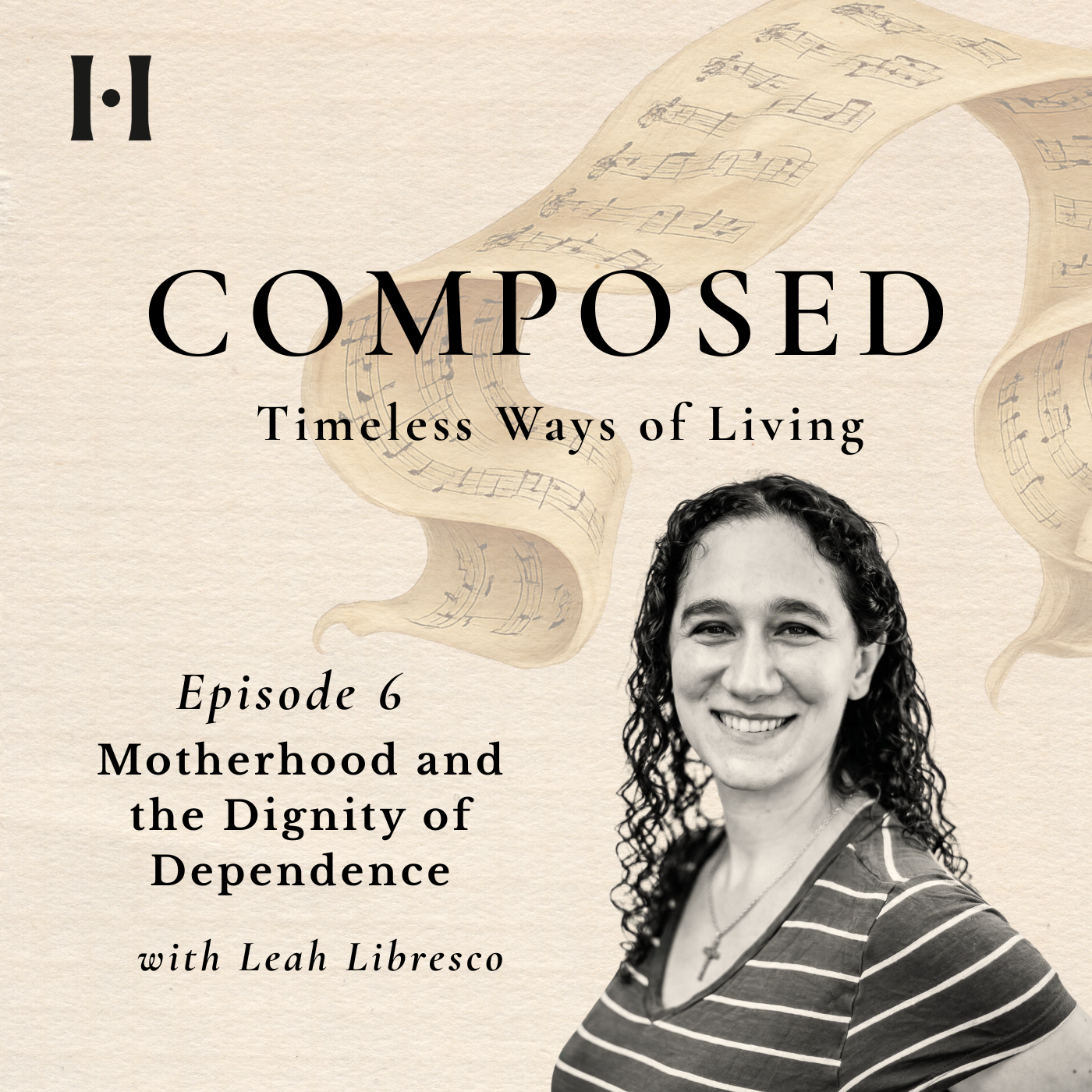
Composed: Timeless Ways of Living
Motherhood and the Dignity of Dependence

Dependence is not a defect, it is part of what it means to be human. In this episode, our Host, Christine Perrin speaks with Leah Libresco about The Dignity of Dependence and the modern illusion that freedom means self-sufficiency. Together they explore why equality does not require sameness, how women’s lives reveal truths our culture tries to ignore, and why asking for help may be one of the most human things we can do. From sourdough and ballroom dancing to caregiving, marriage, disability, and friendship, this conversation offers a richer vision of love, responsibility, and shared life. It is a thoughtful and hopeful episode for anyone seeking a more humane way to live.
Contributors

Guest
Leah Libresco Sargent
Author
Leah Libresco is the author of three books, most recently The Dignity of Dependence: A Feminist Manifesto. This book argues that women’s equality with men doesn’t depend on their interchangeability with men. Leah has been writing on these themes for some time on her Substack, Other Feminisms. Leah currently works in family policy in Washington D.C. Previously, she worked as a news writer for FiveThirtyEight and in campus ministry at Princeton. Leah lives in Maryland with her husband and children
Host
Christine Perrin
Podcast Host and Contributing Writer
Christine Perrin is a literature professor, writer, poet, and podcast host. After teaching literature full-time at Messiah University for almost 20 years, Christine arranges her time to write, teach in Italy, and host the Composed Podcast. Christine is a graduate of Johns Hopkins University (BA in Writing Seminars) and the University of Maryland (MFA in Poetry).
Related Resources

School-Choice Tax Credit Gets Big Boost From Treasury
Married couples can donate double, making tax break worth $3,400, not $1,700

Bessent Advances Divisive $26 Billion School Tax Credit Plan
The program, dubbed the Education Freedom Tax Credit, allows individual taxpayers to direct up to $1,700 of their annual federal tax bill to nonprofits that grant scholarships to students to pay for qualified educational expenses.

Not All ‘Classical’ Schools Are Created Equal
The most consequential differences are often the least obvious.